All species › Parrots › Parrots › Blue-crowned Parakeet
Blue-crowned Parakeet | Thectocercus acuticaudatus
Blauwkroonparkiet | Aratinga cabeciazul
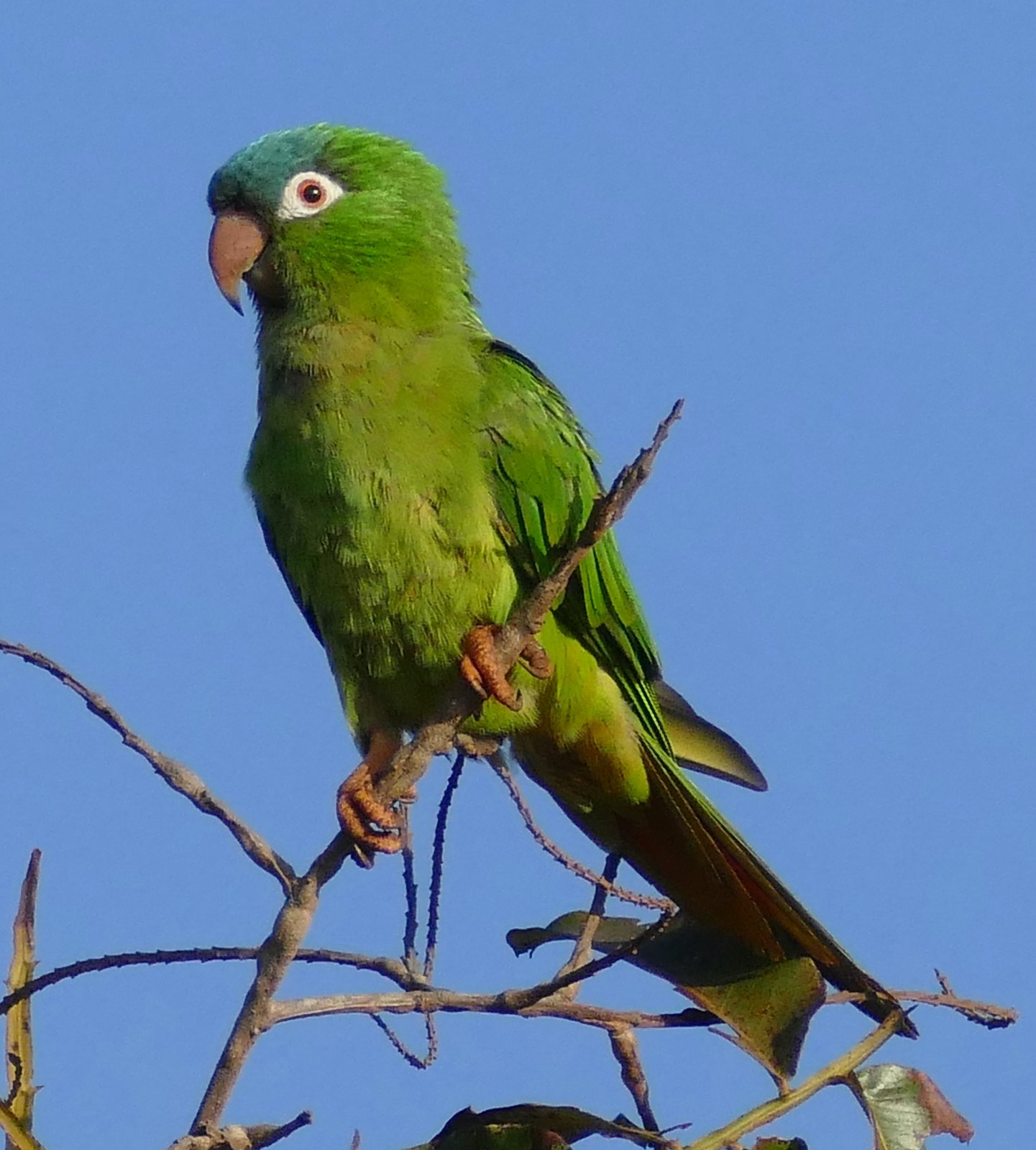
The Blue-crowned Parakeet is a large green conure with a blue head and a long tail that is reddish below. It is widely kept as a cage bird. Curaçao holds a free-flying population, mainly in the west and centre of the island; elsewhere in the region only single escapes have been reported.
Voice
Loud and raw: a repeated, grating kreek-kreek in flight and a rasping chatter from flocks in trees.
Recording: Dante Buzzetti — CC BY-NC-SA 4.0 · converted to mono · xeno-canto
Identification
33–38 cm, with a long pointed tail. Green, with dull blue forehead and crown; in some forms the blue extends over cheeks and ear coverts. A ring of bare white skin surrounds the eye. The underside of the tail is reddish-brown at the base of the feathers, the underwing yellowish green. The upper mandible is pale horn with a dark tip, the lower dark. The sexes are alike; young birds show less blue on the head.
Confusion species
Brown-throated Parakeet Eupsittula pertinax is much smaller, with a yellowish-brown face and olive-brown breast and no blue on the head. Chestnut-fronted Macaw Ara severus has a chestnut forehead, a bare white face and a black bill. Other escaped conures show red on the head or in the wing, such as Scarlet-fronted Parakeet Psittacara wagleri and White-eyed Parakeet P. leucophthalmus.
Habitat
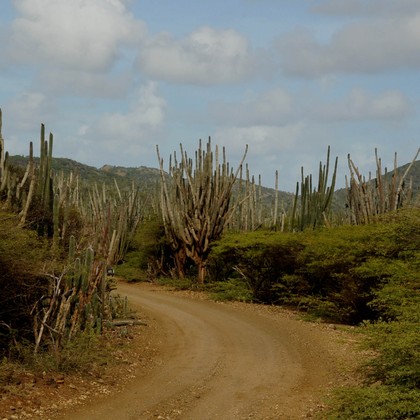
On Curaçao golf courses, residential areas, country estates, dams and the surroundings of the sewage works, and the scrub and mangroves around bays and salt pans. It eats seeds, fruit and flowers. In its native range dry woodland, savanna, scrub and forest edge; it avoids dense humid forest. It nests in tree holes.
Where the bird is most at home, classified by the vegetation types of the Caribbean.



Range and movements
Curaçao: free-flying population, with records from Blue Bay, Piscadera Bay, Klein Hofje, Saliña Sint Michiel, Julianadorp and Malpais, among others. A few records of escapes on Puerto Rico; no populations known from other islands. Native in two separate areas: north-eastern Colombia, northern Venezuela and Isla Margarita, and from eastern Bolivia and Paraguay to northern Argentina, Uruguay and Brazil.
- Resident
- dark = core range, pale = thinly spread
How and when to look
On Curaçao around Blue Bay and at the dams and salt pans west of Willemstad, where noisy flocks fly between the trees. The blue head shows only in good light; size and long tail already separate it from Brown-throated Parakeet.
Conservation status
Not threatened globally. On Curaçao an alien; the size of the population and its effect on the native Brown-throated Parakeet have not been studied.
Scientific name
Thectocercus acuticaudatus | (Vieillot, 1818) (GBIF: Aratinga acuticaudata)
Vieillot described the species in 1818 as Psittacus acuticaudatus; because it was later moved to another genus, the author and year stand in brackets. The genus Thectocercus was introduced in 1912 by Ridgway. Thectocercus is Greek, from thēktos 'sharpened' and kerkos 'tail', after the long, pointed tail. acuticaudatus is Latin for 'sharp-tailed', from acutus 'pointed' and caudatus 'tailed'. The specimen the first description was based on came from Paraguay (around 24° S).