All species › Parrots › Parrots › Scarlet-fronted Parakeet
Scarlet-fronted Parakeet | Psittacara wagleri
Roodvoorhoofdparkiet | Aratinga frentirroja
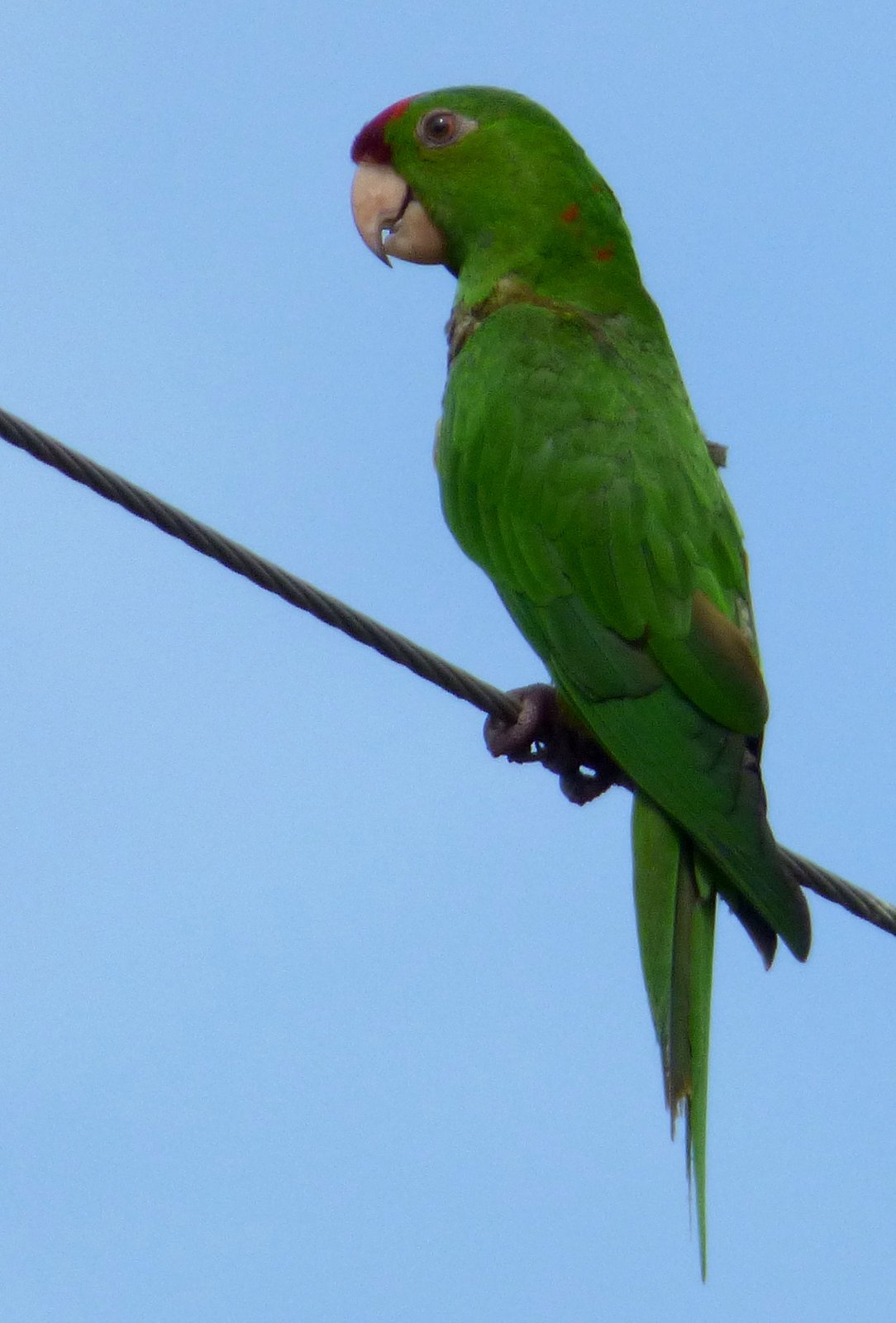
The Scarlet-fronted Parakeet is a large green conure of the Andes and coastal ranges of Colombia and Venezuela, with a bright red forehead. Curaçao holds a small free-flying population derived from escaped or released cage birds. The birds there associate with the more numerous Blue-crowned Parakeets and hybridise with them. The forms frontatus and minor of Peru and Ecuador are now usually treated as a separate species.
Voice
A loud, continuous screeching chatter in flight and a harsh kreee; perched birds also give squeaky notes.
Recording: Mauricio Cuellar Ramirez (@Birding.travel) — CC BY-NC-SA 4.0 · converted to mono · xeno-canto
Identification
34–38 cm, with a long pointed tail. Green, yellower below. Forehead and forecrown are bright red; some birds also show red spots on the throat. The wing shows little or no red, and the underwing and underside of the tail are olive-yellow. The bare eye-ring is grey to greyish white, the iris pale grey to yellow and the bill horn-coloured. The sexes are alike; juveniles have less red on the head.
Confusion species
Blue-crowned Parakeet Thectocercus acuticaudatus has a dull blue head without red and a reddish-brown tail base below; hybrids with a mix of blue and red on the head also occur on Curaçao. White-eyed Parakeet Psittacara leucophthalmus has scattered red feathers instead of a red forehead and red and yellow patches under the wing. The native Brown-throated Parakeet Eupsittula pertinax is much smaller, with a yellowish-brown face.
Habitat
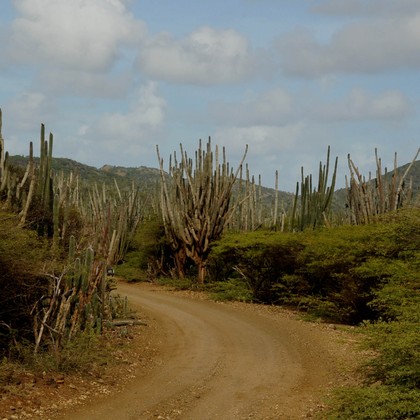
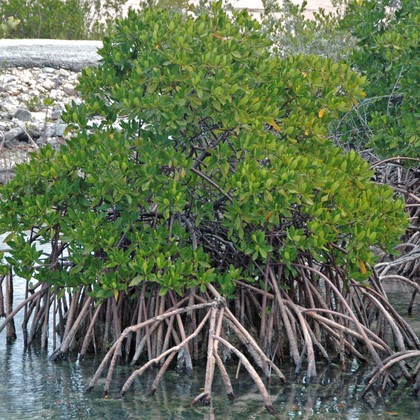
On Curaçao golf courses and hotel grounds, gardens and residential areas, the area around the Klein Hofje sewage works, country estates such as Hofi Mango, and the scrub and mangroves around salt pans and bays. It eats seeds, fruit and flowers, mainly in built-up areas. In its native range cloud-forest edge, dry deciduous forest, gallery and secondary forest, fields and orchards, at 350–2500 m. It nests in tree holes and rock crevices.
Where the bird is most at home, classified by the vegetation types of the Caribbean.



Range and movements
Curaçao: free-flying population, established earlier than the Blue-crowned Parakeets but smaller in number, with records from Blue Bay, Klein Hofje, Saliña Sint Michiel, Hofi Mango, Piscadera Bay and Jan Thiel, among others. Aruba: a few records, including at Bubali. No records known from other islands. Native in the Andes and the Sierra Nevada de Santa Marta in Colombia and in northern and western Venezuela.
- Resident
- dark = core range, pale = thinly spread
How and when to look
On Curaçao around Blue Bay and Klein Hofje, usually among flocks of Blue-crowned Parakeets. In good light the red forehead shows from afar; birds with some blue on the head are probably hybrids.
Conservation status
Considered Near Threatened globally because of trapping for the trade, persecution as a crop pest and habitat loss. On Curaçao an alien; the size of the population and the effects of hybridisation with Blue-crowned Parakeets are unknown.
Scientific name
Psittacara wagleri | (Gray, 1845) (GBIF: Aratinga wagleri)
Gray described the species in 1845 as Conurus Wagleri; because it was later moved to another genus, the author and year stand in brackets. The genus Psittacara was introduced in 1825 by Vigors. Psittacara joins Greek psittakos 'parrot', Latin psittacus, with the genus name Ara, the macaws. wagleri honours the German zoologist Johann Georg Wagler (1800–1832). The specimen the first description was based on came from not stated (the type is from Bogotá, Colombia).