All species › Passerines › New World sparrows › White-crowned Sparrow
White-crowned Sparrow | Zonotrichia leucophrys
Witkruingors | Chingolo coroniblanco
The White-crowned Sparrow is a large, long-tailed sparrow of western and northern North America, where in winter it is among the most familiar birds of thickets, gardens and field margins. Its winter range lies mostly in the western and southern United States and Mexico, so the Caribbean is well off its normal route. Even so, a few birds are reported almost every winter, mainly in Cuba and the Bahamas.
Voice
The call is a sharp, metallic pink or tsit; in flight a thin tseep. The song, which may also be heard in winter, opens with one or two long whistled notes and runs into buzzy trills and chirping notes.
Recording: Don Profota — CC BY-NC-SA 4.0 · converted to mono · xeno-canto
Identification
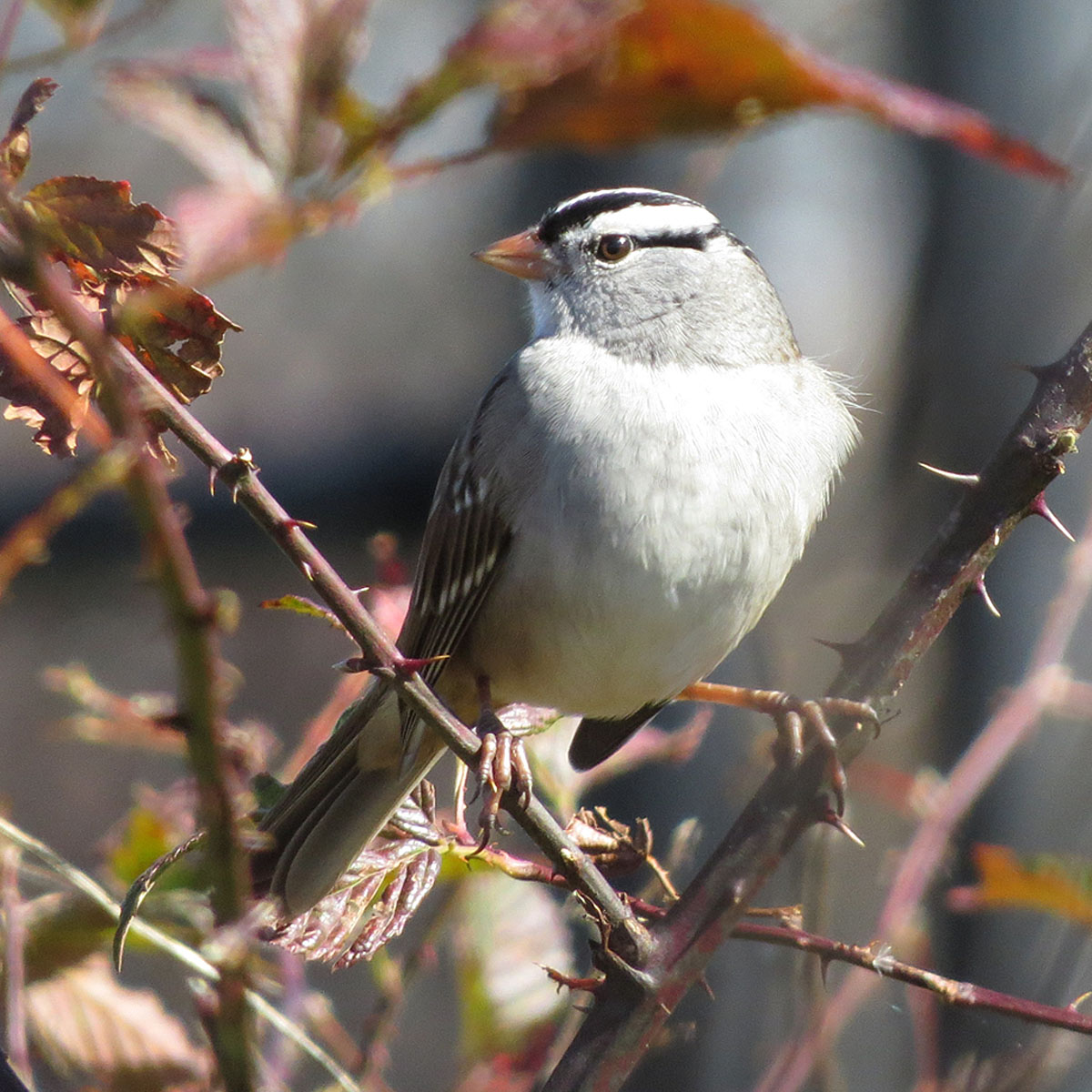
15–16 cm, with a long tail and a small, pink to orange-yellow bill. Adults have a black-and-white striped crown: a white median stripe, black lateral crown stripes, a broad white supercilium and a black eyestripe. Face, neck and underparts are plain grey, the flanks and lower belly washed brownish grey. The back is grey-brown with dark streaks, the wings brown with two narrow white wing bars. First-winter birds show the same pattern in rufous-brown and buff instead of black and white. In the subspecies gambelii the white supercilium starts at the bill; in the eastern nominate form the lores are black. The sexes are alike.
Confusion species
With its black-and-white head stripes and plain grey breast an adult is hard to confuse. Rufous-collared Sparrow Zonotrichia capensis, of Hispaniola and Trinidad, has a grey-and-black striped head, a small crest and a rufous collar. Young White-crowned Sparrows may recall Lark Sparrow Chondestes grammacus, but that species has a chestnut ear patch, a central breast spot and white tail corners. Chipping Sparrow Spizella passerina and Clay-colored Sparrow Spizella pallida are smaller, with a dark bill and a slimmer build.
Habitat
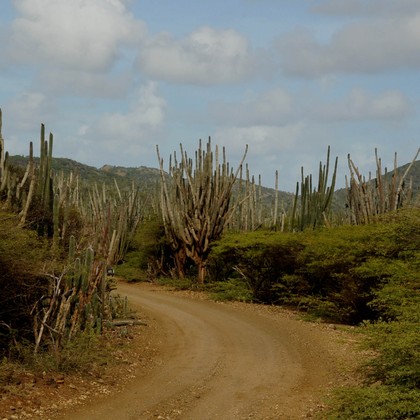
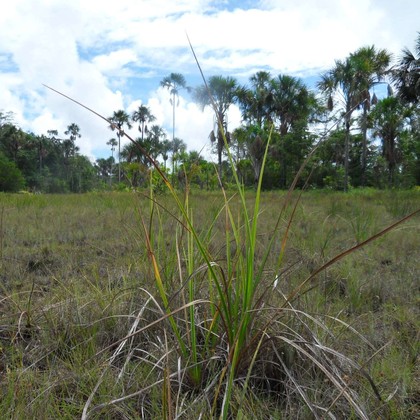
In the region mainly in coastal scrub, weedy ground and thickets along fields and pastures, and in gardens and parks with dense shrubs and bare soil. It forages on the ground for seeds, usually close to cover, and flies into the bushes when disturbed. Records mostly involve single birds, sometimes with other sparrows or grassquits.
Where the bird is most at home, classified by the vegetation types of the Caribbean.



Range and movements
Rare winter visitor and passage migrant in Cuba and the Bahamas; a few reports from the Cayman Islands and the Turks and Caicos Islands. Elsewhere in the region at most a very rare vagrant. Breeds in Alaska, Canada and the mountains and coast of the western United States; winters from the western and southern United States to central Mexico.
- Winter visitor (c. Apr–Sep)
- dark = core range, pale = thinly spread
How and when to look
The best chance is from November to March in western Cuba and the northern Bahamas, in rough field edges, coastal hedges and gardens. A large, long-tailed sparrow with a striped head feeding on bare ground under bushes deserves a closer look; young birds stand out mainly by their brown-and-buff head pattern.
Conservation status
Not threatened. The species is numerous and widespread in North America, although surveys show a slow decline. In the Caribbean it is rare and irregular.
Scientific name
Zonotrichia leucophrys | (Forster, 1772)
Forster described the species in 1772 as Emberiza leucophrys; because it was later moved to another genus, the author and year stand in brackets. The genus Zonotrichia was introduced in 1832 by Swainson. Zonotrichia is Greek, from zōnē 'band' and thrix 'hair'. leucophrys is Greek, from leukos 'white' and ophrus 'eyebrow', after the white stripe above the eye. The specimen the first description was based on came from the Severn River, Hudson Bay.