All species › Passerines › New World sparrows › Savannah Sparrow
Savannah Sparrow | Passerculus sandwichensis
Savannahgors | Chingolo sabanero
The Savannah Sparrow is a small, streaked sparrow of open grassland and one of the most numerous sparrows in North America. Northern populations move in winter to the southern United States, Central America and the northern Caribbean islands. In the region it is the most frequently seen North American sparrow, especially in the Bahamas and Cuba.
Voice
In winter mainly a thin, high tsip and a weak tsew in flight. The song, a series of short chips followed by a buzzy trill and a lower final note, tsip-tsip-tsip-tseeeee-tsaay, is rarely heard in the region.
Recording: Greg Irving — CC BY-NC-SA 4.0 · shortened to the first 60 s, mono · xeno-canto
Identification
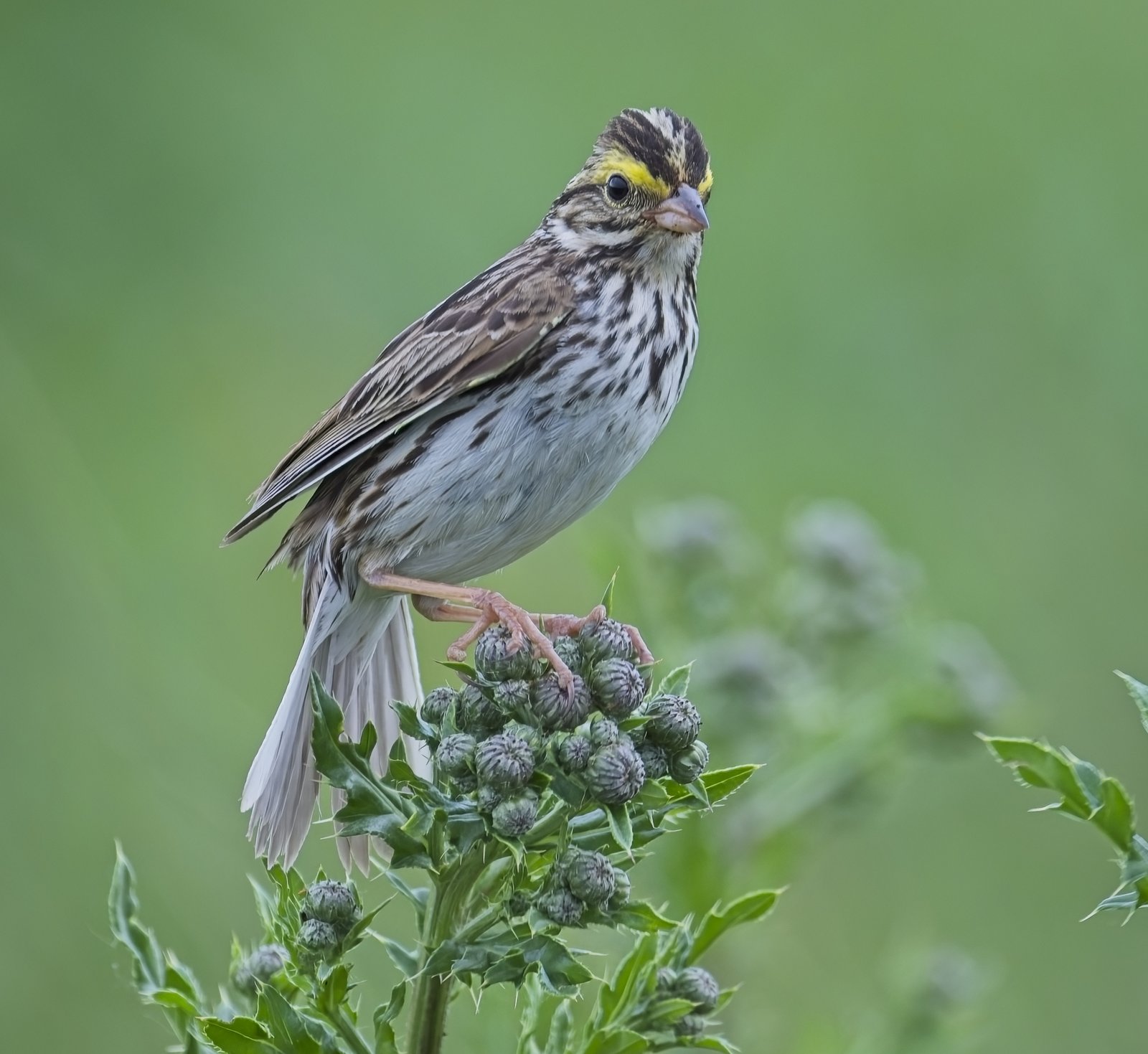
13–15 cm, with a short, notched tail and a small, pointed bill. The upperparts are brown with blackish streaks. The head shows a narrow pale crown stripe, a supercilium that is often yellow in front of the eye, a dark eyestripe and a dark malar stripe beside the white throat. Breast and flanks are white with sharp brown to blackish streaks, often merging into a central breast spot; the belly is white. The legs are pink. The sexes are alike; the amount of yellow and the colour of the streaks vary by subspecies and individual.
Confusion species
Grasshopper Sparrow Ammodramus savannarum has a flatter head, a larger bill, a shorter tail and an unstreaked buff breast. Lincoln's Sparrow Melospiza lincolnii has a buff breast band with fine streaks, a grey face and a narrow pale eye-ring, and keeps to denser cover. Chipping Sparrow Spizella passerina and Clay-colored Sparrow Spizella pallida have unstreaked underparts.
Habitat
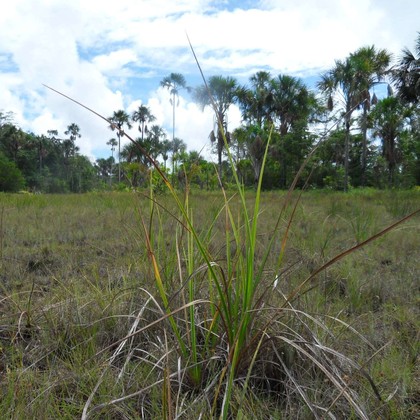
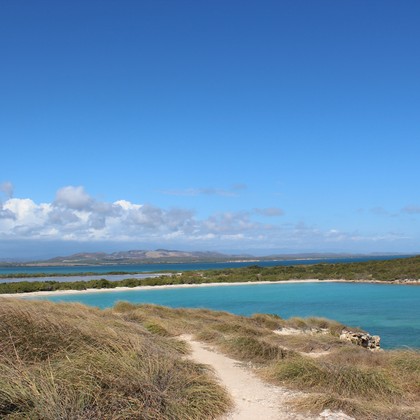
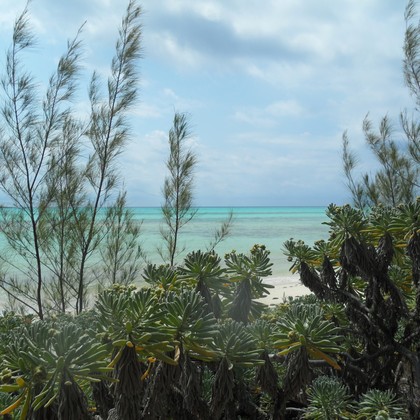
Short grassland, pastures, lawns and the grassy edges of airfields, golf courses and fields, also low-vegetated dunes and grassy areas behind beaches. It walks and runs through the grass in search of seeds and small insects, and when flushed flies off low to drop in again further on or perch on a post or shrub. It often winters in small, loose groups.
Where the bird is most at home, classified by the vegetation types of the Caribbean.



Range and movements
Winter visitor in the Bahamas, especially the northern islands (Grand Bahama, Abaco, New Providence), and in Cuba and the Cayman Islands. Rare in the Turks and Caicos Islands, Jamaica and San Andrés; elsewhere at most a vagrant. Breeds from Alaska and Canada to the northern and central United States, with resident populations along the Pacific coast and in Mexico and Guatemala; winters from the southern United States to Central America.
- Winter visitor (c. Apr–Sep)
- Passage (Mar–Apr, Oct–Nov)
- dark = core range, pale = thinly spread
How and when to look
Most likely along the grassy margins of airfields, golf courses and pastures on Grand Bahama, Abaco and New Providence, and in western Cuba, from November to March. Birds often hide in the grass; walking the edge flushes them onto a post or low bush, where the yellow lores and streaked breast can be seen.
Conservation status
Not threatened. The species is numerous and widespread, although numbers have fallen in parts of North America through loss of grassland. In the Caribbean a regular winter visitor in small numbers.
Scientific name
Passerculus sandwichensis | (Gmelin, 1789)
Gmelin described the species in 1789 as Emberiza sandwichensis; because it was later moved to another genus, the author and year stand in brackets. The genus Passerculus was introduced in 1838 by Bonaparte. Passerculus is Latin for 'little sparrow', a diminutive of passer 'sparrow'. sandwichensis refers to Sandwich Sound in Alaska (named after the Earl of Sandwich), where the first specimen was collected on Cook's third voyage; sources differ on exactly which place is meant. The specimen the first description was based on came from Unalaska, Alaska.