All species › Hummingbirds and swifts › Hummingbirds › Vervain Hummingbird
Vervain Hummingbird | Mellisuga minima
Dwergkolibrie | Zumbadorcito
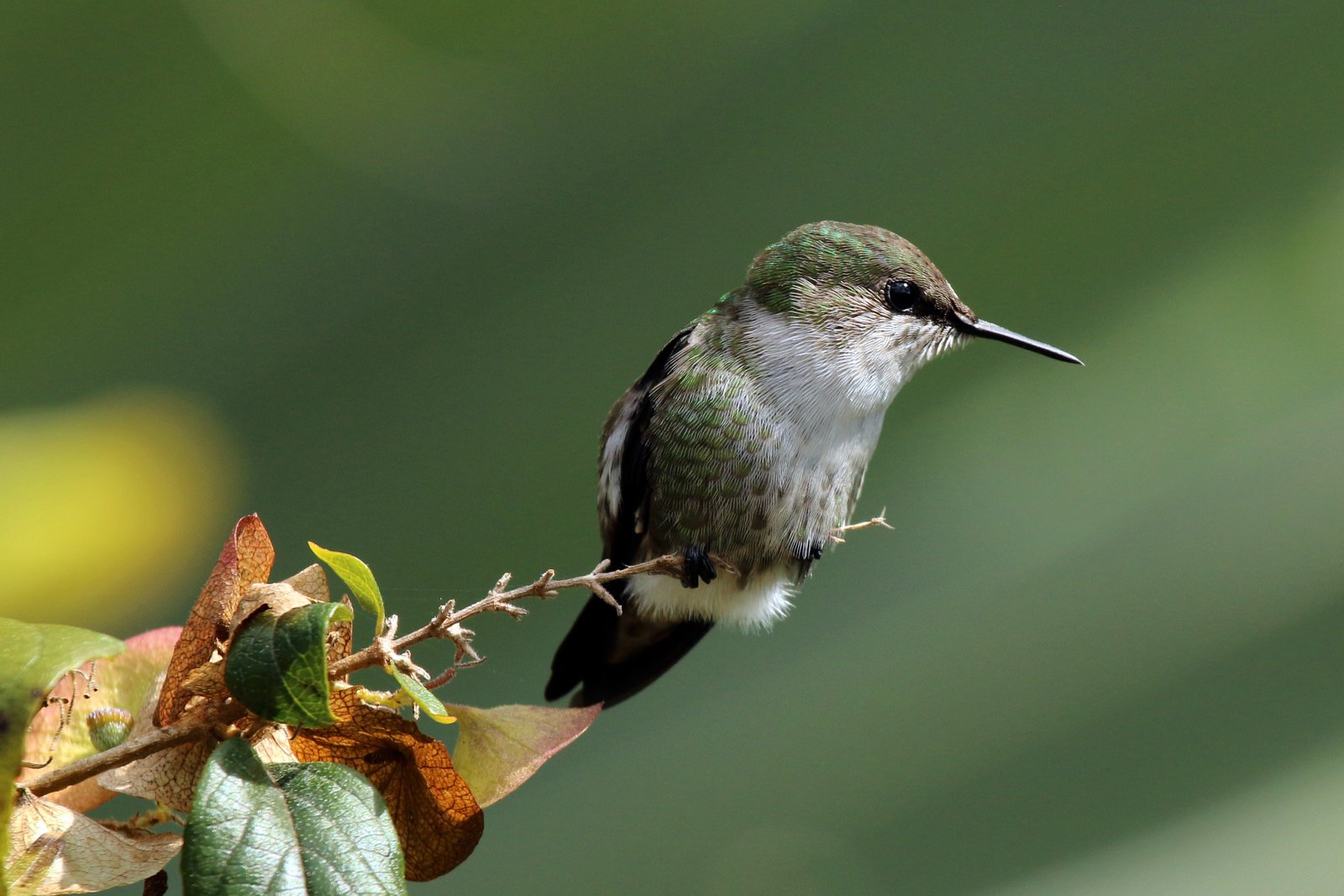
The Vervain Hummingbird is, after the Bee Hummingbird, the second smallest bird in the world, and common in Jamaica and Hispaniola. It lacks the iridescent throat patch of most hummingbirds and is therefore one of the plainest species. Males sing often and at length for a hummingbird.
Voice
The male sings from a bare twig for long periods, a rhythmic, very high, squeaky song of repeated syllables. In confrontations both sexes give a dry, chittering scold.
Recording: Johan Chaves — CC BY-NC-SA 4.0 · converted to mono · xeno-canto
Identification
About 6 cm, including a short, straight black bill of 1 cm. The male is dull metallic green above, almost black on the rump, and greyish-white below with fine dark spots on chin and throat. The tail is black and slightly forked. The female is green to blue-green above and pale grey below, with a rounded tail whose outer feathers have white tips. Neither sex has an iridescent throat patch.
Confusion species
Its size and uniformly pale underparts rule out confusion. In Hispaniola, Hispaniolan Emerald Riccordia swainsonii is much larger, with a deeply forked tail; the male is green below. In Jamaica the streamertails Trochilus polytmus and T. scitulus and Jamaican Mango Anthracothorax mango are all much larger. Large insects such as hawk-moths can be mistaken for a Vervain Hummingbird at flowers.
Habitat
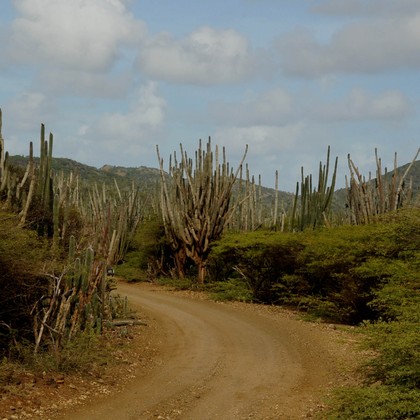
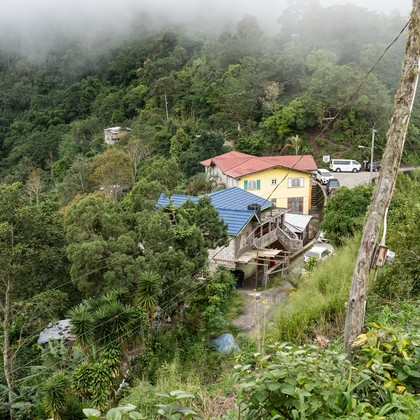
A wide range of open and semi-open landscapes: dry forest, gallery forest, thorn and cactus scrub, the edges of humid forest, plantations, farmland mosaic, gardens and urban parks, from sea level to about 1,600 m. It avoids the interior of dense montane forest. It visits small flowers, including those of herbs such as vervain, from which the English name derives. The nest is a small cup fixed to a twig with cobweb; breeding runs from December to August.
Where the bird is most at home, classified by the vegetation types of the Caribbean.




Range and movements
Resident in Jamaica and in Hispaniola, in both Haiti and the Dominican Republic, including the larger offshore islands. There is one unconfirmed record from Puerto Rico. It does not occur outside the region.
- Resident
- dark = core range, pale = thinly spread
How and when to look
Common in Jamaica and Hispaniola in gardens, hotel grounds and dry scrub, including in towns. The singing male on a bare lookout usually gives the species away first; at low flowering shrubs the bird can be watched at close range with some patience.
Conservation status
Not threatened. The species has a large range on two islands, a stable population and adapts well to man-modified landscapes.
Scientific name
Mellisuga minima | (Linnaeus, 1758)
Linnaeus described the species in 1758 as Trochilus minimus; because it was later moved to another genus, the author and year stand in brackets. The genus Mellisuga was introduced in 1760 by Brisson. Mellisuga is Latin, from mel 'honey' and sugere 'to suck': 'honey-sucker', after its nectar feeding. minima is Latin for 'smallest', after its tiny size. The specimen the first description was based on came from Jamaica.