All species › Hummingbirds and swifts › Hummingbirds › Cuban Emerald
Cuban Emerald | Riccordia ricordii
Cubaanse smaragdkolibrie | Zunzún
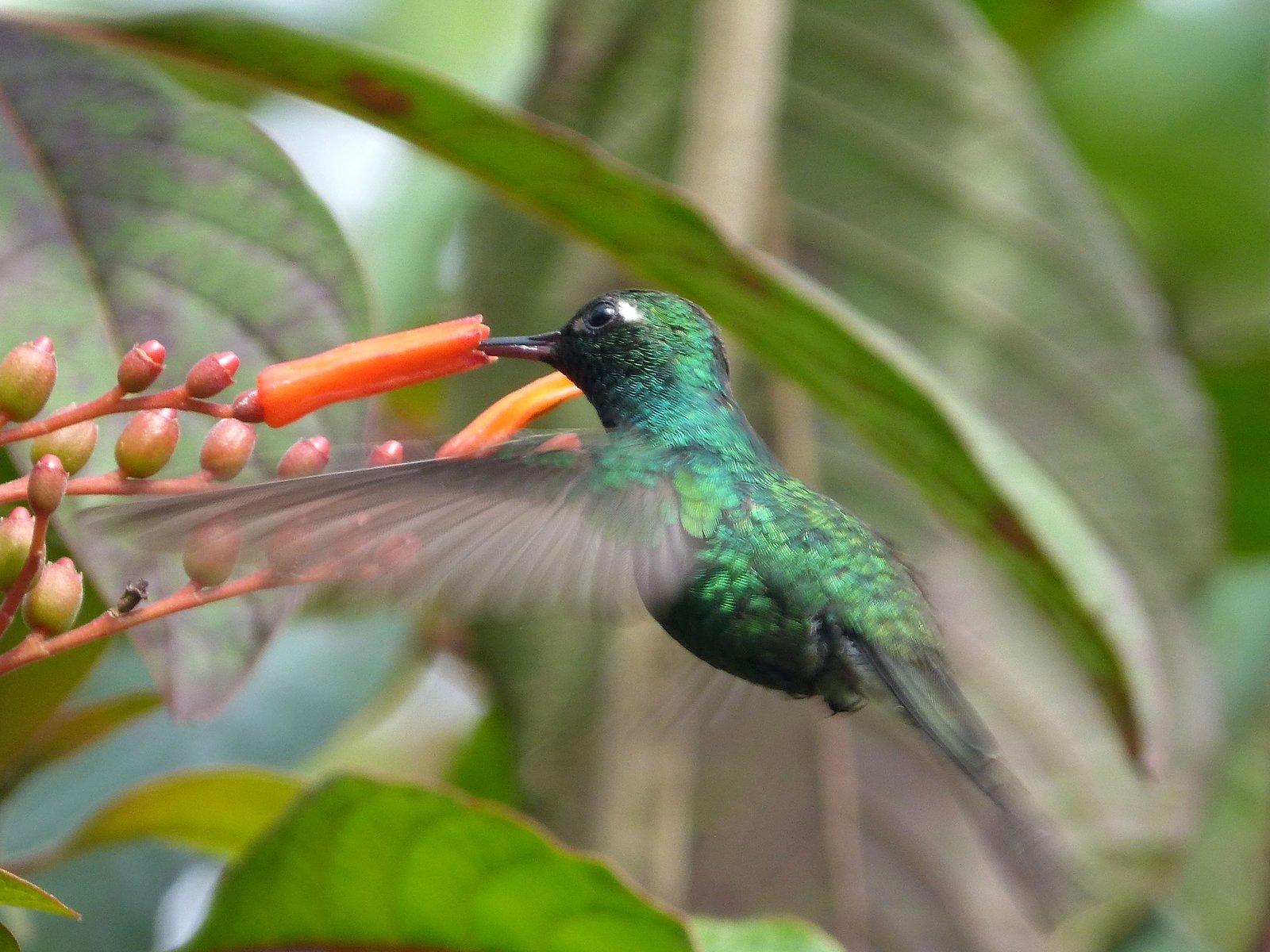
The Cuban Emerald is the commonest hummingbird in Cuba and also occurs on a few northern islands of the Bahamas. It can be found almost anywhere there are flowers, from coastal forest high into the mountains and right into the towns. In Cuba it is called zunzún.
Voice
The male gives a rapid, rolling series of slee notes mixed with sputtering, metallic sounds. The female has a high seeee in flight; both sexes also make buzzing and chittering sounds.
Recording: FREDERIC Lionel — CC BY-NC-SA 4.0 · converted to mono · xeno-canto
Identification
9.5–11.5 cm, the female smaller than the male, with a slightly decurved, black-tipped bill. The male is glossy metallic green, glittering emerald below, with white undertail coverts and a small white spot behind the eye. The tail is long, deeply forked and dark blue-black. The female is green above and brownish-grey below, with green flanks, white undertail coverts, a longer whitish stripe behind the eye and a less deeply forked tail with grey tips.
Confusion species
Bee Hummingbird Mellisuga helenae is much smaller, with a short tail and pale grey underparts. In the Bahamas, Bahama Woodstar Nesophlox evelynae has a shorter tail, square-ended or narrowly forked, and rufous flanks and belly; the male has a purplish-red throat. Ruby-throated Hummingbird Archilochus colubris, a scarce winter visitor, is largely white below and shorter-tailed.
Habitat
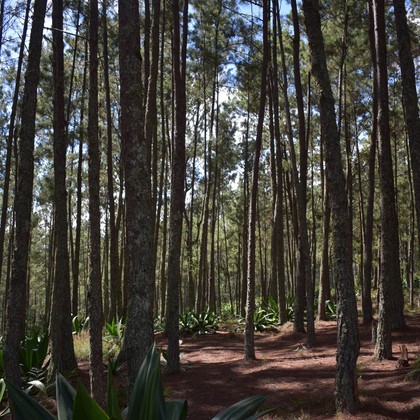
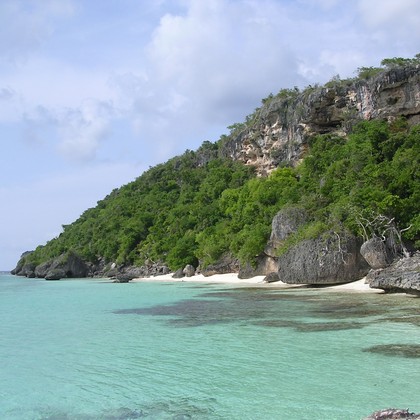
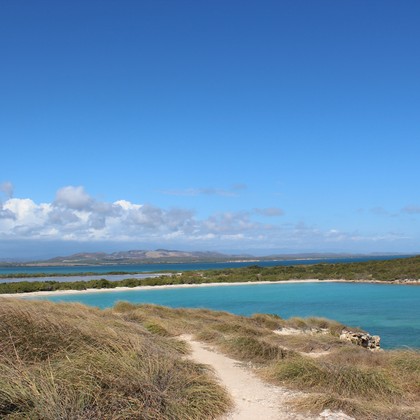
Dry and humid open forest, forest edges, coastal forest and scrub, pine forest (in the Bahamas mainly pine woods and scrub), plantations, parks and gardens, from sea level to at least 1,300 m. It takes nectar from a wide variety of flowers and visits feeders. It breeds mainly from April to July; the cup of plant fibre and cobweb is placed 1–4 m above the ground.
Where the bird is most at home, classified by the vegetation types of the Caribbean.



Range and movements
Resident in Cuba, the Isla de la Juventud and many smaller cays off the Cuban coast, and in the Bahamas on Grand Bahama, Abaco, Andros and Green Cay. Outside the region an occasional vagrant to Florida.
- Resident
- dark = core range, pale = thinly spread
How and when to look
In Cuba common in almost any garden with flowering shrubs, including in Havana, and in every forested area. In the Bahamas found in the pine forest and in gardens on Grand Bahama and Abaco. The female is told by the pale eye-stripe and green flanks.
Conservation status
Not threatened. The species is common over most of its range and adapts well to man-modified landscapes.
Scientific name
Riccordia ricordii | (Gervais, 1835)
Gervais described the species in 1835 as Ornismya Ricordii; because it was later moved to another genus, the author and year stand in brackets. The genus Riccordia was introduced in 1854 by Reichenbach. Riccordia honours the French surgeon and naturalist Alexandre Ricord (b. 1798), after whom the type species ricordii is also named. ricordii honours the French surgeon and naturalist Alexandre Ricord (b. 1798), who collected in the Caribbean. The specimen the first description was based on came from Santiago de Cuba, Cuba.