All species › Passerines › Tanagers › Turquoise Tanager
Turquoise Tanager | Tangara mexicana
Turkooistangare | Tangara turquesa
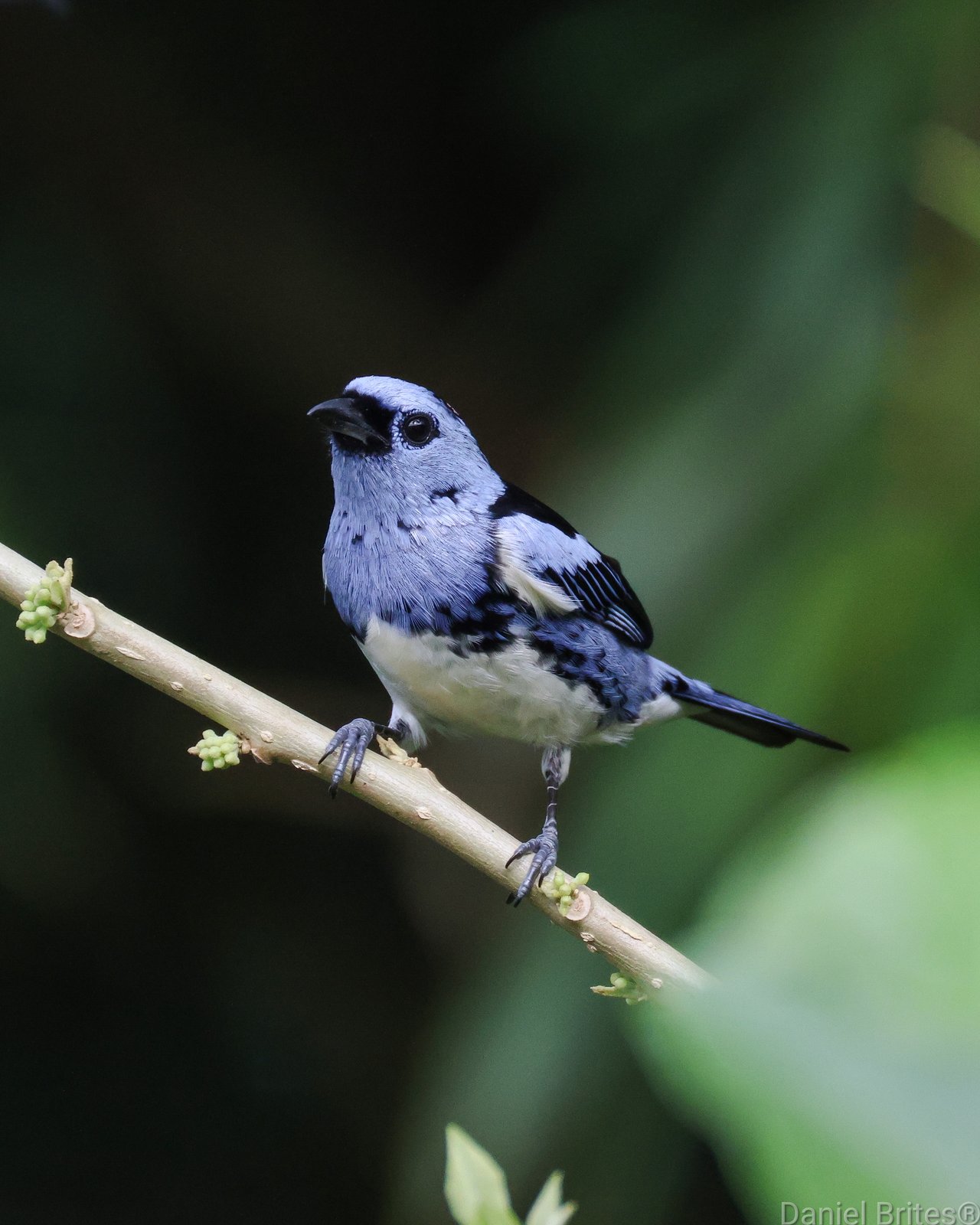
The Turquoise Tanager is a small, compact tanager that almost always travels in noisy groups of four to ten birds. The groups move through the crowns of fruiting trees and are often heard before they are seen. Despite its scientific name, the species does not occur in Mexico.
Voice
Groups give a fast, squeaky twitter, a series of short tic-tic-tic-tic notes, and high, thin contact calls.
Recording: Odirlei Vieira da Fonseca — CC BY-NC-SA 4.0 · shortened to the first 60 s, mono · xeno-canto
Identification
13–14 cm, with a fairly short, dark, pointed bill. Forehead and face are black, crown, throat and breast deep cobalt blue, spotted with black on the breast sides and flanks. The back is black, the rump blue, and there is a paler turquoise-blue patch on the shoulder. Wings and tail are black with blue edges. Belly and undertail coverts are bright yellow. The sexes are alike; young birds are duller and greyer. The Trinidad subspecies, vieilloti, is darker blue on the head and breast and brighter yellow below than mainland birds.
Confusion species
The male Swallow Tanager Tersina viridis is paler turquoise-blue with a white central belly and barred flanks, and has a broad, flat bill. The male Blue Dacnis Dacnis cayana is smaller and slimmer, turquoise-blue with a black throat patch and back, and lacks the yellow belly. Male Violaceous Euphonias Euphonia violacea are dark blue-black above and yellow below, but have a yellow forehead and a shorter tail.
Habitat
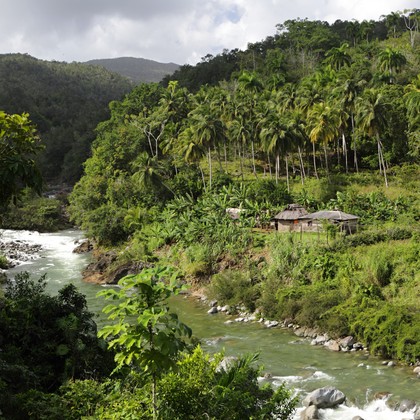
Moist forest edges, secondary forest, clearings with tall trees, cocoa and coffee plantations, gardens and parks with fruit trees, from the lowlands up to the lower slopes of the hills. It feeds mainly on fruit, including Cecropia, and also takes insects from twigs and leaves. The nest is a cup in a tree or shrub.
Where the bird is most at home, classified by the vegetation types of the Caribbean.





Range and movements
In the Caribbean only on Trinidad, where it is fairly common; it is absent from Tobago. Single reports from Martinique and St Vincent are unconfirmed. Outside the region in northern and central South America, from Colombia and Venezuela through the Amazon basin to Bolivia and Brazil.
- Resident
- dark = core range, pale = thinly spread
How and when to look
Fruiting trees and fruit feeders in wooded gardens and lodges in the Northern Range, such as in the Arima Valley, regularly attract groups. The twittering announces an approaching group, and the birds then often stay in the same tree for some time.
Conservation status
Not threatened. A widespread species that also lives in secondary forest, plantations and gardens.
Scientific name
Tangara mexicana | (Linnaeus, 1766)
Linnaeus described the species in 1766 as Tanagra mexicana; because it was later moved to another genus, the author and year stand in brackets. The genus Tangara was introduced in 1760 by Brisson. Tangara is a Tupi name from Brazil, often explained as 'dancer', for a brightly coloured bird. mexicana means 'of Mexico', a mistake: the species does not occur there and the type locality is Cayenne. The specimen the first description was based on came from Cayenne, French Guiana.