All species › Passerines › Tanagers › Bay-headed Tanager
Bay-headed Tanager | Tangara gyrola
Okerkaptangare | Tangara cabecibaya
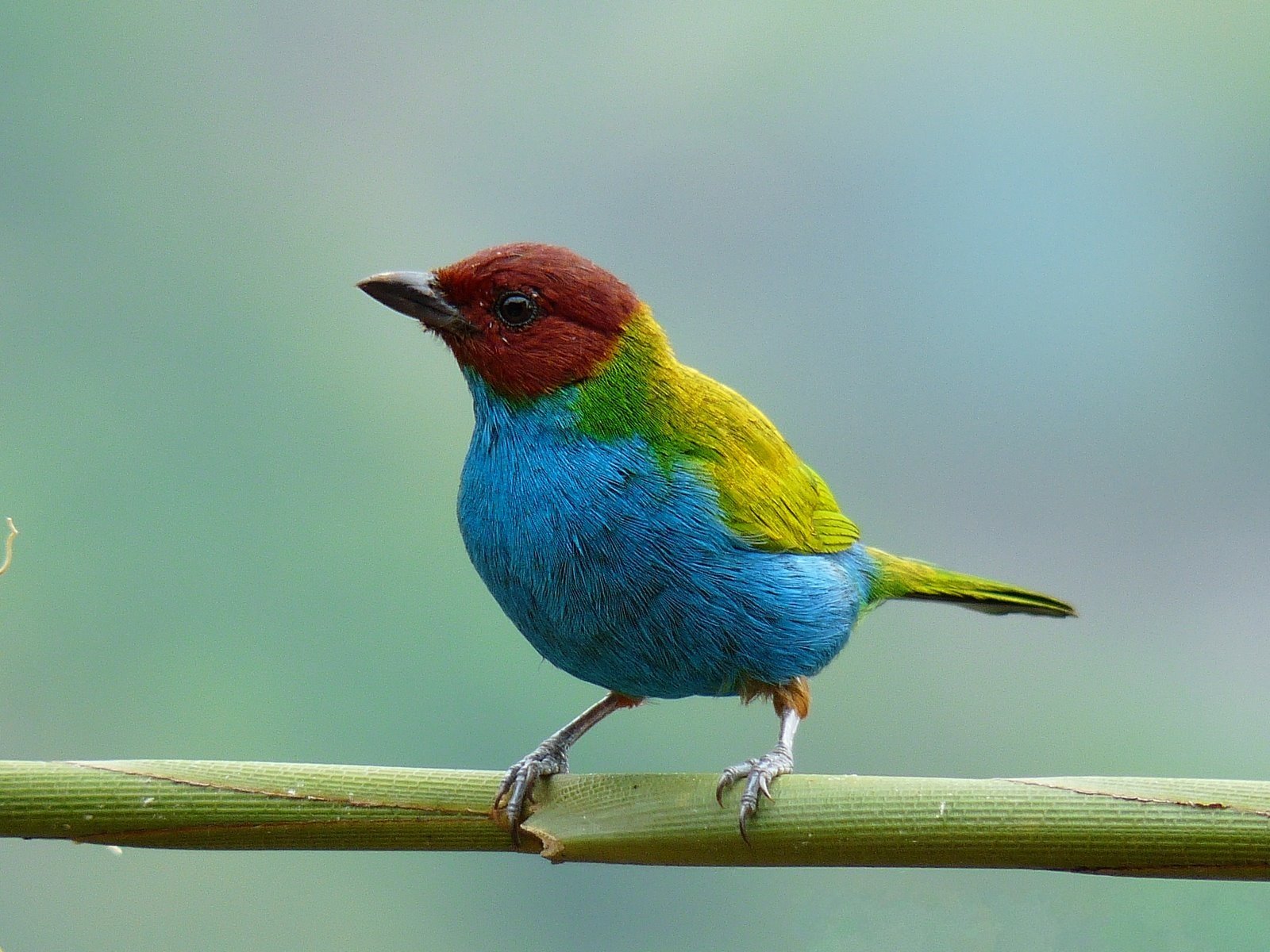
The Bay-headed Tanager is a small green tanager with a reddish-brown head that moves through the canopy in pairs or small groups, often with other tanagers and honeycreepers. Plumage varies strongly between subspecies; Trinidad birds are entirely green on the body.
Voice
The song is a slow series of thin see notes, followed by two shorter, higher notes. Calls are high, sharp tsip notes.
Recording: Juan Freile — CC BY-NC-SA 4.0 · shortened to the first 60 s, mono · xeno-canto
Identification
13–14 cm, with a short, pointed bill. The head is uniform chestnut to reddish-brown, separated from the back by a narrow golden-yellow nape band that is not always obvious. The body is bright grass-green, including the underparts; the Trinidad subspecies viridissima lacks the blue belly shown by other subspecies. Wings and tail are blackish with broad green edges, the wing coverts with a golden sheen. The sexes are alike. Juveniles are duller, with a green head flecked reddish-brown.
Confusion species
Speckled Tanager Ixothraupis guttata is also green, but has a yellow face and black spots on the back and underparts. The female Green Honeycreeper Chlorophanes spiza is uniform grass-green without a brown head and has a slightly curved bill with a yellow lower mandible. Young Bay-headed Tanagers with little brown on the head are recognised by the compact shape and the short black bill.
Habitat
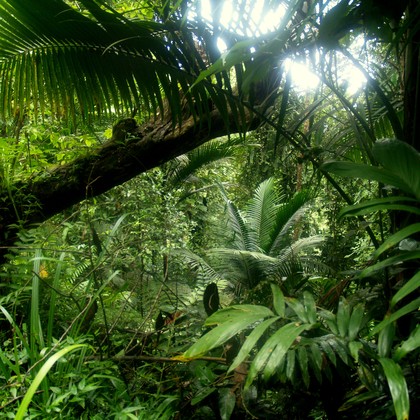
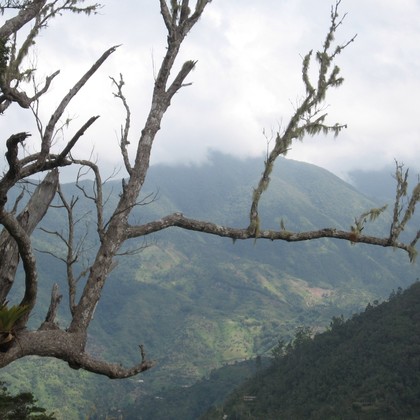
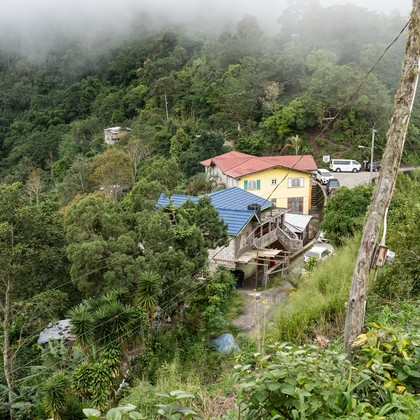
Moist forest, forest edges, mature secondary forest and shaded cocoa plantations; on Trinidad mainly in the hills and mountains of the Northern Range, less in the lowlands. It feeds mainly on fruit, swallowed whole, and searches for insects on the undersides of branches. The nest is a cup in a tree; the female incubates the eggs.
Where the bird is most at home, classified by the vegetation types of the Caribbean.


Range and movements
In the Caribbean only on Trinidad, where it is fairly common in wooded country; it is absent from Tobago. The subspecies viridissima also occurs in north-eastern Venezuela. Other subspecies range from Costa Rica through northern South America to Bolivia and Brazil.
- Resident
- dark = core range, pale = thinly spread
How and when to look
Mixed groups of tanagers and honeycreepers at fruiting trees along mountain roads in the Northern Range, such as the Blanchisseuse road and the Arima Valley, and at fruit feeders give the best chances.
Conservation status
Not threatened. The species occurs over a large area and tolerates secondary forest and plantations with shade trees.
Scientific name
Tangara gyrola | (Linnaeus, 1758)
Linnaeus described the species in 1758 as Fringilla Gyrola; because it was later moved to another genus, the author and year stand in brackets. The genus Tangara was introduced in 1760 by Brisson. Tangara is a Tupi name from Brazil, often explained as 'dancer', for a brightly coloured bird. gyrola is a diminutive of Latin gyrus 'ring, circle', possibly after the golden collar of some forms. The specimen the first description was based on came from Suriname.