All species › Hummingbirds and swifts › Hummingbirds › Green Mango
Green Mango | Anthracothorax viridis
Groene mango | Zumbador verde
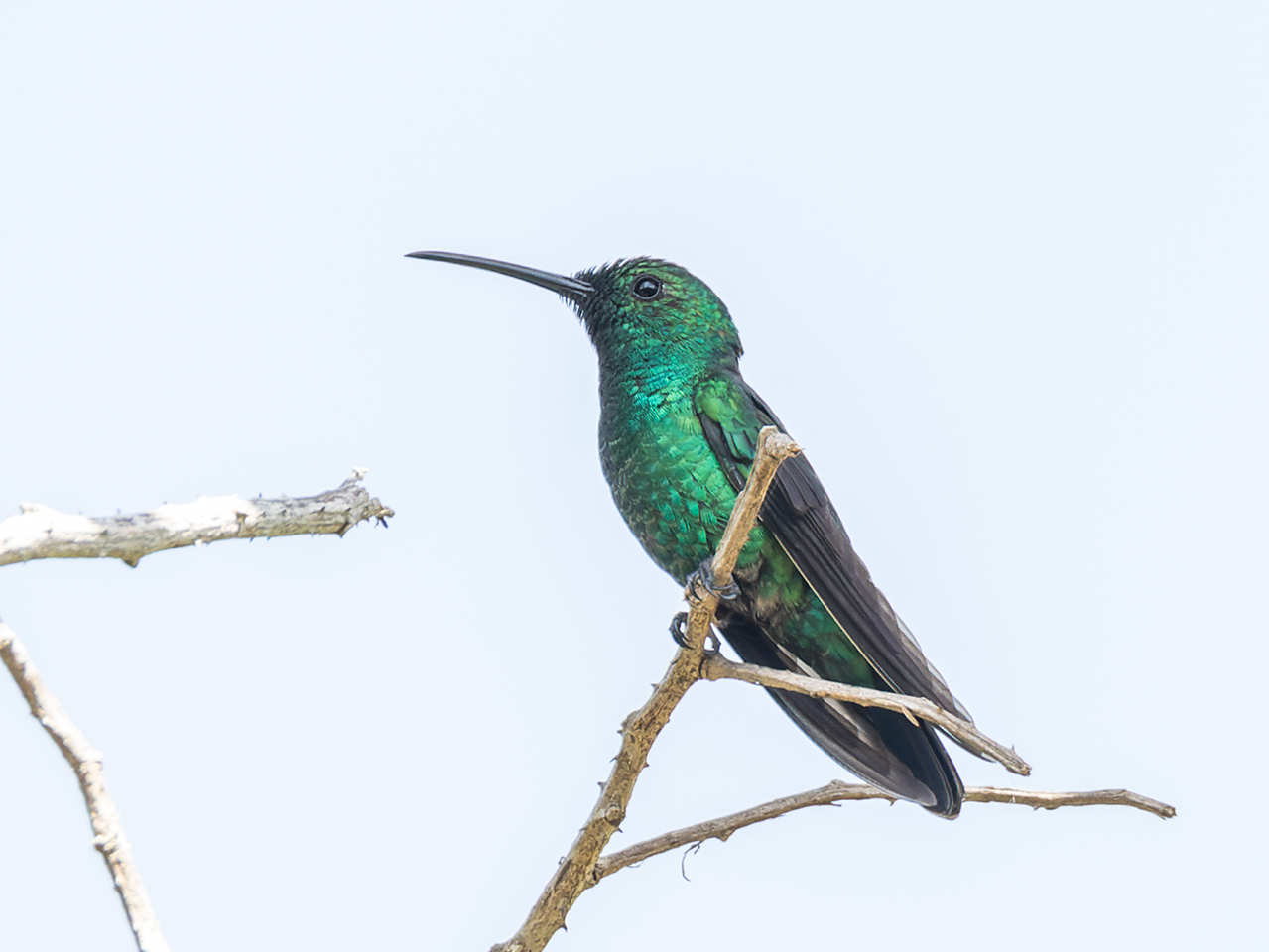
The Green Mango is a medium-sized hummingbird found only in Puerto Rico, mainly in the mountains of the centre and west of the island. Male and female are nearly alike: entirely green with a dark tail. In the mountains it is the most frequent large hummingbird; males defend flowering trees against their own and other species.
Voice
Not very vocal. Calls include a repeated short tsik and a high twittering trill; disputes bring harsh rattles and chatters.
Recording: Daniel Lane — CC BY-NC-SA 3.0 · converted to mono · xeno-canto
Identification
11–14 cm, with a slightly curved black bill. Glossy emerald green above and metallic blue-green below, without any pattern on throat or breast. The tail is blue-black, the outer feathers tipped white or grey. The female has a small white spot behind the eye. Young birds show a brownish wash on the head and back.
Confusion species
Puerto Rican Mango Anthracothorax aurulentus lives mainly in the lowlands and has a golden-green back; the male has a green throat and black breast, the female is white or grey below. Green-throated Carib Eulampis holosericeus has a more strongly curved bill, a blue band across the green breast and a grey belly, and keeps mainly to the east and the lowlands. Puerto Rican Emerald Riccordia maugaeus is much smaller and has a forked tail.
Habitat
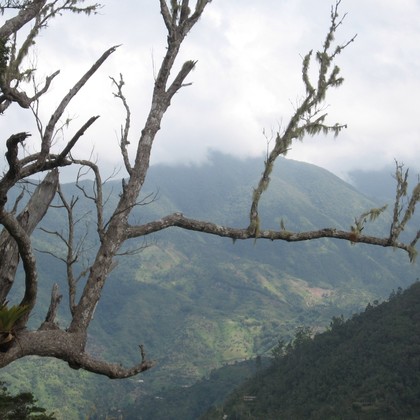
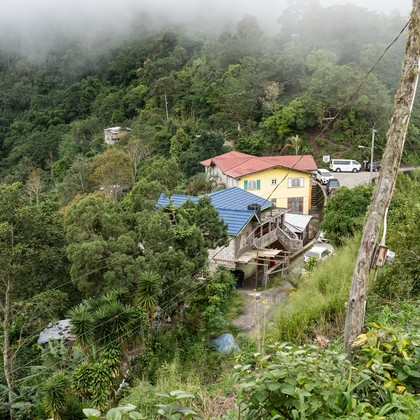
Humid montane forest, cloud forest, mature secondary forest and shaded coffee plantations, as well as forest edges and gardens in the mountains; most frequent between about 800 and 1,200 m, rare on the coast. It feeds from the understorey to above the treetops and takes many insects in flight. It makes seasonal movements up and down the slopes.
Where the bird is most at home, classified by the vegetation types of the Caribbean.



Range and movements
Endemic to Puerto Rico, where it is common in the Cordillera Central and the western mountains and rare in the lowlands and along the coast. Not known from Vieques, Culebra or the Virgin Islands.
- Resident
- dark = core range, pale = thinly spread
How and when to look
Best looked for in the Maricao and Toro Negro state forests and along mountain roads through coffee country, at flowering trees and forest edges. A mango that is entirely green below, with no black or white, in the mountains of Puerto Rico is almost certainly this species.
Conservation status
Not threatened. The range is small, but the species is common in the mountains and tolerates coffee plantations and secondary forest.
Scientific name
Anthracothorax viridis | (Audebert & Vieillot, 1801)
Audebert & Vieillot described the species in 1801 as Trochilus viridis; because it was later moved to another genus, the author and year stand in brackets. The genus Anthracothorax was introduced in 1831 by Boie. Anthracothorax is Greek, from anthrax 'coal' (i.e. 'black') and thōrax 'chest', after the black central stripe on breast and belly. viridis is Latin for 'green', after the largely green plumage. The specimen the first description was based on came from ‘Guiana’ (as stated, probably erroneous: the species occurs only on Puerto Rico).