All species › Gamebirds › Guans, chachalacas and curassows › Trinidad Piping Guan
Trinidad Piping Guan | Pipile pipile
Trinidadgoean | Pava de Trinidad
The Trinidad Piping Guan, called pawi on the island, is a black, turkey-like tree fowl found only in Trinidad. It lives high in the canopy of the forests in the north-east of the island. It once occurred over a much larger part of Trinidad; hunting has pushed it back to the remote forests of the Northern Range, and it is critically endangered.
Voice
The song is a series of thin, rising whistles, given mainly early in the morning and shortly before sunset; it gives the group its English name. There is also a mechanical sound: in a short glide the bird produces a dry, rattling drumming with its wings, trrrrr.
No recording with a suitable Creative Commons licence is available for this species yet.
Identification
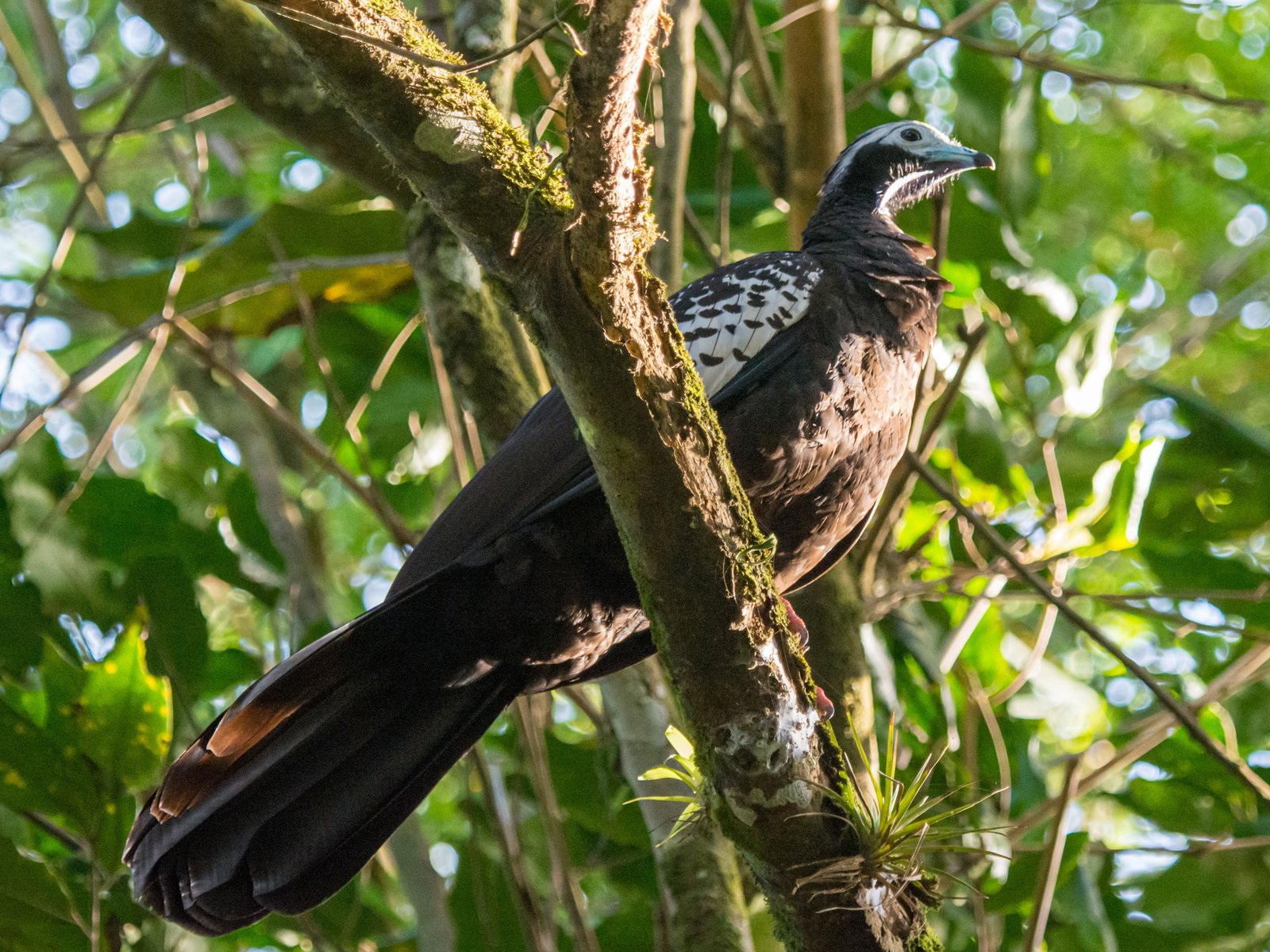
About 60 cm, with a long tail, a thin neck and a small head. The plumage is black with a purple gloss. The large shaggy crest is blackish edged with white; the wing coverts carry a large white patch, visible even on a perched bird. The bare face is pale blue, the throat wattle dark blue. The bill is bluish at the base with a black tip; the legs are bright pinkish red. The sexes are alike.
Confusion species
There is nothing in Trinidad it can be confused with: no other large arboreal bird is black with white wing patches and a blue throat wattle. Rufous-vented Chachalaca Ortalis ruficauda lives in the wild only on Tobago and is brown with a grey head. The related piping guans of the South American mainland (Pipile) do not occur in the region.
Habitat
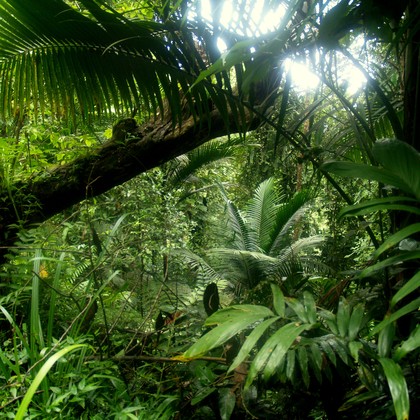
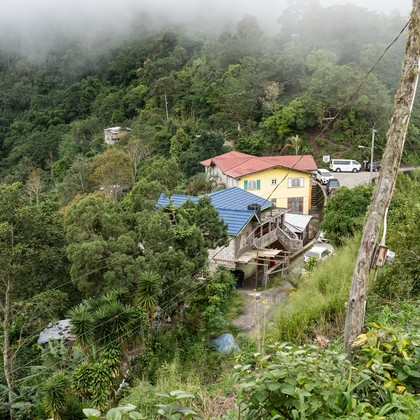
Montane rainforest and moist lowland forest, especially at forest edges, in river valleys and around abandoned cacao and coffee estates within the forest. It lives in the canopy, usually more than five metres up, and seldom comes to the ground. It feeds mainly on fruit, including nutmeg and wild nutmeg Virola surinamensis. It lives in pairs or small groups and is most active early in the morning and late in the afternoon. The clutch is two or three cream-coloured eggs.
Where the bird is most at home, classified by the vegetation types of the Caribbean.


Range and movements
Only in Trinidad. Now confined to the forests of the Northern Range, chiefly in the north-east, with records from Grande Riviere, Matura, Madamas, Aripo and Cumaca among other places. In the Trinity Hills in the south-east it is rare or gone, and it has disappeared from the lowlands, including Nariva Swamp. It is absent from Tobago and does not occur outside Trinidad.
- Resident
- dark = core range, pale = thinly spread
How and when to look
At Grande Riviere on the north-east coast, where birds are regularly seen early in the morning in the trees around the village and along the forest road, and have become used to people. The whistled song and the wing-drumming at dawn give the bird away; in fruiting trees it may sit still for a long time.
Conservation status
Critically Endangered. The population is small and the range limited to part of the Northern Range. The main threat is illegal hunting, followed by forest loss. In Trinidad the species is designated an Environmentally Sensitive Species and is protected by law.
Scientific name
Pipile pipile | (Jacquin, 1784)
Jacquin described the species in 1784 as Crax pipile; because it was later moved to another genus, the author and year stand in brackets. The genus Pipile was introduced in 1856 by Bonaparte. Pipile goes back to Crax pipile: the name refers to the soft, piping call (compare Latin pipilare 'to chirp'). pipile refers to the soft, piping call; Jacquin wrote in 1784 that the bird owed its local name to this 'piping'. The specimen the first description was based on came from Orinoco near Cumaná, Venezuela (probably erroneous).