All species › Passerines › New World warblers › Swainson's Warbler
Swainson's Warbler | Limnothlypis swainsonii
Swainsons zanger | Reinita de Swainson
Swainson's Warbler is an inconspicuous brown wood-warbler that keeps to the ground in dense undergrowth and is heard far more often than seen. Part of the breeding population migrates south-east and winters in the Greater Antilles, especially Jamaica and Cuba; the rest goes to the Yucatán Peninsula and Central America.
Voice
The call is a loud, metallic chip. The song, on the breeding grounds, is loud and clear: a few slow, drawn-out whistles followed by a faster, descending series, whee whee whee whee-chew-whee-chew.
Recording: Sue Riffe — CC BY-NC-SA 4.0 · converted to mono · xeno-canto
Identification
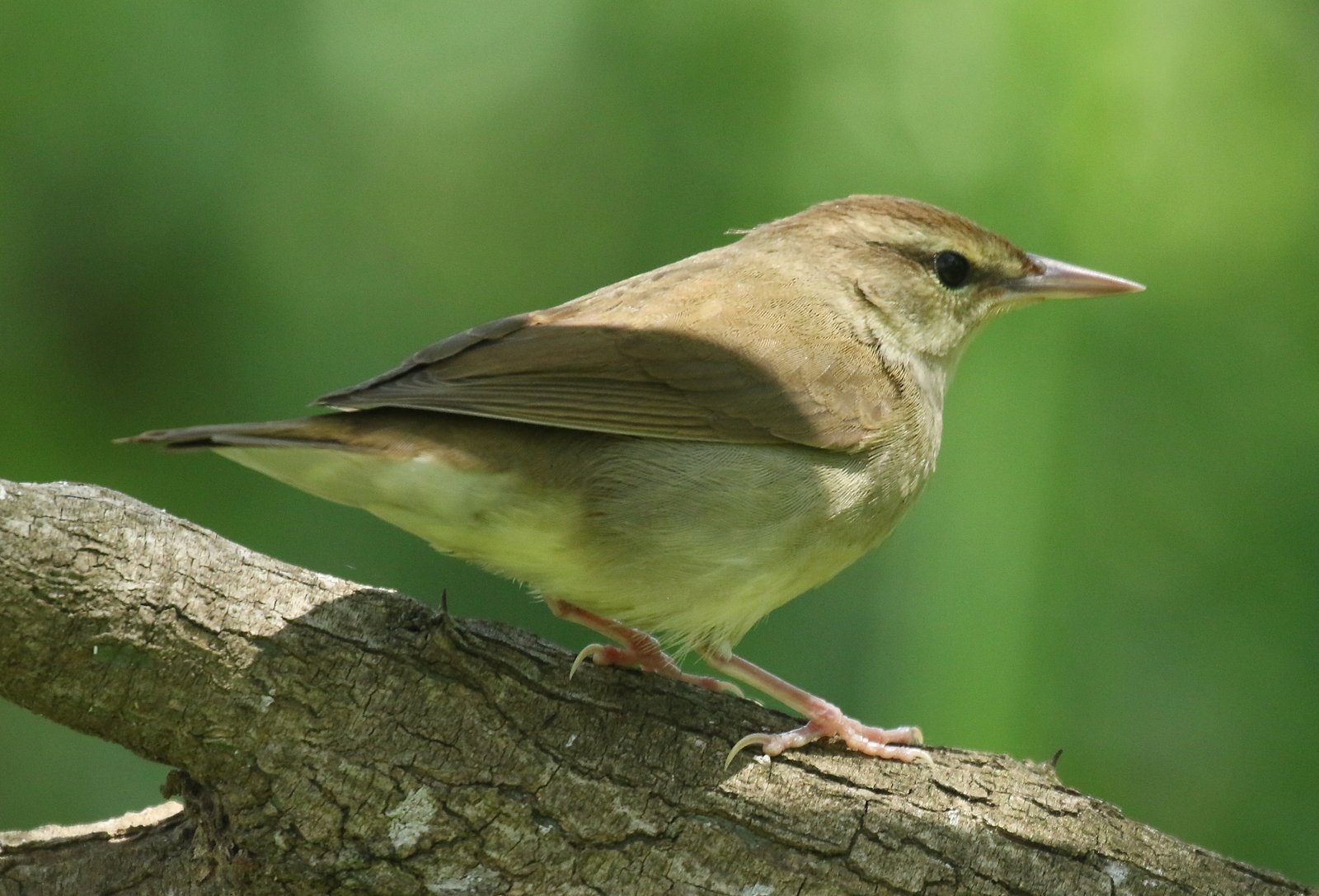
13–15 cm, with a long, pointed, fairly heavy bill and a short tail. Upperparts plain olive-brown, the crown warm rufous-brown. A pale yellowish supercilium above a dark eye-stripe. Underparts dull white to pale yellowish, greyer on the flanks, without streaks. Legs pink. The sexes are alike.
Confusion species
Worm-eating Warbler Helmitheros vermivorum has four black stripes on a buff head and buff underparts. Northern Waterthrush Parkesia noveboracensis, Louisiana Waterthrush Parkesia motacilla and Ovenbird Seiurus aurocapilla are streaked below. Vireos with a supercilium have a shorter, thicker, hooked bill and stay higher in the trees.
Habitat
Moist and semi-evergreen broadleaf forest, limestone forest and montane forest with dense undergrowth and a thick layer of leaf litter. It walks on the ground and flips leaves with its bill in search of insects, spiders and other invertebrates. Wintering birds hold individual territories.
Where the bird is most at home, classified by the vegetation types of the Caribbean.




Range and movements
A scarce winter visitor to Jamaica, especially in the Blue Mountains and the limestone Cockpit Country, and to Cuba. Rare in the Bahamas and the Cayman Islands; a vagrant on Hispaniola, Puerto Rico and the Virgin Islands. Breeds in the south-eastern United States and winters in the Greater Antilles, the Bahamas, the Yucatán Peninsula and Central America.
- Winter visitor (c. Apr–Sep)
- Passage (Mar–Apr, Oct–Nov)
- dark = core range, pale = thinly spread
How and when to look
Best in moist forest with plenty of leaf litter in Jamaica, as along the forest trails of the Blue Mountains, by listening for leaves being turned over and for the metallic chip. The bird is shy and usually stays low in dense cover.
Conservation status
Not threatened. The population is small but stable to slightly increasing. Loss of undergrowth and forest in the wintering range, including Jamaica and Cuba, is a concern.
Scientific name
Limnothlypis swainsonii | (Audubon, 1834)
Audubon described the species in 1834 as Sylvia Swainsonii; because it was later moved to another genus, the author and year stand in brackets. The genus Limnothlypis was introduced in 1914 by Stone. Limnothlypis is Greek, from limnē 'marsh' and thlupis, an unidentified small bird: 'marsh warbler', after its swampy forest habitat. swainsonii honours the English naturalist and illustrator William Swainson (1789–1855). The specimen the first description was based on came from Edisto River near Charleston, South Carolina (USA).