All species › Passerines › New World warblers › Golden-winged Warbler
Golden-winged Warbler | Vermivora chrysoptera
Geelvleugelzanger | Reinita alidorada
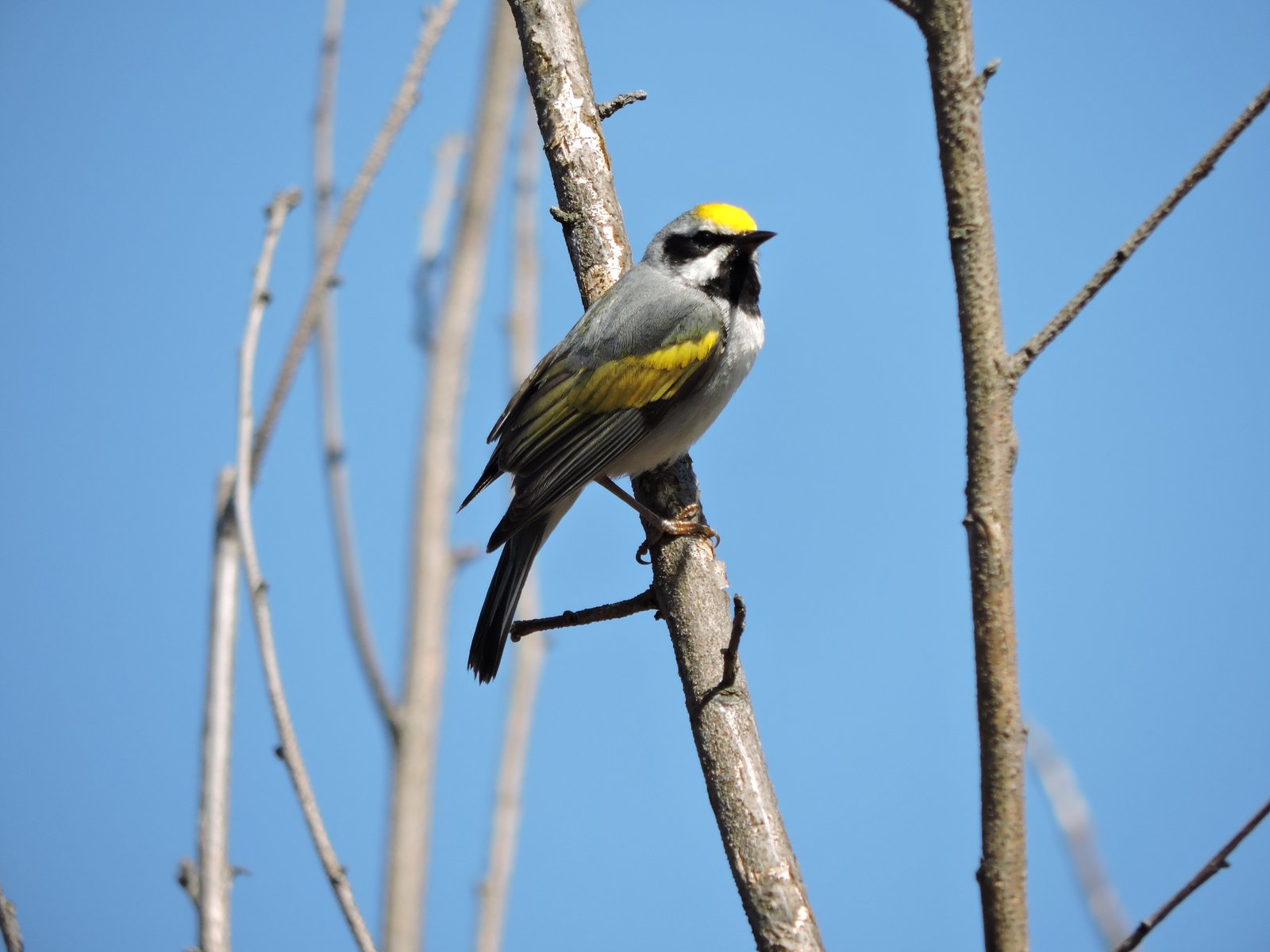
The Golden-winged Warbler is a grey wood-warbler with a yellow crown and a large yellow wing patch, breeding in young second-growth woodland in north-eastern North America. It winters in Central America and northern South America and reaches the Caribbean only in small numbers. It regularly hybridises with Blue-winged Warbler.
Voice
The call is a fairly sharp chip. The song, on the breeding grounds, is a buzzy bee-buzz-buzz-buzz, the first note higher.
Recording: Valerie Heemstra — CC BY-NC-SA 4.0 · shortened to the first 60 s, mono · xeno-canto
Identification
11–12 cm, with a fine, pointed bill. Upperparts blue-grey, underparts greyish white. The male has a yellow forecrown, a black eye mask and a black throat, both bordered white, and a large yellow patch on the wing. The female shows the same pattern but grey instead of black on cheek and throat, and a duller crown and wing patch.
Confusion species
Blue-winged Warbler Vermivora cyanoptera is yellow below, with a narrow black eye-stripe and two white wing bars on a blue-grey wing. Hybrids between the two, known as 'Brewster's Warbler' (grey and white with a narrow eye-stripe and yellow or white wing bars) and 'Lawrence's Warbler' (yellow with the black mask and throat of Golden-winged), are also seen on the islands. The black-and-white head pattern may recall Black-and-white Warbler Mniotilta varia, but that species is streaked all over.
Habitat
In the region moist and semi-evergreen forest, montane forest and limestone forest, especially edges and clearings. It forages in the middle and upper levels, often hanging from dead leaves and leaf clusters, for insects and spiders, and joins mixed flocks.
Where the bird is most at home, classified by the vegetation types of the Caribbean.




Range and movements
A rare passage migrant and winter visitor in Cuba, Jamaica, the Bahamas and the Cayman Islands; very rare on Hispaniola, Puerto Rico and the Virgin Islands. A vagrant in the Lesser Antilles, on Trinidad and Tobago and the ABC Islands. Breeds in southern Canada, around the Great Lakes and in the Appalachians, and winters from southern Mexico to Colombia and Venezuela.
- Summer visitor (c. Oct–Mar)
- Winter visitor (c. Apr–Sep)
- Passage (Mar–Apr, Oct–Nov)
- dark = core range, pale = thinly spread
How and when to look
The chance is greatest in the migration months of September–October and April in Cuba and Grand Cayman, in mixed flocks in forest. The black mask and yellow wing patch are visible even on a bird high in the foliage.
Conservation status
Near Threatened. The population has declined sharply in recent decades, especially in the southern part of the breeding range, through loss of young second growth, hybridisation with Blue-winged Warbler and forest loss in the wintering range.
Scientific name
Vermivora chrysoptera | (Linnaeus, 1766)
Linnaeus described the species in 1766 as Motacilla chrysoptera; because it was later moved to another genus, the author and year stand in brackets. The genus Vermivora was introduced in 1827 by Swainson. Vermivora is Latin, from vermis 'worm' and -vorus '-eating': 'worm-eater'. chrysoptera is Greek, from khrusos 'gold' and -pteros '-winged', after the yellow wing patch. The specimen the first description was based on came from near Philadelphia, Pennsylvania (USA).