All species › Passerines › Wrens › St. Lucia Wren
St. Lucia Wren | Troglodytes mesoleucus
Sint-Luciawinterkoning | Chivirín de Santa Lucía
St. Lucia Wren is the rarest of the four house wrens of the Lesser Antilles. Until 2024 it was treated as a subspecies of Northern House Wren Troglodytes aedon; it was then recognised as a separate species on the basis of genetics, song and plumage. It lives in small, scattered populations in dry forest on Saint Lucia.
No photograph of a living wild bird of this species with a suitable Creative Commons licence exists. Do you have one that meets the rules? Send it in.
Voice
The song is a rapid series of clear notes and trills, clearly different from that of mainland house wrens. Calls are a rasping chrr and a dry chatter. In surveys the species is usually located with song playback.
No recording with a suitable Creative Commons licence is available for this species yet.
Identification
11–13 cm, small, with a short, often cocked tail and a thin, slightly curved bill. The upperparts are brown, warmer on rump and tail; wings and tail finely barred dark. Characteristic are the pale, whitish underparts, recalled in the scientific name (mesoleucus, 'white in the middle'), and a distinct pale supercilium. The flanks and undertail are brownish. Clearly paler than the rufous Kalinago and Grenada Wrens. The sexes are alike.
Confusion species
The only wren on Saint Lucia. Grey Trembler Cinclocerthia gutturalis also cocks its tail, but is much larger, with a long, curved bill. St. Lucia Warbler Setophaga delicata is grey and yellow. Female Lesser Antillean Bullfinch Loxigilla noctis is brown, but has a short conical bill and an unbarred tail.
Habitat
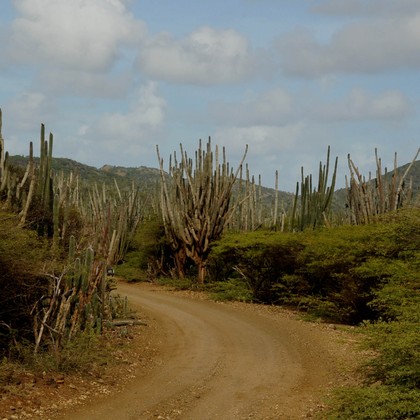
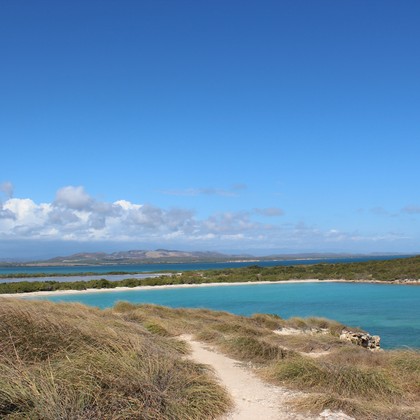
Dry deciduous forest and dry coastal woodland with dense undergrowth, on slopes and in valleys near the coast. It forages low in vegetation, in leaf litter and in crevices in trunks and rocks for insects and spiders, and quickly disappears into cover when disturbed.
Where the bird is most at home, classified by the vegetation types of the Caribbean.


Range and movements
Only on Saint Lucia, in a few separate areas of dry forest, mainly in the north and northeast (around Grande Anse and the Iyanola area) and locally in the southwest. It is absent from the wet, forested mountain slopes of the interior and from built-up areas. It does not occur outside Saint Lucia.
- Resident
- dark = core range, pale = thinly spread
How and when to look
Best early in the morning in the dry coastal forest of the northeast, where the song is the first clue. A local guide who knows the territories greatly improves the chances.
Conservation status
Not yet assessed by IUCN (NE), as the species was only split in 2024. A playback survey in 1997 found 59 birds in four separate populations, and the total was estimated at about one hundred birds. With such a small population on a single island and loss of dry coastal forest, a high threat category in a future assessment is likely.
Scientific name
Troglodytes mesoleucus | (Sclater, 1876)
Sclater described the species in 1876 as Thryothorus mesoleucus; because it was later moved to another genus, the author and year stand in brackets. The genus Troglodytes was introduced in 1809 by Vieillot. Troglodytes is Greek, from troglē 'hole, crevice' and dyein 'to creep into': 'cave-dweller', after the habit of disappearing into crevices and holes while foraging. mesoleucus is Greek, from mesos 'middle' and leukos 'white', after the white centre of the underparts. The specimen the first description was based on came from Saint Lucia.