All species › Waders, gulls and terns › Gulls and terns › Sooty Tern
Sooty Tern | Onychoprion fuscatus
Bonte stern | Charrán sombrío
The Sooty Tern is the most numerous seabird of the tropical oceans. It forms dense, noisy colonies of sometimes tens of thousands of pairs on remote cays and outside the breeding season is almost constantly on the wing: its plumage is poorly waterproof and it does not rest on the water. It feeds by picking prey from the surface, not by diving.
Voice
At and above the colony, day and night, a nasal, three-syllabled ker-wack-a-wack or wide-a-wake, the source of its old name wideawake; also harsh alarm calls.
Recording: AUDEVARD Aurélien — CC BY-NC-SA 4.0 · converted to mono · xeno-canto
Identification
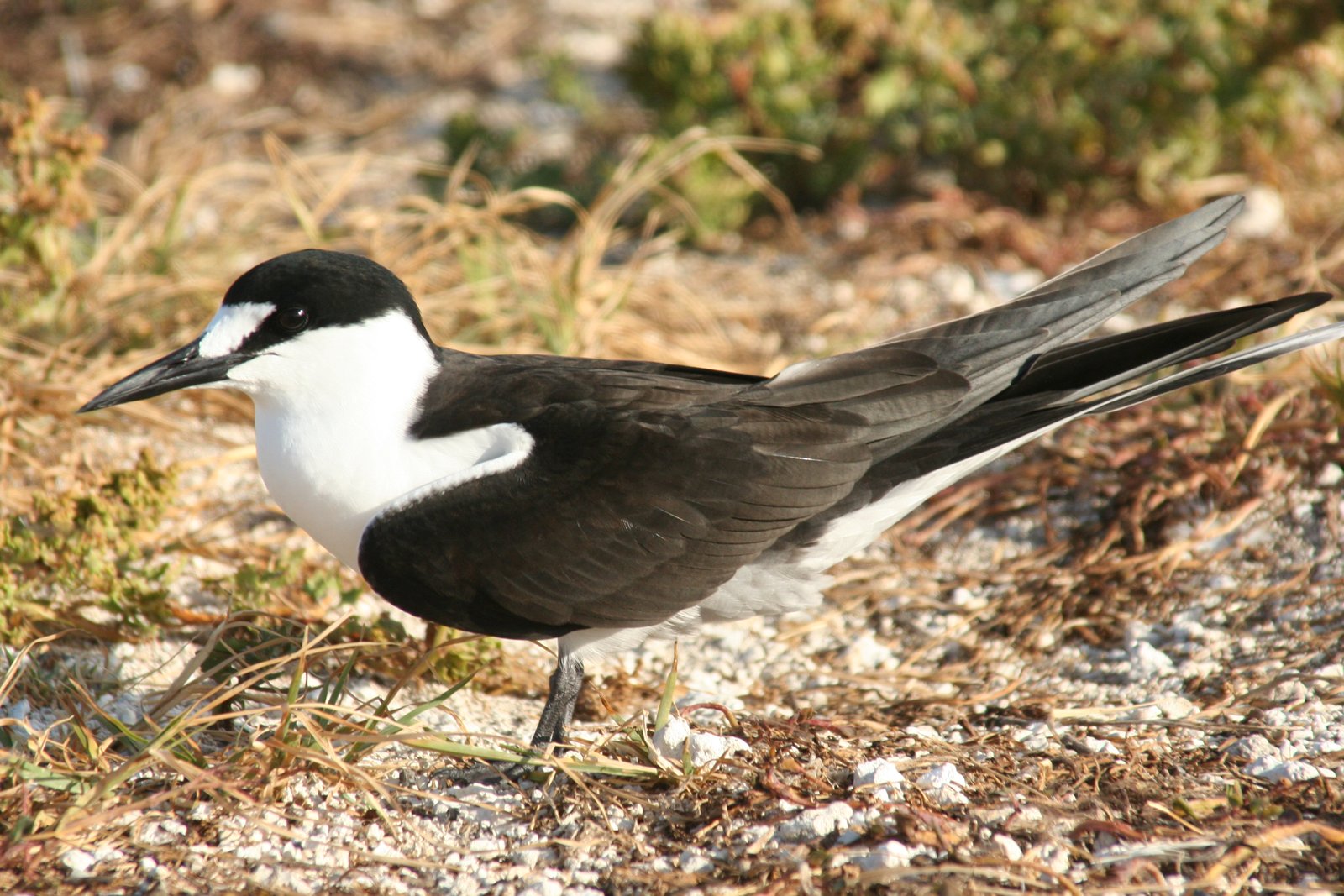
36–45 cm, with long, pointed wings and a deeply forked tail. Upperparts, wings and tail are black, with white outer edges to the tail. A broad white forehead patch reaches to above the eye but not beyond it, and a black loral stripe runs from eye to bill. Underparts white; the underwing has white coverts and contrasting dark flight feathers. Bill and legs black. The sexes are alike. Juveniles are sooty brown with white spots on the back and wings, a paler belly and undertail and a less deeply forked tail.
Confusion species
Bridled Tern Onychoprion anaethetus is smaller and slimmer, with a grey-brown back contrasting with the black cap, a white hindneck collar and a narrower white forehead patch extending behind the eye as a supercilium. Juvenile Sooty Terns resemble Brown Noddy Anous stolidus, which has a uniformly brown belly, a pale crown and a wedge-shaped tail.
Habitat
Open ocean, often far from land, where flocks feed over schools of tuna. It nests densely on the ground on flat sand and coral cays and rocky islets, among low vegetation or on bare ground; the single egg lies in a shallow scrape.
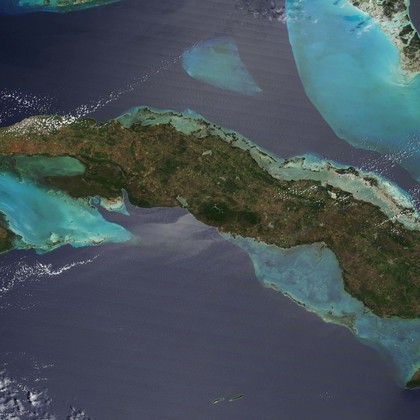
Where the bird is most at home, classified by the vegetation types of the Caribbean.


Range and movements
Large breeding colonies on remote islets throughout the region, including the Bahamas, the Turks and Caicos Islands, cays off Cuba and Jamaica (notably the Pedro and Morant Cays), around Puerto Rico (Culebra) and the Virgin Islands, in the Lesser Antilles (including off Anguilla and Antigua and in the Grenadines), off Aruba, off Tobago and around San Andrés. Elsewhere mostly seen over open sea. Beyond the region it breeds in all tropical and subtropical oceans, in the Atlantic also on the Dry Tortugas and Ascension.
- Resident
- Summer visitor (c. Oct–Mar)
- Passage (Mar–Apr, Oct–Nov)
- dark = core range, pale = thinly spread
How and when to look
Colonies are best viewed from a boat during the breeding season; landing disturbs the birds and is not allowed on many islets. At sea, flocks can be heard from far off. After storms birds are sometimes seen over land or in bays.
Conservation status
Not threatened. The world population numbers many millions. In the Caribbean, colonies have declined through egg collecting, which still occurs on some islands, and through introduced rats, cats and goats on breeding islands.
Scientific name
Onychoprion fuscatus | (Linnaeus, 1766)
Linnaeus described the species in 1766 as Sterna fuscata; because it was later moved to another genus, the author and year stand in brackets. The genus Onychoprion was introduced in 1832 by Wagler. Onychoprion comes from Greek onux 'nail, claw' and prion 'saw'. fuscatus is Latin for 'darkened', from fuscus 'dark', after the sooty upperparts. The specimen the first description was based on came from Santo Domingo.