All species › Tubenoses › Petrels and shearwaters › Sooty Shearwater
Sooty Shearwater | Ardenna grisea
Grauwe pijlstormvogel | Pardela sombría
The Sooty Shearwater is one of the most numerous seabirds in the world. Atlantic birds breed around Tierra del Fuego and on the Falkland Islands and, in the southern winter, travel north through the Atlantic and back in a great loop. In the Caribbean it is a scarce passage migrant that seldom comes close to shore.
Voice
Almost silent at sea; sometimes harsh calls when competing for food. At the colony, moaning and cooing calls at night.
Recording: David Boyle — CC BY-NC-SA 4.0 · shortened to the first 60 s, mono · xeno-canto
Identification
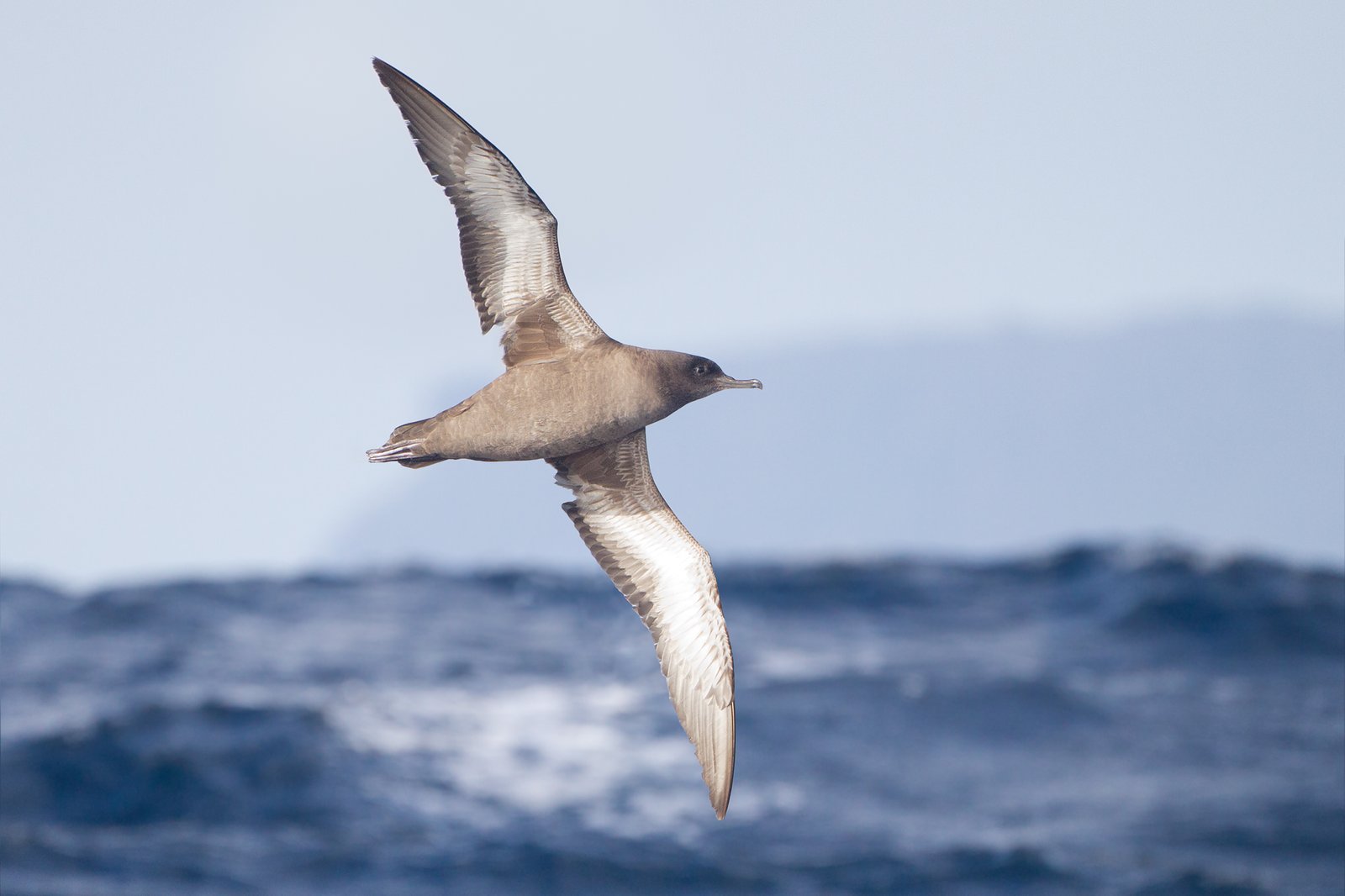
40–51 cm. A large, all-dark shearwater with long, narrow wings set well back and a fairly short body. The plumage is dark chocolate-brown, slightly paler below. The underwing coverts form a silvery-grey to whitish panel along the centre of the underwing, which flashes as the bird banks. Bill long, slender and dark; legs dark. It flies with quick, stiff wingbeats and long glides, in high arcs in strong wind. The sexes are alike.
Confusion species
No other large shearwater in the region is all dark. Dark jaegers such as Pomarine Jaeger Stercorarius pomarinus have broader wings with a white flash at the base of the primaries, also on the upperwing, and a more active flight. Dark Trindade Petrels Pterodroma arminjoniana have a short, thick bill, a fairly long tail and a pale patch at the base of the primaries instead of a silvery central panel.
Habitat
Open ocean, over deep water as well as the continental shelf; it sometimes follows ships. It eats fish, squid and krill, taken at the surface or in dives to several tens of metres. It breeds in burrows on vegetated islands in the southern hemisphere.
Where the bird is most at home, classified by the vegetation types of the Caribbean.

Range and movements
A scarce passage migrant at sea around the region, mainly on northward migration in May and June; there are records from, among others, the Bahamas, Puerto Rico and the Lesser Antilles. Most birds pass east of the island chain over the open ocean. The range map shows presence in the northern summer; these are non-breeding migrants. Beyond the region it breeds around New Zealand and southern Australia, in southern Chile, around Tierra del Fuego and on the Falklands, and ranges through the Atlantic and Pacific into subarctic waters.
- Summer visitor (c. Oct–Mar)
- dark = core range, pale = thinly spread
How and when to look
Chances are best on pelagic trips and during seawatches from headlands in the Lesser Antilles in May and June. An all-dark shearwater with a silvery central panel on the underwing is almost certainly this species.
Conservation status
Near Threatened according to the IUCN. The world population still numbers many millions of birds but has declined in recent decades. Causes include bycatch in fisheries, the harvest of chicks in New Zealand and changes in food supply as the ocean warms.
Scientific name
Ardenna grisea | (Gmelin, 1789) (GBIF: Puffinus griseus)
Gmelin described the species in 1789 as Procellaria grisea; because it was later moved to another genus, the author and year stand in brackets. The genus Ardenna was introduced in 1853 by Reichenbach. Ardenna goes back to Artenna, the spelling the Italian naturalist Ulisse Aldrovandi used for a seabird in 1603 and which Reichenbach cited when naming the genus. grisea is medieval Latin for 'grey'. The specimen the first description was based on came from New Zealand.