All species › Tubenoses › Petrels and shearwaters › Great Shearwater
Great Shearwater | Ardenna gravis
Grote pijlstormvogel | Pardela capirotada
The Great Shearwater breeds almost exclusively on a few islands in the South Atlantic, in the Tristan da Cunha group and on Gough. After breeding almost the entire population moves north along the east coast of South and North America, crosses the Atlantic in late summer and returns south past Europe and Africa. The Caribbean lies at the western edge of the northward route.
Voice
Usually silent at sea, but groups at food or around fishing boats give harsh, bleating calls. At the colony, plaintive, moaning calls at night.
Recording: Sven Normant — CC BY-NC-SA 4.0 · converted to mono · xeno-canto
Identification
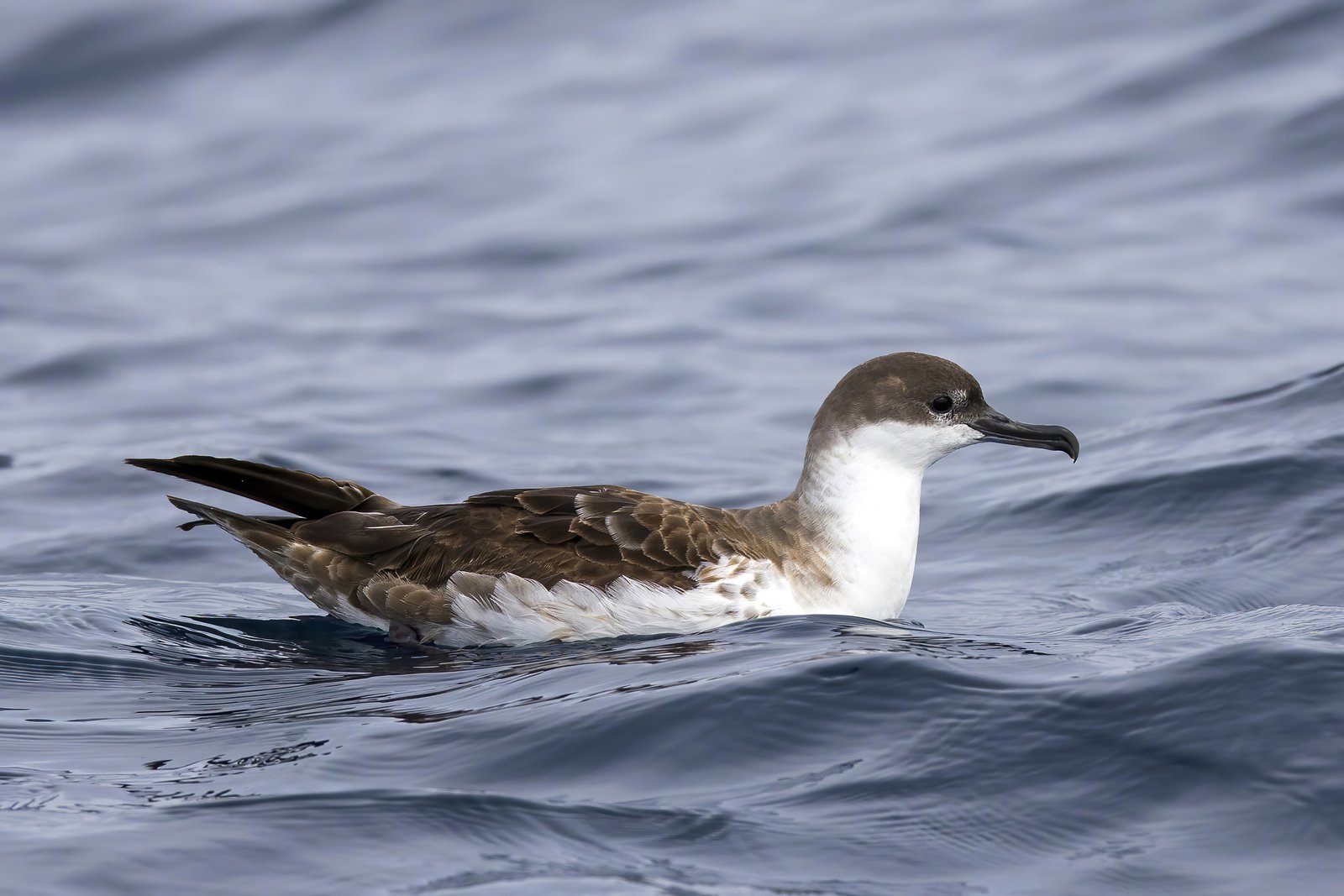
43–51 cm. A large shearwater with a sharply defined dark cap reaching below the eye, contrasting with the white throat and an almost complete white collar. Upperparts grey-brown with pale fringes, giving a scaly pattern; a narrow white band across the uppertail coverts forms a horseshoe above the dark tail. Underparts white with a dusky brown patch in the centre of the belly and dark undertail coverts. Underwing white with dark marks across the axillaries and coverts and a dark trailing edge. Bill slender and dark. The flight is powerful, with quick, stiff beats and long glides. The sexes are alike.
Confusion species
Scopoli's Shearwater Calonectris diomedea and Cory's Shearwater Calonectris borealis have a yellow bill, a head that merges gradually into the white throat, no collar or belly patch and a more relaxed flight. Black-capped Petrel Pterodroma hasitata also has a dark cap and white on the neck and rump, but is smaller, with a short, thick bill, a white forehead, a broad white rump and a much higher, swinging flight.
Habitat
Open ocean; in the region almost only far offshore. It eats fish and squid, taken at the surface or by diving, and follows fishing boats and whales. It breeds in burrows among tussock grass and ferns on the breeding islands.
Where the bird is most at home, classified by the vegetation types of the Caribbean.

Range and movements
A scarce passage migrant at sea, mainly from May to July during northward migration. Most records come from waters around the Lesser Antilles; it is rare around the Bahamas, the Greater Antilles and the Virgin Islands. The range map shows presence in the northern summer; these are non-breeding migrants. Beyond the region it breeds on Tristan da Cunha, Nightingale, Inaccessible and Gough, and in small numbers on the Falklands. In the northern summer most birds stay in the north-western Atlantic, including off Newfoundland and in the Gulf of Maine.
- Summer visitor (c. Oct–Mar)
- dark = core range, pale = thinly spread
How and when to look
A chance exists almost only on pelagic trips or seawatches in May and June. The dark cap with white collar and the white horseshoe on the rump are visible even at a distance.
Conservation status
Not threatened. The population numbers several million pairs but is concentrated on a few islands, which makes the species vulnerable to introduced mammals at the colonies. At sea birds die as bycatch in fisheries and from swallowing plastic.
Scientific name
Ardenna gravis | (O'Reilly, 1818) (GBIF: Puffinus gravis)
O'Reilly described the species in 1818 as Procellaria Gravis; because it was later moved to another genus, the author and year stand in brackets. The genus Ardenna was introduced in 1853 by Reichenbach. Ardenna goes back to Artenna, the spelling the Italian naturalist Ulisse Aldrovandi used for a seabird in 1603 and which Reichenbach cited when naming the genus. gravis is Latin for 'heavy' or 'weighty'. The specimen the first description was based on came from Cape Farewell, Greenland.