All species › Passerines › Typical antbirds › Silvered Antbird
Silvered Antbird | Sclateria naevia
Mangrovemiervogel | Hormiguero plateado
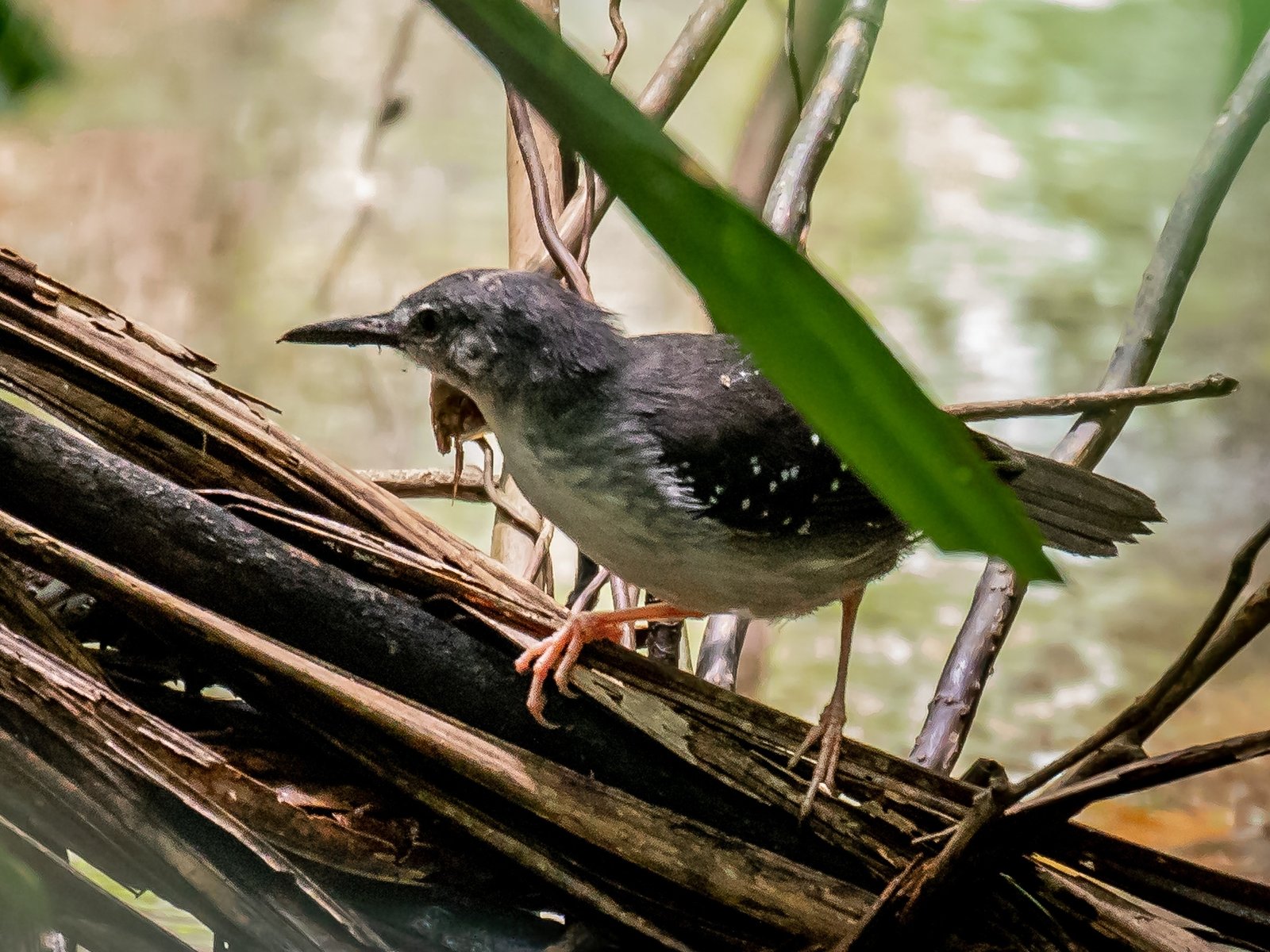
The Silvered Antbird is a grey-and-white antbird of flooded forest and stream banks that lives low down near the water. In the region it occurs only in Trinidad, where it is scarce and local. Despite its Dutch name (mangrovemiervogel) it is not a typical mangrove bird: it lives mainly in freshwater swamp forest and along forest streams.
Voice
The song is a long, rapid trill of abrupt notes that builds in intensity and drops steeply at the end. Also short pit calls and a long downslurred whistle.
Recording: Jacob Wijpkema — CC BY-NC-SA 4.0 · shortened to the first 60 s, mono · xeno-canto
Identification
14–16 cm, with a long, thin bill and a fairly short tail. The male has a dark grey crown, nape and upperparts; wings and tail are blackish grey, with white tips to the wing-coverts forming two rows of spots. The face is mostly dark grey with a paler supercilium. The underparts are mostly white, with grey scalloping on the sides. The female has the same pattern but is greyish brown instead of grey and has cinnamon tips to the wing-coverts. Young males resemble females.
Confusion species
White-bellied Antbird Myrmeciza longipes is rufous above, with a black (male) or buff (female) breast, and lives on the floor of drier forest. Plain Antvireo Dysithamnus mentalis is smaller, bigger-headed and shorter-billed, with yellow on the belly.
Habitat
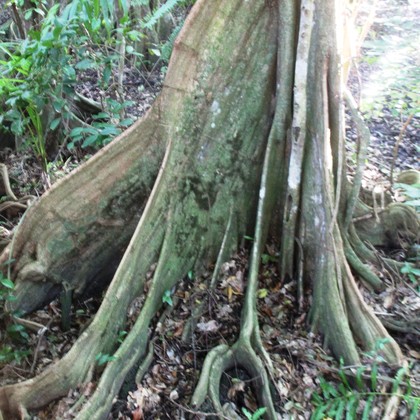
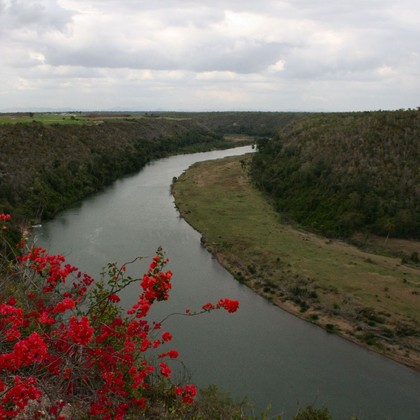
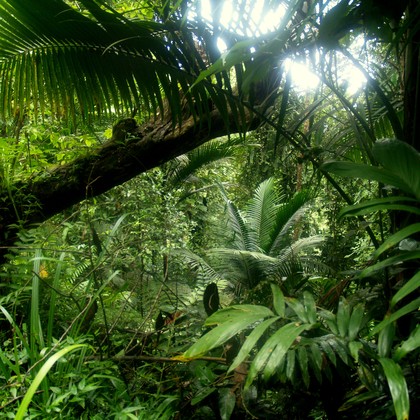
The understorey and floor of flooded and swampy forest, especially where dense vegetation overhangs water, and the banks of lowland forest streams. It forages low near the water, on fallen trunks, roots and muddy ground, for insects and spiders.
Where the bird is most at home, classified by the vegetation types of the Caribbean.
Range and movements
In Trinidad a rare and local resident of lowland swamp forest; Nariva Swamp is considered the best site. Absent from Tobago and the rest of the region. Outside the region across much of tropical South America east of the Andes, from Colombia and Venezuela to Bolivia and Brazil.
- Resident
- dark = core range, pale = thinly spread
How and when to look
In Trinidad best searched for in Nariva Swamp, along the edges of swamp forest and streams with overhanging vegetation. The trill is usually the first sign; the bird itself stays low and close to the water.
Conservation status
Not threatened. The species has a large range in South America. The small population in Trinidad depends on the survival of swamp forest, which is locally cleared and drained.
Scientific name
Sclateria naevia | (Gmelin, 1788)
Gmelin described the species in 1788 as Sitta naevia; because it was later moved to another genus, the author and year stand in brackets. The genus Sclateria was introduced in 1899 by Oberholser. Sclateria honours the British ornithologist Philip Lutley Sclater (1829–1913). naevia is Latin, from naevius 'spotted', after the speckled underparts. The specimen the first description was based on came from Suriname.