All species › Passerines › Typical antbirds › White-bellied Antbird
White-bellied Antbird | Myrmeciza longipes
Witbuikmiervogel | Hormiguero ventriblanco
The White-bellied Antbird is a long-legged antbird that lives mainly on or just above the forest floor. In the region it occurs only in Trinidad. Its loud, swelling song is a familiar forest sound, but the bird itself often stays hidden in the undergrowth. After a 2013 revision of the genus it is the only remaining species of Myrmeciza.
Voice
The male sings a bright, ringing series of 15 to 25 loud, rapid notes that first swells, then descends, fades and ends in a few chew notes on one pitch. The female sings a shorter version. Calls include a short liquid rattle and whistles.
Recording: Johan Chaves — CC BY-NC-SA 4.0 · converted to mono · xeno-canto
Identification
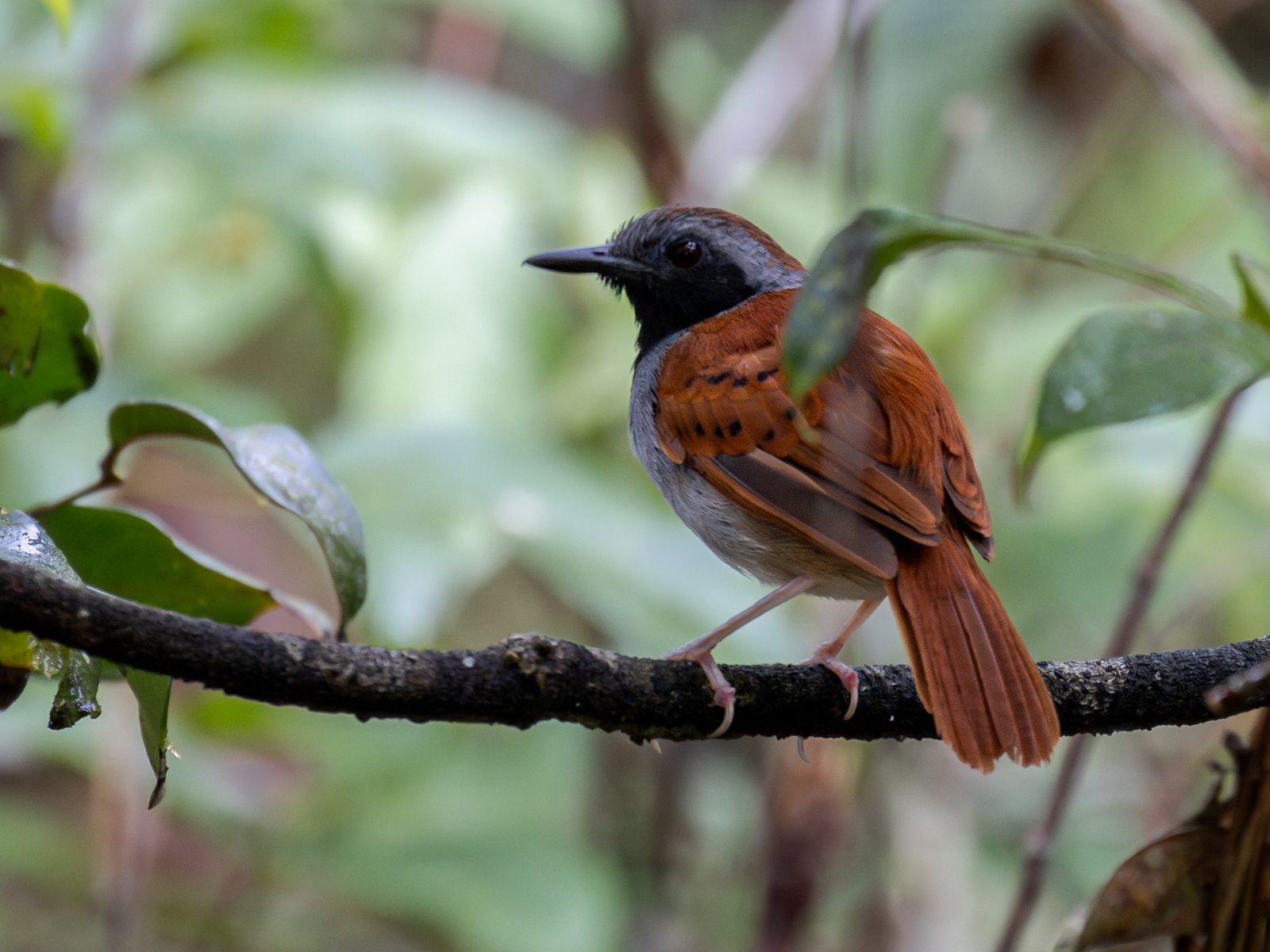
15–16 cm, with long, pale legs and a fairly short tail. The male is cinnamon-rufous on the crown, upperparts, wings and tail, with a hidden white patch between the shoulders. Sides of the head, throat and upper breast are black, bordered slate grey; lower breast and belly are white, the flanks tawny. The female shares the rufous upperparts, but has black bars on the wing-coverts and dark brown sides to the head; the chin is white, throat and upper breast ochraceous buff and the belly white with buff flanks.
Confusion species
Black-faced Antthrush Formicarius analis also walks on the forest floor, but is darker brown, with a short cocked tail and no white belly. Silvered Antbird Sclateria naevia is grey (male) or greyish brown (female), not rufous, and lives in swamp forest.
Habitat
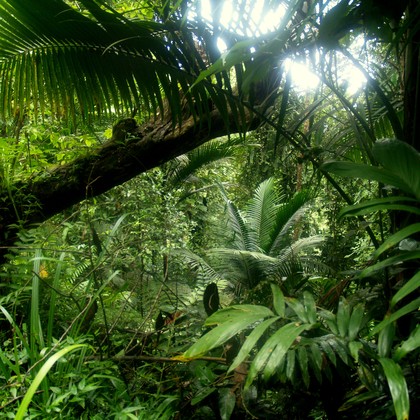
The floor and understorey of semi-evergreen and dry deciduous forest, also gallery forest, secondary forest and shaded cacao. It forages by walking on the ground and through the leaf litter for insects and other invertebrates.
Where the bird is most at home, classified by the vegetation types of the Caribbean.



Range and movements
In Trinidad a resident of the forested parts of the island; absent from Tobago and unknown elsewhere in the region. Outside the region in Panama, northern Colombia and Venezuela, the Guianas and northern Brazil.
- Resident
- dark = core range, pale = thinly spread
How and when to look
In Trinidad along forest trails in the Northern Range, including at the Asa Wright Nature Centre. On hearing the song it pays to stand still and scan the forest floor; the bird often walks in the open between the trunks.
Conservation status
Not threatened. The species has a large range and tolerates secondary forest.
Scientific name
Myrmeciza longipes | (Swainson, 1825)
Swainson described the species in 1825 as Drymophila longipes; because it was later moved to another genus, the author and year stand in brackets. The genus Myrmeciza was introduced in 1841 by Gray. Myrmeciza is Greek, from murmēx 'ant'; the second element is variously explained as 'to sit' or 'to lie in ambush', after antbirds foraging at army-ant swarms. longipes is Latin, from longus 'long' and pes 'foot', after the fairly long legs. The specimen the first description was based on came from Trinidad (designated; originally 'somewhere in Brazil').