All species › Hummingbirds and swifts › Swifts › Short-tailed Swift
Short-tailed Swift | Chaetura brachyura
Kortstaartgierzwaluw | Vencejo colicorto
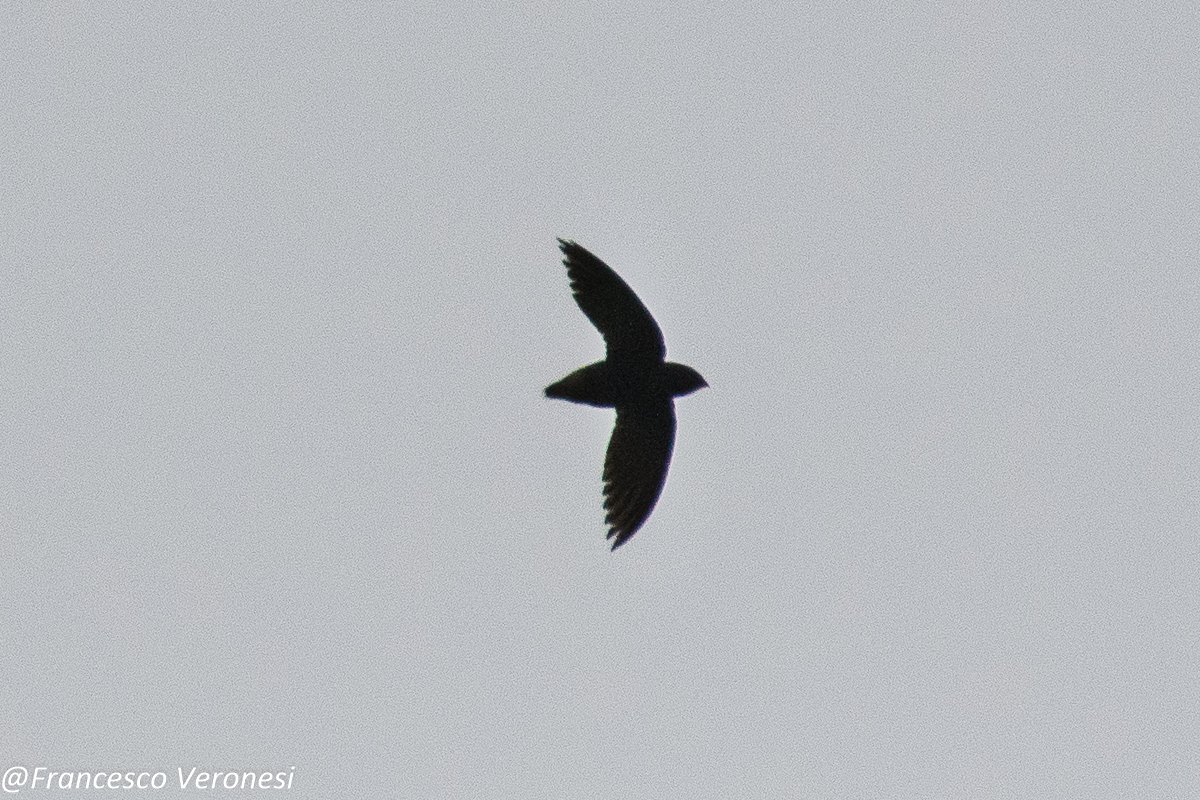
The Short-tailed Swift is a common swift of northern South America that inhabits the southernmost islands of the region. The birds on Grenada, St Vincent and Tobago are assigned to a separate subspecies, praevelox. With its very short tail and broad inner wing it has a flight silhouette unlike that of any other swift in the region.
Voice
A rapid, twittering series, sti-sti-stew-stew-stew, heard mainly from groups flying low.
Recording: JAYRSON ARAUJO DE OLIVEIRA — CC BY-NC-SA 4.0 · converted to mono · xeno-canto
Identification
10–11 cm, stocky, with a very short tail that barely projects beyond the trailing edge of the wing in flight. The wings are broad at the secondaries and narrow at the base, giving them a paddle-shaped outline. The plumage is mainly blackish brown, with a pale grey-brown rump and uppertail coverts that merge without a sharp border into the short tail; the undertail coverts are also pale. The throat is slightly paler than the rest of the underparts. The sexes are alike.
Confusion species
Grey-rumped Swift Chaetura cinereiventris has a longer tail, a glossy blue-black back and a grey rump sharply contrasting with the black tail. Band-rumped Swift Chaetura spinicaudus in Trinidad has a narrow whitish band across the rump and a longer tail. Lesser Antillean Swift Chaetura martinica, which occurs alongside Short-tailed Swift on St Vincent, is smaller and slimmer, with a longer tail and dark undertail. Chimney Swift Chaetura pelagica is uniformly dark, without a pale rump.
Habitat
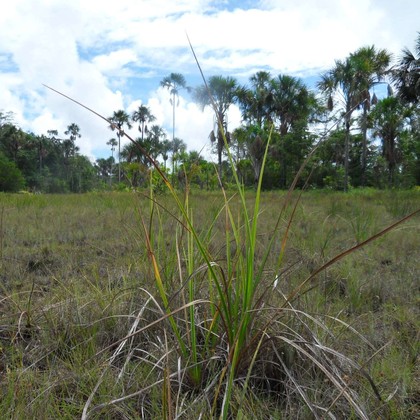
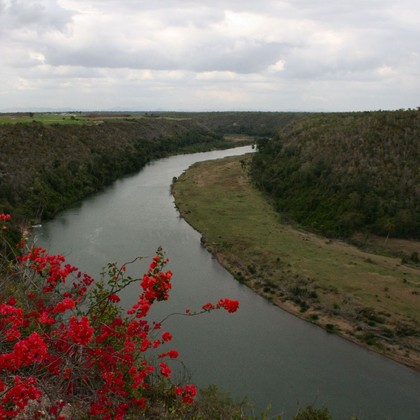
Hunts over open and semi-open lowland country: forest edges, open woodland, savanna, pasture and small-scale farmland, river valleys and villages. Usually below about 800 m. Feeds in groups, often with other swifts and swallows. Nests in hollow trees, caves, shafts and chimneys; the nest is a small, shallow half-cup of twigs glued with saliva to a vertical surface.
Where the bird is most at home, classified by the vegetation types of the Caribbean.




Range and movements
Resident in Trinidad and Tobago, Grenada and St Vincent; in Trinidad one of the commonest swifts. There are also reports from St Lucia and Martinique, where its status is unclear and confusion with Lesser Antillean Swift may play a part; a few single records are known from Guadeloupe, Barbados and the Virgin Islands. Outside the region from Panama, Colombia, Venezuela and the Guianas to Ecuador, Peru, Bolivia and Amazonian Brazil.
- Resident
- dark = core range, pale = thinly spread
How and when to look
In Trinidad, groups can be expected over open lowland country and forest edges, for example in the Northern Range and the Aripo Savanna; in Tobago and Grenada over valleys and villages. In flight the silhouette with its almost absent tail and broad trailing edge is the best feature.
Conservation status
Not threatened. The species has a very large range and is common over much of it. It also uses buildings and chimneys for nesting and benefits from open, human-made landscapes.
Scientific name
Chaetura brachyura | (Jardine, 1846)
Jardine described the species in 1846 as Acanthylis brachyura; because it was later moved to another genus, the author and year stand in brackets. The genus Chaetura was introduced in 1826 by Stephens. Chaetura is Greek, from khaitē 'hair, bristle' and oura 'tail', after the spiny projecting shafts of the tail feathers. brachyura is Greek, from brakhus 'short' and oura 'tail', after the very short tail. The specimen the first description was based on came from Tobago.