All species › Hummingbirds and swifts › Swifts › Antillean Palm Swift
Antillean Palm Swift | Tachornis phoenicobia
Antilliaanse palmgierzwaluw | Vencejito de palma
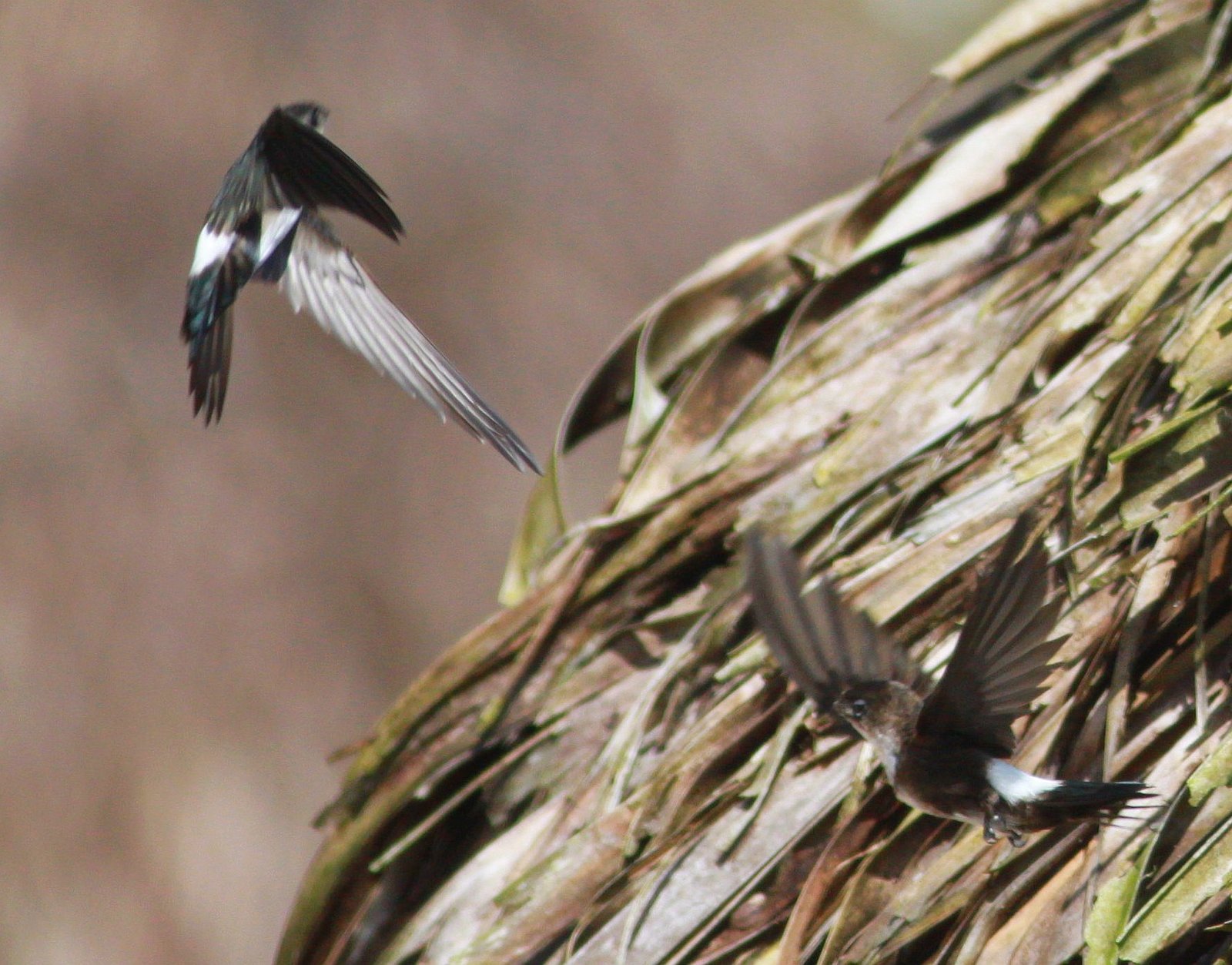
The Antillean Palm Swift is the smallest swift in the region and occurs only in Cuba, Jamaica and Hispaniola. It lives almost anywhere there are palms and hangs its nest from dead palm fronds. Small groups fly low and fluttering around palms, over fields and between houses, with a fast, erratic, somewhat bat-like flight. Two subspecies are recognised: iradii in Cuba and the Isla de la Juventud, and the nominate form in Jamaica and Hispaniola.
Voice
Very noisy. An almost continuous, weak, twittering tooee-tooee and high, trilling series, especially at nest sites and from groups in flight.
Recording: Zsombor Károlyi — CC BY-NC-SA 4.0 · converted to mono · xeno-canto
Identification
9–11 cm, very small and slender, with narrow wings and a slightly forked tail that is usually held closed. The upperparts are blackish brown, the crown and nape slightly browner, with a distinctive white band across the rump. Throat and belly are dull white; the sides of the breast, flanks and undertail coverts are darker. The sexes are alike. Juveniles are duller, with less clean white underparts. The Cuban subspecies is slightly larger, with a more deeply forked tail.
Confusion species
Its size, white rump and pale underparts rule out confusion with any other swift on these islands. Chimney Swift Chaetura pelagica, a passage migrant, is larger and uniformly dark. American Black Swift Cypseloides niger and White-collared Swift Streptoprocne zonaris are much larger and usually fly higher. Cave Swallow Petrochelidon fulva also has a pale rump, but it is rufous-buff, and it has broader wings and a gliding swallow flight.
Habitat
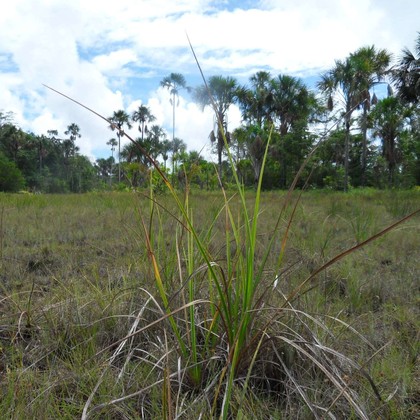
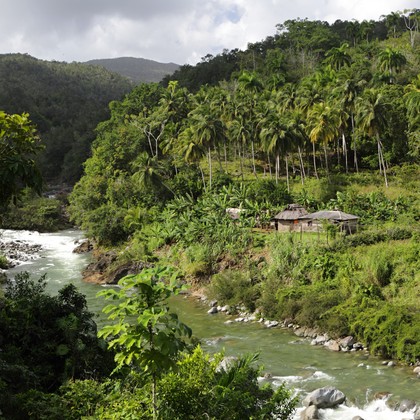
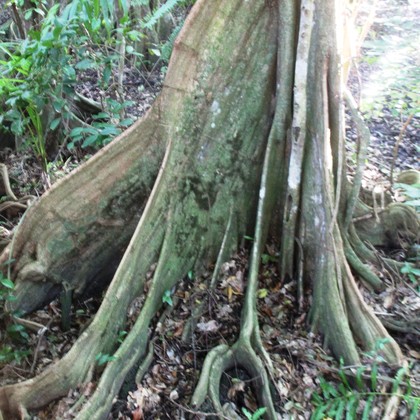
Open and semi-open country with palms: palm savanna, pasture and farmland with scattered royal palms, coconut plantations, dry forest and scrub, palm swamps, and villages and towns with palms in parks and along streets. From sea level to about 1700 m. It hunts small flying insects low down. The nest is a hanging pouch of plant fibres and feathers, glued with saliva to each other and to the underside of a dead palm frond; several pairs often nest in the same palm.
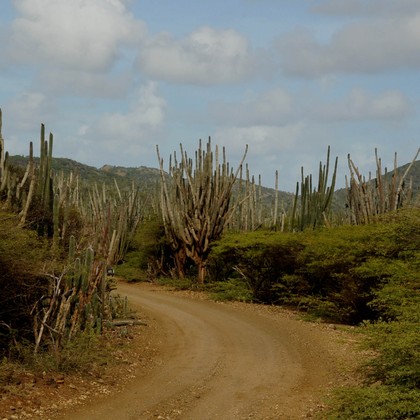
Where the bird is most at home, classified by the vegetation types of the Caribbean.



Range and movements
Resident in Cuba and the Isla de la Juventud, Jamaica and Hispaniola (Haiti and the Dominican Republic), including a number of smaller offshore islands. Recorded only as a vagrant in Puerto Rico, the Bahamas, the Cayman Islands and the Turks and Caicos Islands, although there are repeated reports from Puerto Rico and the Bahamas. Outside the region a vagrant to Florida.
- Resident
- dark = core range, pale = thinly spread
How and when to look
Seen around palms in almost any village or town park in Cuba, Jamaica and Hispaniola; groups are most active early in the morning and late in the afternoon. At a palm with dead, hanging fronds the birds can often be watched flying in and out of their nests.
Conservation status
Not threatened. The species is common and adapts well to human-altered landscapes as long as palms remain. Locally, the removal of dead palm fronds can destroy nests.
Scientific name
Tachornis phoenicobia | Gosse, 1847
Gosse described the species in 1847 and placed it straight away in the genus where it still stands. He introduced the genus Tachornis in that same work. Tachornis is Greek, from takhus 'fast' and ornis 'bird': 'fast bird'. phoenicobia is Greek, from phoinix 'palm tree' and bios 'life': 'palm-dwelling', after its nests in palm fronds. The specimen the first description was based on came from Jamaica.