All species › Birds of prey › Hawks, eagles and kites › Sharp-shinned Hawk
Sharp-shinned Hawk | Accipiter striatus
Amerikaanse sperwer | Gavilán americano
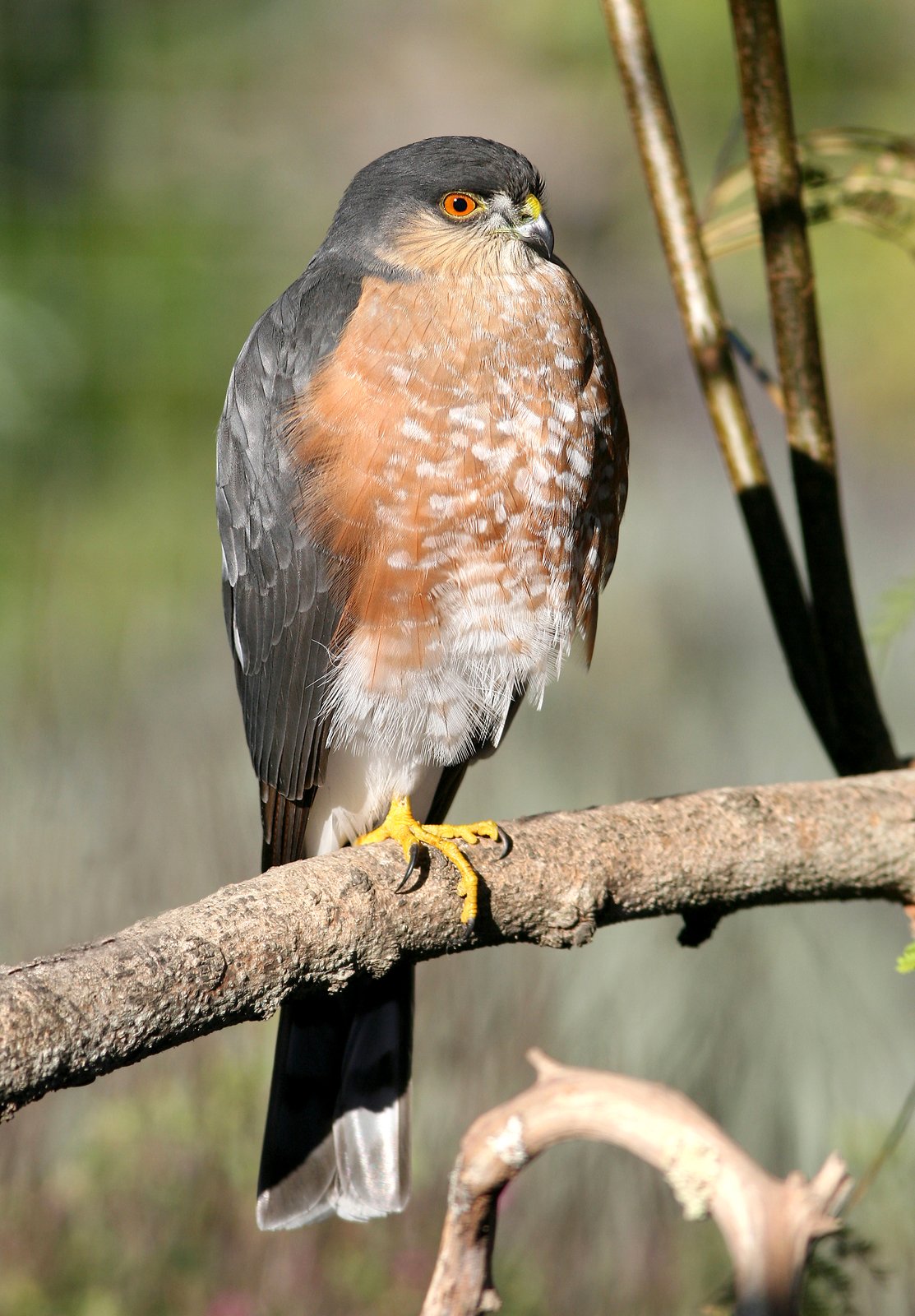
The Sharp-shinned Hawk is the smallest hawk in the Americas and a specialist in catching small birds. In the Greater Antilles three subspecies of their own are resident in montane forest: fringilloides on Cuba, the nominate striatus on Hispaniola and venator on Puerto Rico. On the basis of genetic work these island forms have been proposed as separate species, but this has not yet been adopted. In winter migrants from North America join them.
Voice
Usually silent outside the breeding season. At the nest a high, rapid kee-kee-kee-kee or kek-kek-kek, loud and persistent when disturbed.
Recording: Stanislas Wroza — CC BY-NC-SA 4.0 · converted to mono · xeno-canto
Identification
23–37 cm, with short, rounded wings, a long, square-ended tail and long, very thin legs. The female is clearly larger than the male. Adults have a dark cap and blue-grey upperparts; the underparts are white with fine rufous bars, and the iris is orange to red. The grey tail has three or four dark bands and a narrow white tip. Juveniles are brown above with rufous feather edges and have white underparts with brown or rufous streaks, and a yellow iris. In flight a typical rhythm of a few quick wingbeats alternating with a short glide.
Confusion species
On Cuba, Gundlach's Hawk Astur gundlachi is much larger, with a rounded tail, a black cap and a heavier build. Broad-winged Hawk Buteo platypterus has broader wings, a shorter tail with broad white bands and soars more. Merlin Falco columbarius and American Kestrel Falco sparverius are falcons with pointed wings, dark eyes and faster, direct flight.
Habitat
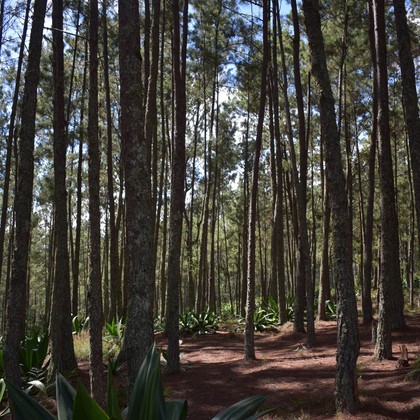
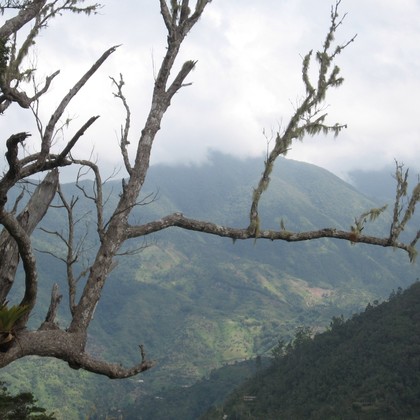
Residents live in montane forest: pine forest, montane rainforest, cloud forest and semi-evergreen forest, on Puerto Rico also in shade-coffee plantations, and on Cuba and Hispaniola also in lower-lying forest. Winter visitors occur in almost any wooded landscape, including dry forest, parks and gardens. It hunts by surprise, from cover or in low flight along forest edges, almost exclusively for small songbirds. The nest is a stick platform in a dense tree, often a conifer.
Where the bird is most at home, classified by the vegetation types of the Caribbean.





Range and movements
Resident on Cuba (mainly in the mountains of the west and east), Hispaniola (Haiti and the Dominican Republic, mainly in the Cordillera Central, Sierra de Neiba and Sierra de Bahoruco) and Puerto Rico (mainly the montane forests of the Cordillera Central). As a winter visitor in the Bahamas, Cuba, the Cayman Islands, the Turks and Caicos Islands and San Andrés, rare elsewhere. Outside the region it breeds from Alaska and Canada to Mexico; related forms live in Central and South America.
- Resident
- Summer visitor (c. Oct–Mar)
- Winter visitor (c. Apr–Sep)
- Passage (Mar–Apr, Oct–Nov)
- dark = core range, pale = thinly spread
How and when to look
Residents are most visible early in the breeding season, when they soar and display over ridges in the morning, for example in the pine forests of the Sierra de Bahoruco or in the Maricao and Toro Negro forest reserves on Puerto Rico. Winter visitors often give themselves away when small birds suddenly alarm or scatter.
Conservation status
Not threatened as a species, but the island forms are under pressure. The Puerto Rico subspecies is listed as endangered in the United States and has declined sharply; on Hispaniola the species is uncommon, local and decreasing, and on Cuba uncommon and local. Deforestation in the mountains is the main threat.
Scientific name
Accipiter striatus | Vieillot, 1808
Vieillot described the species in 1808 and placed it straight away in the genus where it still stands. The genus Accipiter was introduced in 1760 by Brisson. Accipiter is the Latin word for 'hawk', from accipere, 'to grasp'. striatus is Latin for 'striped', after the streaked and barred underparts. The specimen the first description was based on came from Santo Domingo, Dominican Republic.