All species › Passerines › Mockingbirds and thrashers › St. Lucia Thrasher
St. Lucia Thrasher | Ramphocinclus sanctaeluciae
Sint-Luciaspotlijster | Cuitlacoche de Santa Lucía
The St. Lucia Thrasher is a two-toned thrasher of the dry forest on the east coast of Saint Lucia. Described as a separate species in 1887, it was later merged with the Martinique birds as White-breasted Thrasher, and since 2024 it has again been treated as a species in its own right. Most of the world population of the former combined species lives on Saint Lucia.
Voice
Usually silent. When defending its territory against its own kind and other birds, it gives rough, harsh calls and a rasping alarm. It then cocks its tail and droops and quivers its wings, much like a trembler. The song is inconspicuous.
Recording: Paul Driver — CC BY-NC-SA 4.0 · Converted to mp3, mono, full length · xeno-canto
Identification
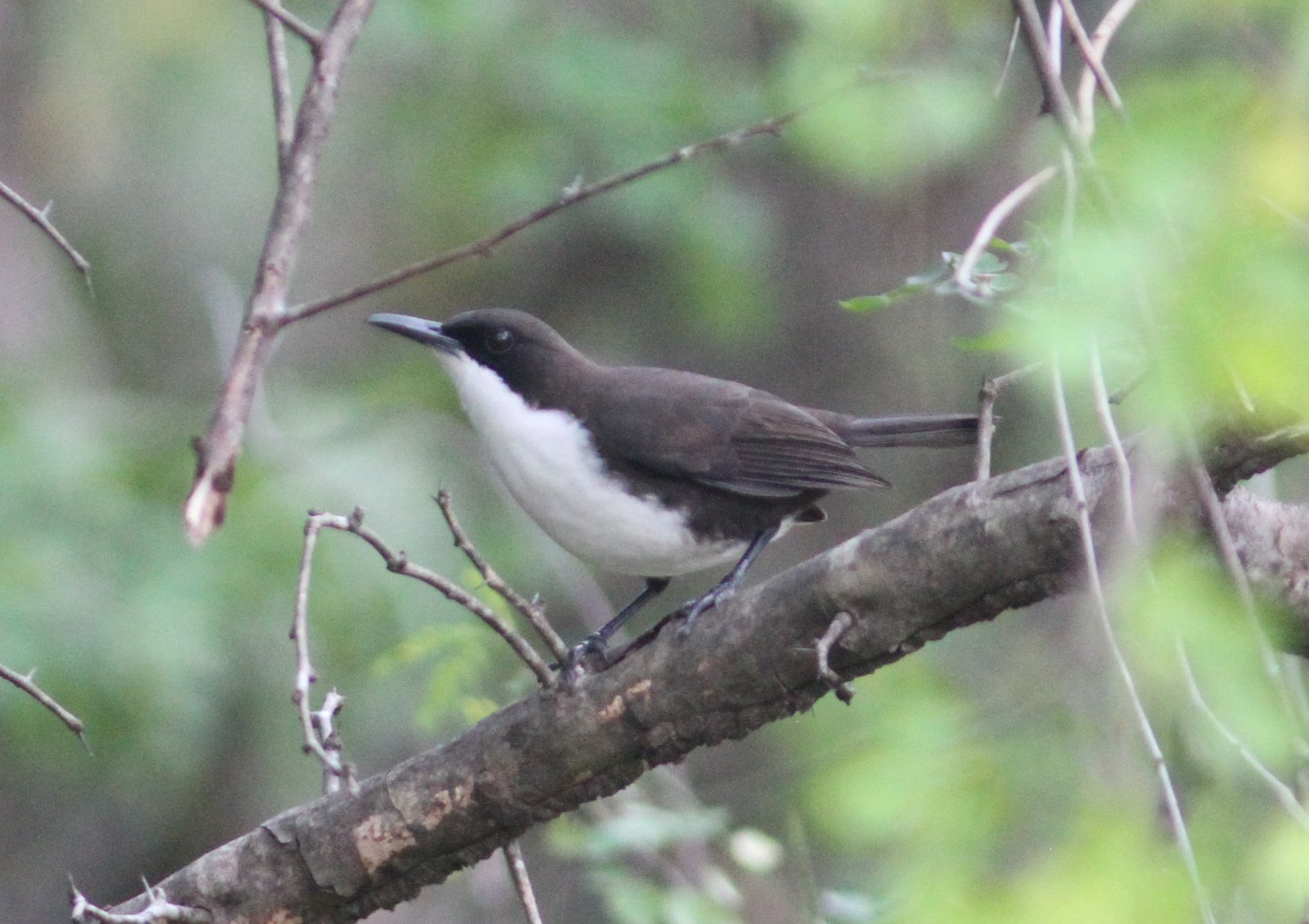
23–25 cm, with a fairly short tail, long dark legs and a long, slightly curved black bill. Upperparts, head and tail are plain dark brown; throat, breast and belly are pure white, sharply set off against the brown sides of the head and flanks. The iris is red. The sexes are alike. Immatures are more uniformly dark brown and first acquire a creamy white breast patch. Compared with Martinique Thrasher Ramphocinclus brachyurus slightly larger and warmer brown above.
Confusion species
On Saint Lucia, the combination of dark brown upperparts, pure white underparts and red iris is unique. Scaly-breasted Thrasher Allenia fusca has a spotted breast, a white wing bar and a pale iris. Pearly-eyed Thrasher Margarops fuscatus is larger, with a white iris, a heavy pale bill and scaled underparts. Grey Trembler Cinclocerthia gutturalis is grey-brown with a long bill and a yellow iris. Tropical Mockingbird Mimus gilvus is grey above, with a long, white-cornered tail, and lives in open country.
Habitat
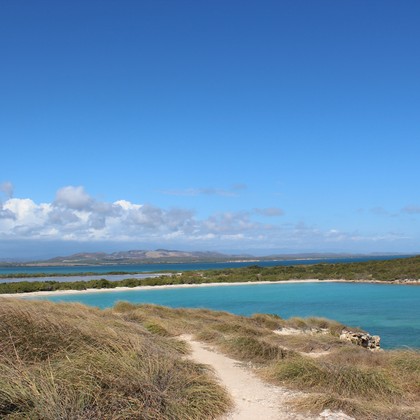
Dry deciduous forest and dense coastal woodland in the ravines and on the slopes of the east coast, in places with a thick layer of leaf litter and little undergrowth. It forages on the ground, walking and tossing leaves aside in search of invertebrates. It nests in trees 2–6 m up, often along streams in the ravines.
Where the bird is most at home, classified by the vegetation types of the Caribbean.


Range and movements
Only on Saint Lucia, in two separate areas on the east coast about 3 km apart: Mandelé, which holds most of the population, and Iyanola in the northeast. There is no evidence of birds moving between the two. The related Martinique Thrasher lives only on the Caravelle Peninsula of Martinique.
- Resident
- dark = core range, pale = thinly spread
How and when to look
The species lives mainly on private and little-accessible land; a local guide or the Saint Lucia forestry department knows where the birds are. Best early in the morning in dry ravines, where rustling in the leaf litter often gives the bird away before its call.
Conservation status
Endangered. An estimate from 2016 put the population at about 1,130 mature individuals, in a small, fragmented area of which little is protected. The main threat is loss and fragmentation of coastal dry forest through clearance, agriculture and development; in addition, introduced mammals and the native St. Lucia lancehead take eggs and young. A conservation plan exists for the Saint Lucia population.
Scientific name
Ramphocinclus sanctaeluciae | Cory, 1887
Cory described the species in 1887 and placed it straight away in the genus where it still stands. The genus Ramphocinclus was introduced in 1843 by De Lafresnaye. Ramphocinclus is Greek, from rhamphos 'bill' and kinklos 'thrush': a thrush-like bird with a prominent, slightly curved bill. sanctaeluciae means 'of Saint Lucia', the island where this thrasher lives. The specimen the first description was based on came from Saint Lucia.