All species › Passerines › Vireos › San Andres Vireo
San Andres Vireo | Vireo caribaeus
San-Andrésvireo | Vireo de San Andrés
The San Andres Vireo occurs only on San Andrés, an island of about 13 by 4 km in the south-western Caribbean Sea that belongs to Colombia but lies closer to Nicaragua. It is one of the commonest birds on the island, but its tiny range makes it vulnerable. It is related to Mangrove Vireo Vireo pallens of the Central American mainland and has sometimes been treated as a subspecies of it.
Voice
Three types of vocalisation are known: a one-syllable chatter, a repeated two-syllable song and a three-syllable song. Singing birds repeat a motif many times in succession.
Recording: GABRIEL LEITE — CC BY-NC-SA 4.0 · converted to mono · xeno-canto
Identification
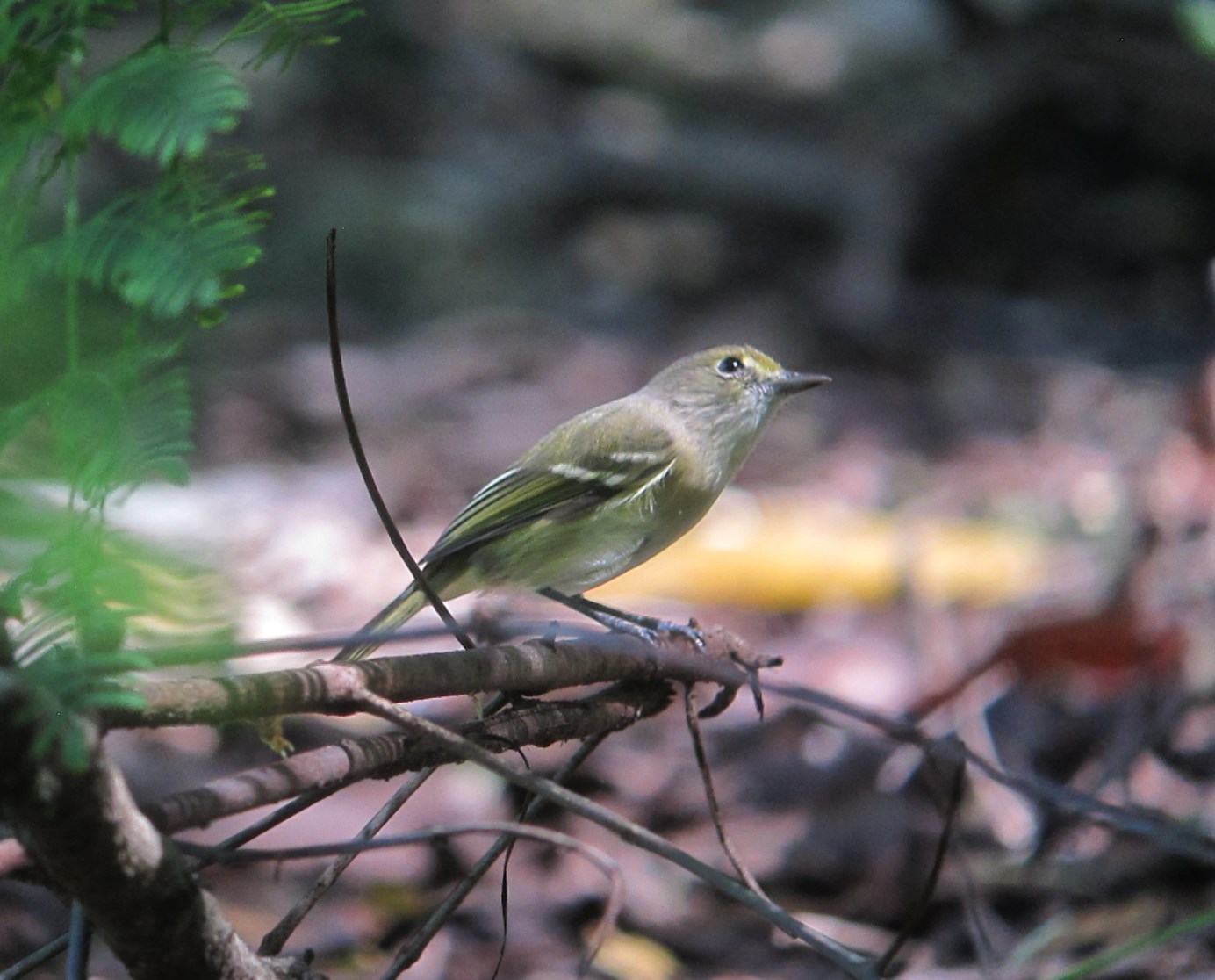
About 12.5 cm. The upperparts are olive-green, the underparts whitish to pale yellow. The wing has two white wing bars, and the flight feathers have pale edges. The lores are pale yellow, the iris grey-brown. The bill is slightly slimmer and darker than that of Mangrove Vireo. The sexes are alike.
Confusion species
No other resident vireo occurs on San Andrés. On nearby Providencia lives Thick-billed Vireo Vireo crassirostris, with a heavier bill. Vireos passing the island on migration, such as Red-eyed Vireo Vireo olivaceus, are larger, lack wing bars and have a grey crown with a white supercilium. Mangrove Warbler Setophaga petechia is yellower, without white wing bars, and has a thinner, pointed bill.
Habitat
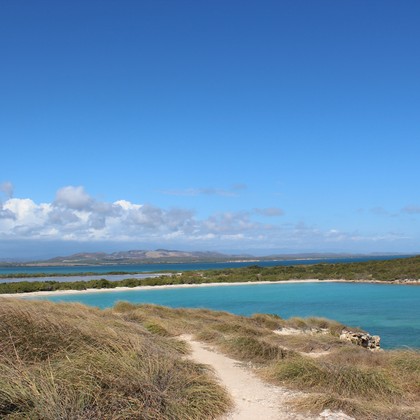
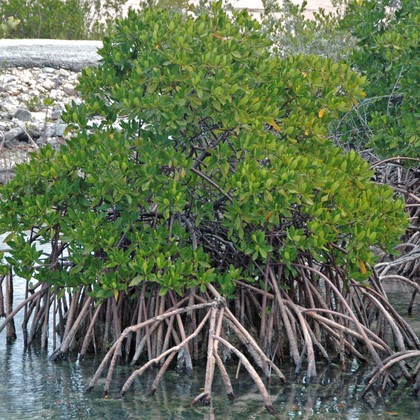
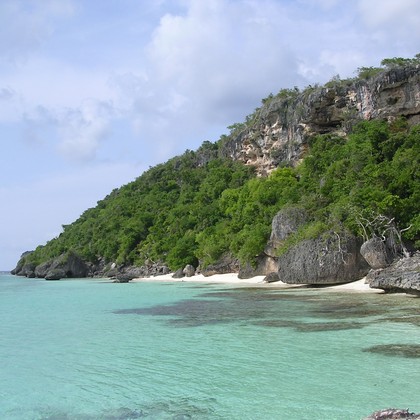
Brushy pastures, dense scrub, overgrown cacao and coconut plots, groves with a dense understorey and the inland mangroves of the island. It forages from just above the ground to about 5 m, occasionally up to 10 m in tall trees, for arthropods and caterpillars. Territories are small, around half a hectare; nests have been found in the fork of a mangrove branch at 1–2 m.
Where the bird is most at home, classified by the vegetation types of the Caribbean.


Range and movements
Only on San Andrés (Colombia). It is concentrated in the less built-up southern part of the island, but has also been recorded in the centre and north. A mention for Providencia is not supported by evidence. The species does not occur outside San Andrés.
- Resident
- dark = core range, pale = thinly spread
How and when to look
In the southern part of San Andrés, in thickets along pastures and in the vegetation around the inland mangroves. The repeated song is the best lead; the bird feeds low down and in dense vegetation is noticed only when it moves.
Conservation status
Vulnerable. The world population is estimated at about 8,200 to 14,000 birds within at most a few tens of square kilometres. Habitat is shrinking through population growth and building, coconut plantations and damage to mangroves; the island is also exposed to hurricanes. The species does tolerate some degradation of the vegetation.
Scientific name
Vireo caribaeus | Bond & Meyer de Schauensee, 1942
Bond & Meyer de Schauensee described the species in 1942 and placed it straight away in the genus where it still stands. The genus Vireo was introduced in 1808 by Vieillot. Vireo was used by Latin authors for a small, green, migratory bird, probably the Eurasian golden oriole, though the European greenfinch has also been suggested. caribaeus is Latin for 'Caribbean', after the island of San Andrés in the Caribbean Sea where the species lives. The specimen the first description was based on came from San Andrés, Colombia.