All species › Passerines › Wrens › Rufous-breasted Wren
Rufous-breasted Wren | Pheugopedius rutilus
Roodborstwinterkoning | Cucarachero pechirrufo
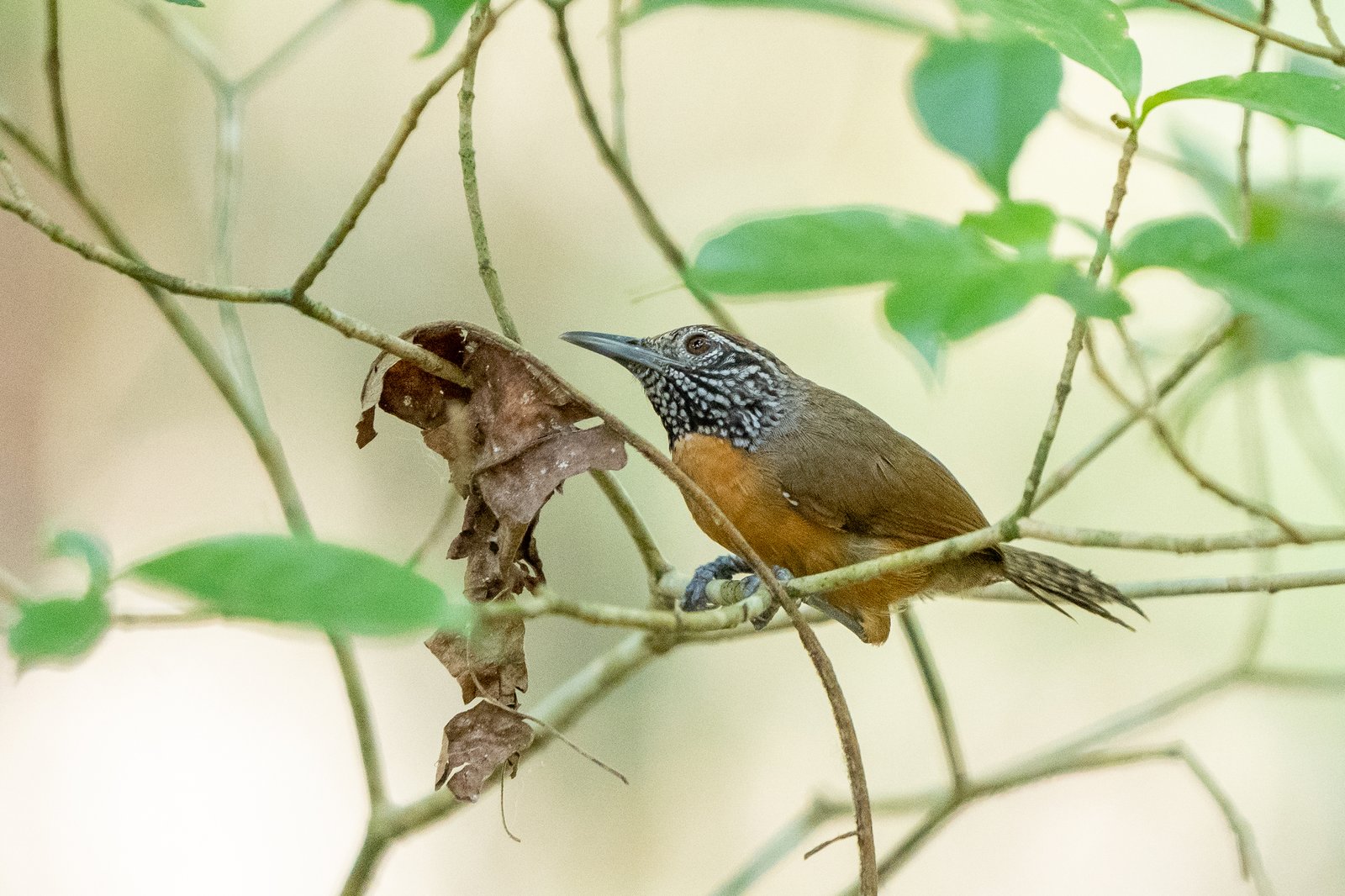
The Rufous-breasted Wren is a forest bird that in the Caribbean occurs only on Trinidad and Tobago. Pairs keep to dense undergrowth and vine tangles and often sing together in a rapid, alternating duet. Its speckled face and rufous breast make it distinctive within the genus Pheugopedius.
Voice
Loud and clear: short whistled phrases repeated several times before the bird switches to another motif, often as a duet in which male and female alternate at high speed. The call is a rasping, rattling churr.
Recording: Sue Riffe — CC BY-NC-SA 4.0 · converted to mono · xeno-canto
Identification
13–14 cm, a medium-sized wren with a straight, fairly long bill. Crown and upperparts are warm brown, the tail grey-brown with heavy dark bars. A white supercilium is bordered black above. Cheeks, chin and throat are finely speckled black and white. The breast is bright rufous, the belly duller grey-brown, the flanks brown. The sexes are alike. Tobago has its own subspecies, tobagensis; Trinidad birds belong to the nominate form.
Confusion species
Southern House Wren Troglodytes musculus is smaller and plain brown, without the speckled face and rufous breast, and lives mainly around houses and in open country. Trilling Gnatwren Ramphocaenus melanurus also forages in vine tangles, but has a much longer, thin bill and a long, slender tail that is often flicked.
Habitat
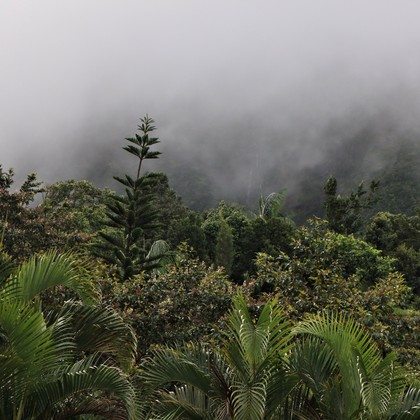
Humid lowland and hill forest, secondary forest, forest edges, clearings with vines and dense thickets, and neglected cocoa and coffee plantations, from sea level to the highest parts of the mountains. Pairs or family groups forage in the undergrowth and sometimes higher in the trees for insects and spiders. The nest is a large ball of leaves and grass with a side entrance, hidden in dense vegetation.
Where the bird is most at home, classified by the vegetation types of the Caribbean.



Range and movements
In the Caribbean only on Trinidad, mainly in the Northern Range and the forest tracts of the centre and south, and on Tobago, where it is common in the Main Ridge forest. Outside the region in Costa Rica, Panama, Colombia and Venezuela.
- Resident
- dark = core range, pale = thinly spread
How and when to look
Along forest trails in the Northern Range on Trinidad and on the Main Ridge on Tobago, for example at Gilpin Trace. The duet can be heard all year; the birds often stay hidden, but with patience they can be seen as they move towards each other through a vine tangle.
Conservation status
Not threatened. The species has a large range and copes well with secondary forest and forest edges.
Scientific name
Pheugopedius rutilus | (Vieillot, 1819)
Vieillot described the species in 1819 as Thryothorus rutilus; because it was later moved to another genus, the author and year stand in brackets. The genus Pheugopedius was introduced in 1851 by Cabanis. Pheugopedius is Greek, from pheugō 'to shun, flee' and pedion 'plain, open country': a bird that shuns the open ground. rutilus is Latin for 'red, auburn', after the rufous breast. The specimen the first description was based on came from Trinidad (restricted; originally 'North America').