All species › Passerines › Mockingbirds and thrashers › Grey Catbird
Grey Catbird | Dumetella carolinensis
Katvogel | Pájaro gato gris
The Grey Catbird is the only member of the mockingbird family in the region that arrives as a migrant from North America. It breeds in scrub and woodland edges from southern Canada to the south-eastern United States and winters in, among other places, the north-western Antilles. There it leads a hidden life in dense thickets and is heard more often than seen. The name refers to its mewing call.
Voice
The best-known call is a nasal, cat-like meeow, often given from cover in winter as well. Also a quick, dry chek-chek. The song, rarely given in full on the wintering grounds, is a long, halting series of scratchy and whistled phrases and imitations, each phrase usually sung only once.
Recording: Scott Olmstead — CC BY-NC-SA 4.0 · shortened to the first 60 s, mono · xeno-canto
Identification
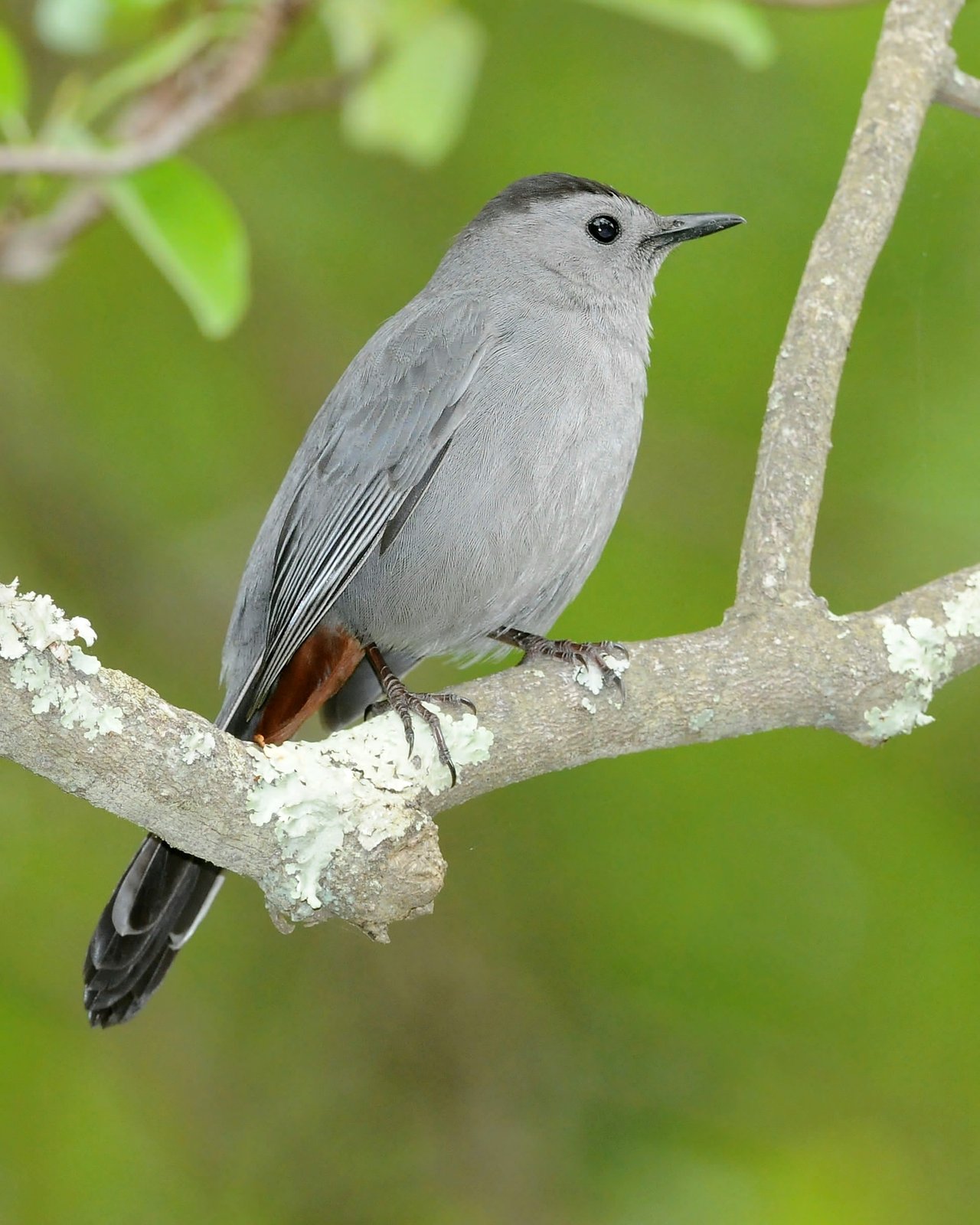
21–24 cm, slender, with a long rounded tail that is often cocked or fanned. Almost entirely plain slate grey, with a black cap and a black tail. The undertail coverts are rufous, most obvious when the tail is raised. Bill, legs and iris are dark. The sexes are alike; first-winter birds are a little duller, with brownish-tinged wings.
Confusion species
The black cap and rufous undertail are distinctive of the catbird. Northern Mockingbird Mimus polyglottos and Bahama Mockingbird Mimus gundlachii are paler grey to grey-brown, with pale underparts, and perch far more in the open. Western Red-legged Thrush Turdus plumbeus is also grey, but larger, with red legs, a red eye-ring and a white throat streaked with black.
Habitat
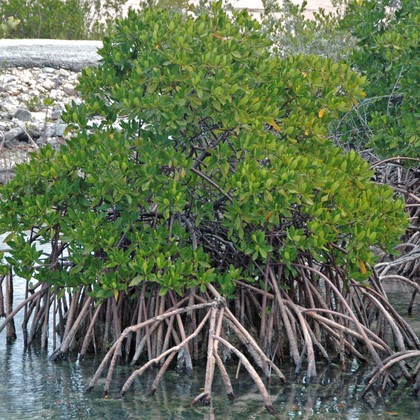
In winter dense thickets, coastal scrub, edges of dry and moist forest, coastal woodland, mangrove edges and overgrown gardens, field margins and parks. It forages on or near the ground among dead leaves for insects and in winter eats many berries and fruits.
Where the bird is most at home, classified by the vegetation types of the Caribbean.





Range and movements
A common winter visitor to the Bahamas, the Turks and Caicos Islands, Cuba and the Cayman Islands, and also San Andrés. Less numerous in Jamaica, scarce in Hispaniola and rare in Puerto Rico and the Virgin Islands. Only a vagrant to the Lesser Antilles, the ABC Islands and Trinidad and Tobago. Breeds from southern Canada to the south-eastern United States and in Bermuda; winters from the south-eastern United States through Mexico and Central America to Panama and in the Antilles.
- Resident
- Summer visitor (c. Oct–Mar)
- Winter visitor (c. Apr–Sep)
- Passage (Mar–Apr, Oct–Nov)
- dark = core range, pale = thinly spread
How and when to look
In winter almost anywhere in the Bahamas and Cuba in dense bushes along tracks, garden edges and woodland margins, including tourist areas. The mewing call gives the bird away; with patience it can then be seen when it briefly comes out onto a branch at the edge of cover.
Conservation status
Not threatened. The breeding population is large and stable. Migrants are at risk on the wintering grounds from the loss of coastal scrub and dry forest to development.
Scientific name
Dumetella carolinensis | (Linnaeus, 1766)
Linnaeus described the species in 1766 as [Muscicapa] carolinensis; because it was later moved to another genus, the author and year stand in brackets. The genus Dumetella was introduced in 1837 by Wood. Dumetella is a diminutive of Latin dumetum 'thicket': 'little thicket bird', after its home in dense shrubbery. carolinensis means 'of Carolina', in North America, where the species was described. The specimen the first description was based on came from Virginia, USA.