All species › Parrots › Old World parakeets › Rosy-faced Lovebird
Rosy-faced Lovebird | Agapornis roseicollis
Perzikkopagapornis | Inseparable de Namibia
The Rosy-faced Lovebird is a small, stocky parrot from south-western Africa and one of the most widely kept cage birds in the world. In the Caribbean all records concern escapes: single birds and small groups have been seen on several islands, but no established population is known.
Voice
A high, sharp, repeated tsheek, mainly in flight; groups chatter continuously.
Recording: African Bioacoustics Community — CC BY-NC-SA 4.0 · converted to mono · xeno-canto
Identification
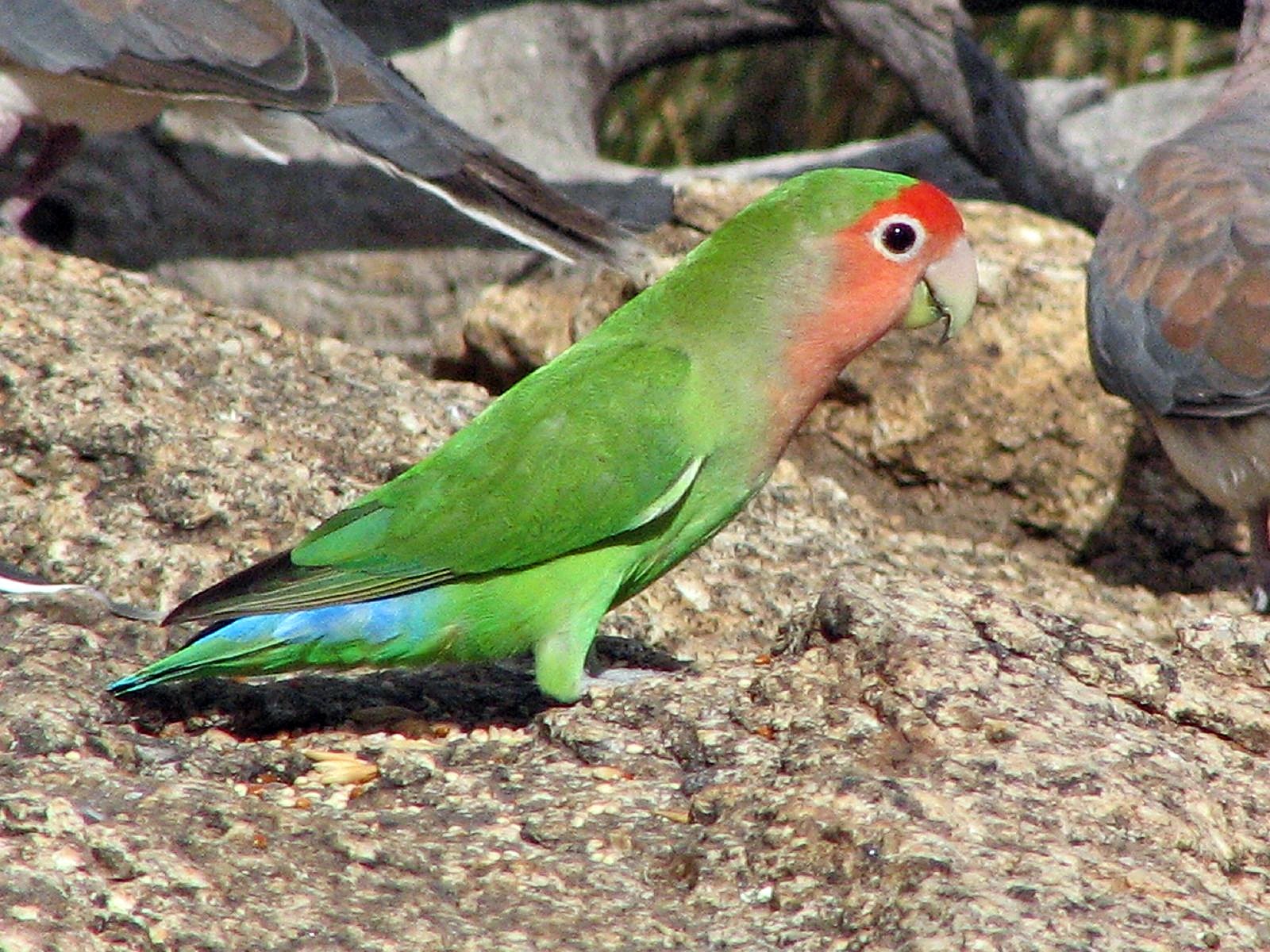
17–18 cm, with a short rounded tail. The wild type is green with a bright blue rump. Forehead and eyebrow are deep pink to red, cheeks and throat paler pink. The bill is horn-coloured. The base of the tail has red and black bands, visible only when the tail is spread. The sexes are alike. Juveniles have a paler pink face, a greenish forecrown and a dark base to the bill. Escaped birds are often colour forms in yellow, blue, grey or pied, or hybrids with other lovebirds.
Confusion species
Green-rumped Parrotlet Forpus passerinus, native on Trinidad and introduced on Jamaica and Curaçao, is smaller and entirely green with no pink face; the male has blue in the wing. Other escaped lovebirds, such as Fischer's Lovebird Agapornis fischeri and Yellow-collared Lovebird A. personatus, have a red bill and a white eye-ring. The parakeets of the region have long pointed tails.
Habitat
In the Caribbean mainly in gardens, parks and residential areas, and at bird feeders. In its native range dry, open country with scattered trees, semi-desert and mountain slopes up to about 1600 m, always within reach of water. It eats seeds, especially of grasses, as well as fruit and buds. It nests in cavities, in Africa often in the communal nests of weavers or in rock crevices; the female carries nest material tucked into her rump feathers.
Where the bird is most at home, classified by the vegetation types of the Caribbean.


Range and movements
Single birds and small groups have been recorded on the Bahamas, Cuba, the Dominican Republic, Puerto Rico, Guadeloupe, Curaçao and Aruba, and occasionally on a few other islands. These are escaped cage birds; breeding in the wild has not been confirmed in the region, including on Puerto Rico. Native to south-western Africa, from south-western Angola through Namibia to the Orange River valley in South Africa. Feral populations live around Phoenix in Arizona and on Hawaii, among other places.
- Resident
- dark = core range, pale = thinly spread
How and when to look
Single birds are usually seen in gardens or at feeders. The wild type is recognised by its green plumage with a blue rump and pink face; colour forms and hybrids differ from it in colour.
Conservation status
Not threatened globally; in the native range trapping for the trade has been offset by man-made water points and buildings that provide nest sites. In the Caribbean an alien with no known established population.
Scientific name
Agapornis roseicollis | (Vieillot, 1818)
Vieillot described the species in 1818 as Psittacus roseicollis; because it was later moved to another genus, the author and year stand in brackets. The genus Agapornis was introduced in 1836 by Selby. Agapornis comes from the Greek agapē, 'love', and ornis, 'bird' — for the close bond between the members of a pair. roseicollis is Latin for 'rosy-necked', from roseus, 'rosy', and collum, 'neck'. The specimen the first description was based on came from interior of the Cape, South Africa.