All species › Parrots › Parrots › Red-bellied Macaw
Red-bellied Macaw | Orthopsittaca manilatus
Roodbuikara | Guacamayo ventrirrojo
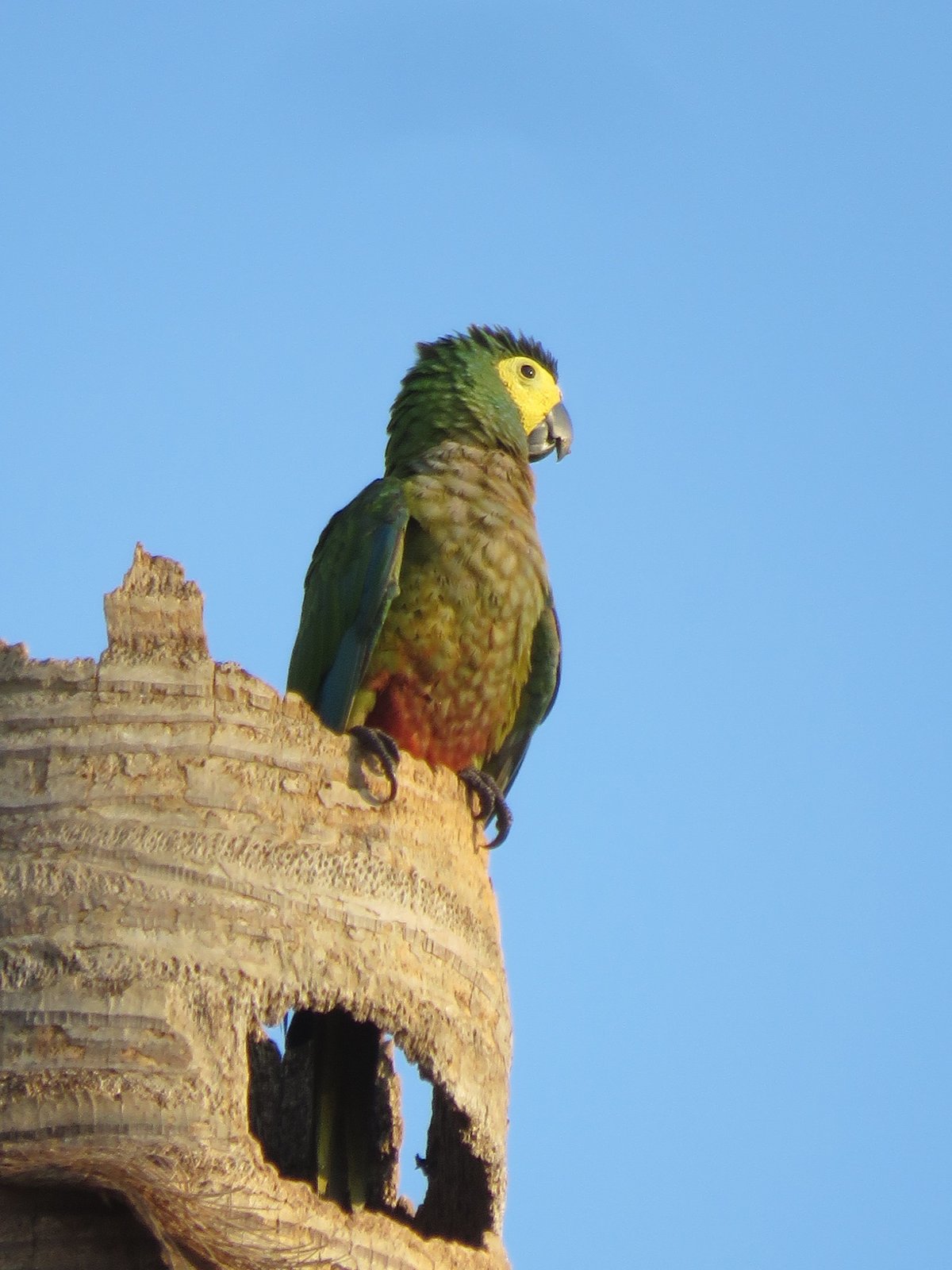
The Red-bellied Macaw is a medium-sized, mainly green macaw that depends entirely on the moriche palm Mauritia flexuosa: it roosts, nests and feeds in and on this palm. In the Caribbean it occurs only on Trinidad, where it is tied to the palm swamps of the east and south of the island.
Voice
High and reedy: a repeated, thin kree-kree and high, screaming cries, less raucous than those of the large macaws. Flocks call a lot in flight and at the roost.
Recording: JAYRSON ARAUJO DE OLIVEIRA — CC BY-NC-SA 4.0 · converted to mono · xeno-canto
Identification
46–50 cm, slender, with a long, tapering tail. Mainly green, with a bluish forehead and crown. The face around the eye and bill base is bare and mustard-yellow. Throat and breast are greyish-green, with a large maroon patch on the lower belly. The underside of wings and tail is olive-yellow, giving a pale impression in flight. The flight feathers are blue above. The bill is black. The sexes are alike. Flight is fast and direct, in pairs or flocks.
Confusion species
Blue-and-yellow Macaw Ara ararauna, reintroduced on Trinidad in the same area, is much larger, blue and yellow, with a white face. Chestnut-fronted Macaw Ara severus, an introduced species, is slightly smaller, with a chestnut forehead, a white bare face with dark lines and red under the wing. Orange-winged Amazon Amazona amazonica has a short tail and orange in the wing.
Habitat
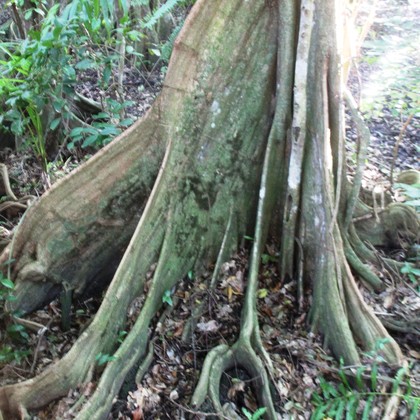
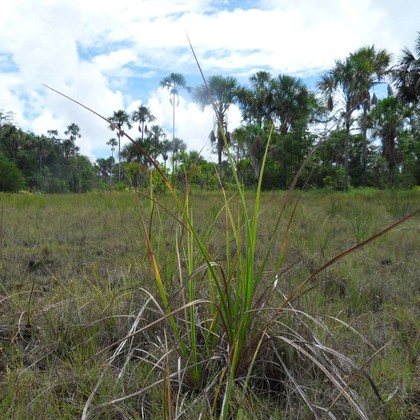
Swamp forest and savanna with moriche palms, also seasonally flooded savanna with palm groves. It feeds mainly on moriche palm fruit, as well as other fruit and seeds. Roosts in groups in the crowns or cavities of moriche palms and nests in cavities in dead palm trunks.
Where the bird is most at home, classified by the vegetation types of the Caribbean.
Range and movements
Local on Trinidad wherever moriche palms grow, mainly in the Nariva Swamp on the east coast and the Aripo Savannas; also scattered in other palm swamps in the east and south. Absent from Tobago and the other islands. Outside the region in the Amazon basin and the Guianas, from Colombia and Venezuela to Peru, Bolivia and Brazil.
- Resident
- Winter visitor (c. Apr–Sep)
- Passage (Mar–Apr, Oct–Nov)
- dark = core range, pale = thinly spread
How and when to look
In the Nariva Swamp the birds are best seen at sunrise and late in the afternoon, when small groups fly back and forth between the moriche palms. The long tail and pale underwing are the best features in flight.
Conservation status
Least Concern. The species has a large range but depends everywhere on moriche palms and declines where these swamps are cleared or drained. On Trinidad it is confined to a few palm swamps, so fire, clearance and trapping can weigh heavily there.
Scientific name
Orthopsittaca manilatus | (Boddaert, 1783) (GBIF: Orthopsittaca manilata)
Boddaert described the species in 1783 as Psittacus manilatus; because it was later moved to another genus, the author and year stand in brackets. The genus Orthopsittaca was introduced in 1912 by Ridgway. Orthopsittaca is Greek, from orthos 'straight' and psittakē 'parrot'. According to Jobling, manilatus comes from Latin manus 'hand' and latus 'broad'; what the name was meant to describe is unclear. The specimen the first description was based on came from Cayenne, French Guiana.