All species › Parrots › Parrots › Orange-winged Amazon
Orange-winged Amazon | Amazona amazonica
Oranjevleugelamazone | Amazona alinaranja
The Orange-winged Amazon is the commonest parrot of Trinidad and Tobago and native there, as an outlier of its South American range. Flocks flying noisily to and from communal roosts at dawn and dusk are part of the daily scene. Because it is widely kept as a cage bird, feral populations also live on other islands. In Venezuela it is called loro guaro.
Voice
Loud and piercing. In flight a rapidly repeated kwik-kwik and a high kee-kee, also hoarse and screeching notes. At the roost a flock keeps up a continuous din.
Recording: JAYRSON ARAUJO DE OLIVEIRA — CC BY-NC-SA 4.0 · shortened to the first 60 s, mono · xeno-canto
Identification
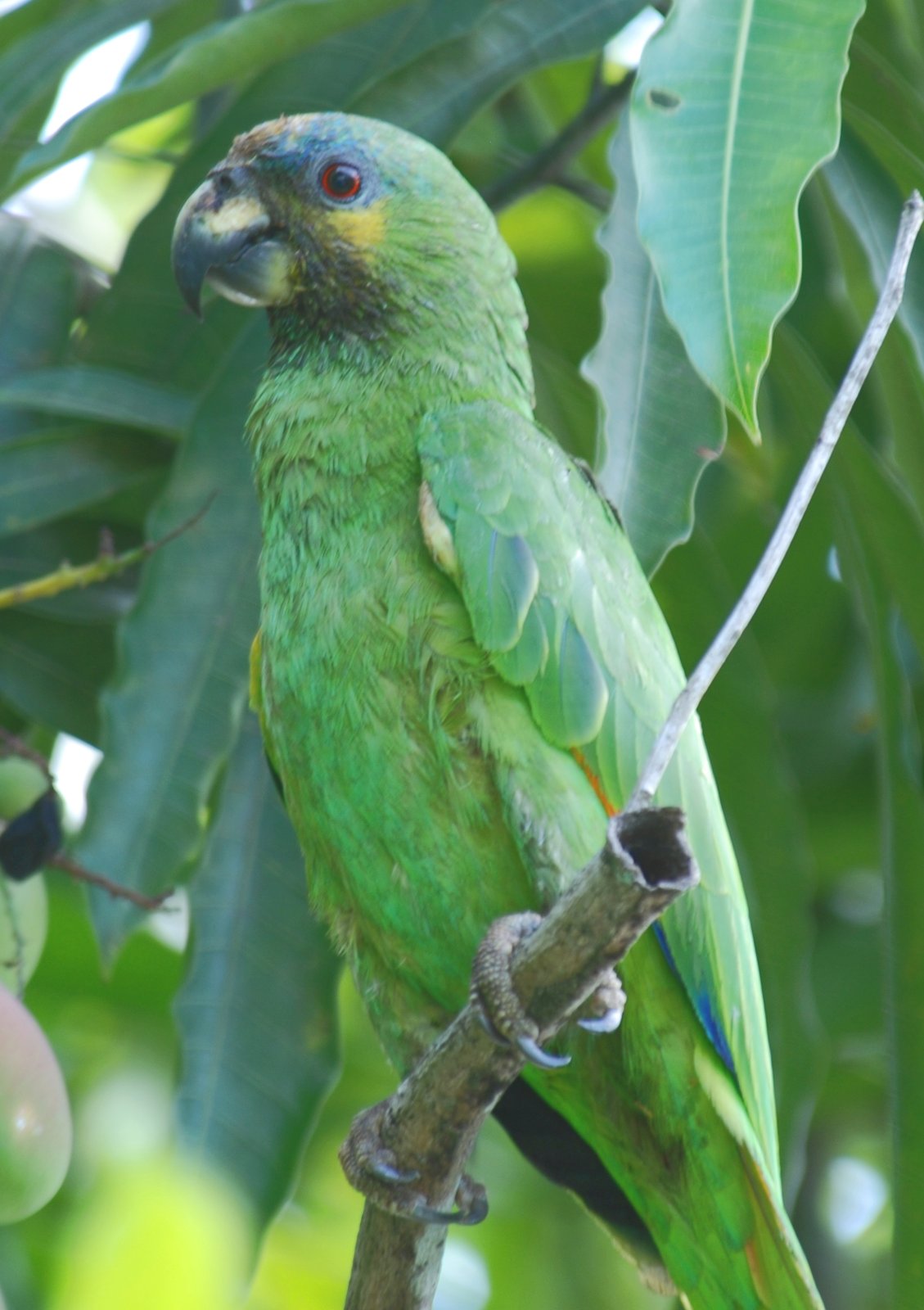
31–33 cm, stocky, with a short rounded tail. Mainly green. Lores and forehead are blue, crown and cheeks yellow; the extent of blue and yellow varies between birds. The wing has an orange patch on the secondaries, and the tail shows orange at the base of the outer feathers; both stand out mainly in flight. The bill is horn with a dark tip, the eye orange. The sexes are alike. Flies with fast, shallow wingbeats, usually in pairs that stay together within flocks.
Confusion species
Turquoise-fronted Amazon Amazona aestiva, an introduced species, is larger, with a red rather than orange wing patch and a dark bill. Yellow-crowned Amazon A. ochrocephala has yellow on the crown but no blue, and a red wing patch. Yellow-shouldered Amazon A. barbadensis of the ABC Islands has a white forehead, a yellow face and a yellow bend of the wing. Blue-headed Parrot Pionus menstruus has a blue head and red undertail.
Habitat
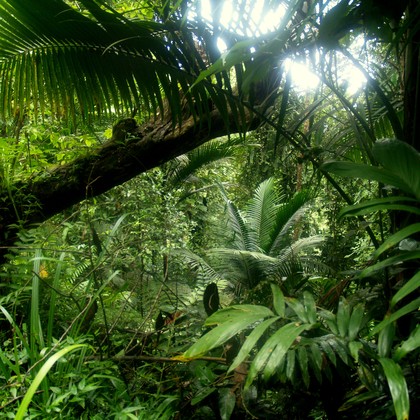
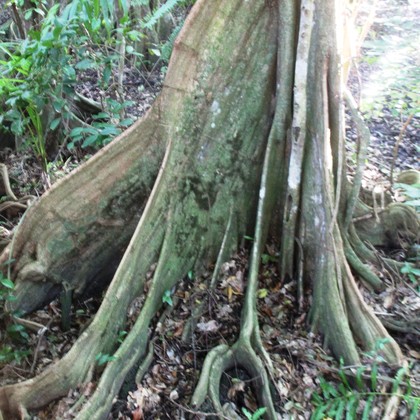
Moist forest, lowland rainforest, palm swamp forest and mangroves, cacao and other plantations, and gardens and parks in suburbs. It eats fruit, seeds, nuts and flowers, including those of crops. Roosts communally in palms and other trees. Nests in tree cavities, often in palms.
Where the bird is most at home, classified by the vegetation types of the Caribbean.




Range and movements
Native to Trinidad and Tobago, where it is common in the lowlands and lower slopes of both islands. Puerto Rico holds a feral population that breeds on its own and is spreading. On Martinique, Barbados, Grenada and Curaçao birds of feral or escaped origin are also seen regularly; how well established these populations are is not known everywhere. Outside the region from Colombia and Venezuela to Bolivia and Brazil.
- Resident
- dark = core range, pale = thinly spread
How and when to look
On Trinidad and Tobago almost anywhere near forest and plantations, especially during the morning and evening flights to and from roosts, for instance at swamp forest and mangroves. The orange in wing and tail is then the best feature.
Conservation status
Least Concern. In South America the species is widespread and common, though in many places it is trapped for trade, hunted and persecuted as a crop pest. Common on Trinidad and Tobago. On Puerto Rico and other islands it is an introduced species.
Scientific name
Amazona amazonica | (Linnaeus, 1766)
Linnaeus described the species in 1766 as Psittacus amazonicus; because it was later moved to another genus, the author and year stand in brackets. The genus Amazona was introduced in 1830 by Lesson. Amazona comes from 'Amazone', the French name Buffon gave to various tropical American parrots because they came from the Amazon region. amazonica is Latin for 'Amazonian', after the Amazon region. The specimen the first description was based on came from Amazon region (originally given as Suriname).