All species › Owls › Typical owls › Puerto Rican Owl
Puerto Rican Owl | Gymnasio nudipes
Puerto Ricaanse schreeuwuil | Múcaro de Puerto Rico
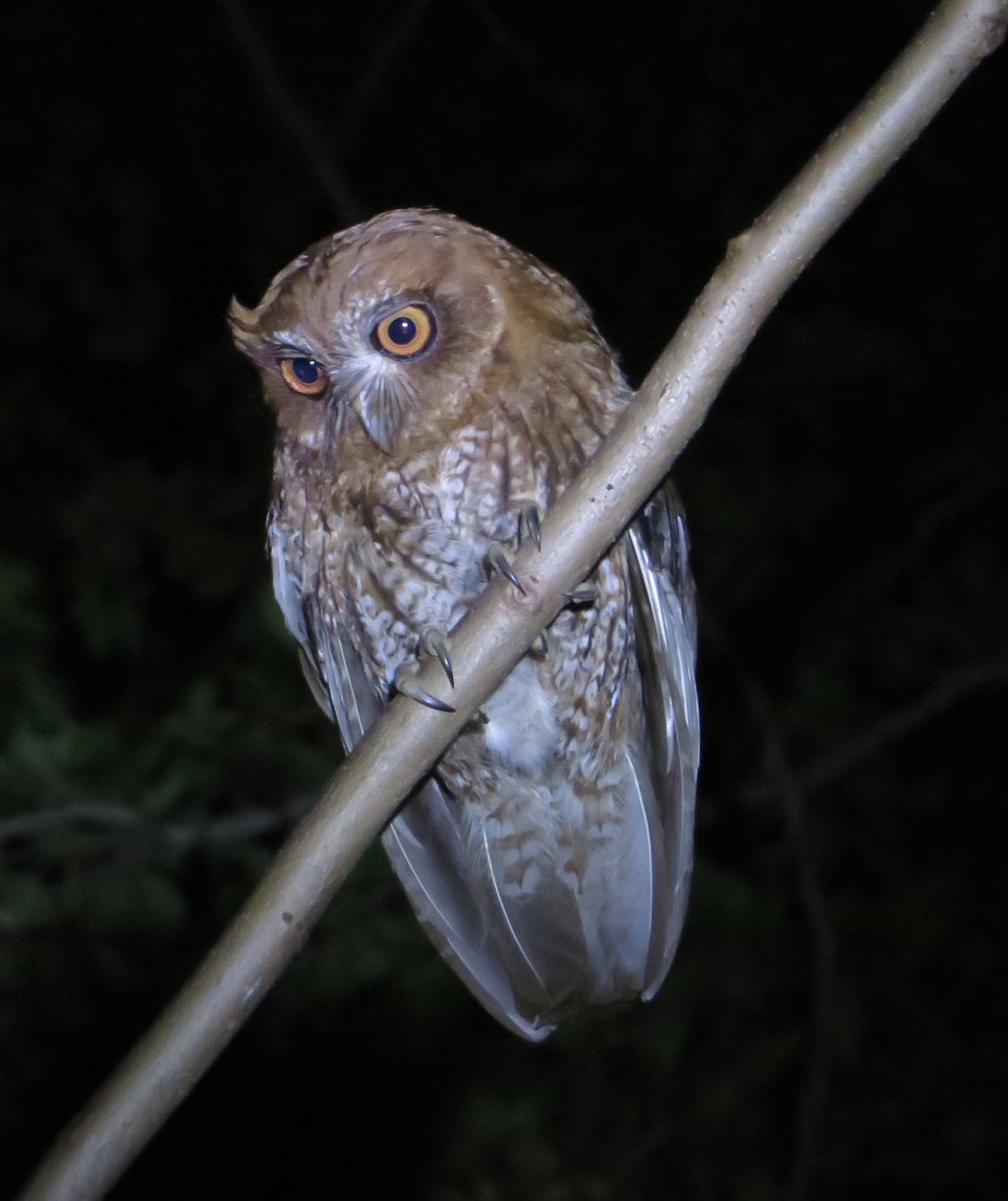
The Puerto Rican Owl is the only native small owl of Puerto Rico, where it is called múcaro. It was long placed in Otus or Megascops, but is now in a genus of its own, Gymnasio. Its unfeathered legs are distinctive.
Voice
The territorial song is a short, fairly low, guttural, toad-like trill, rrrrrrr. Also a soft, cackling goo-goo and a loud coo-coo.
Recording: GABRIEL LEITE — CC BY-NC-SA 4.0 · converted to mono · xeno-canto
Identification
20–25 cm, small and compact, with a round head without or with barely visible ear tufts. There are three colour morphs: brown (most birds), rufous (fairly common) and grey (rare). The upperparts are finely vermiculated, the underparts paler with dark streaks and fine cross-barring. The face is plain, with pale eyebrows; the eyes are brown, the bill greenish yellow. The long legs are bare and pale brown to greyish yellow. Females are slightly heavier than males.
Confusion species
There is no other small owl in Puerto Rico. Short-eared Owl Asio flammeus is much larger, has yellow eyes in dark patches and hunts over open country. Bare-legged Owl Margarobyas lawrencii also has bare legs and brown eyes, but lives only in Cuba.
Habitat
Almost all forest types, from dry coastal forest to moist lowland and montane forest, also limestone forest, coffee plantations, parks and suburbs with large trees. Its food is mainly large arthropods such as cockroaches, grasshoppers and moths, also frogs, lizards, rodents and small birds. It nests in tree cavities from April to June, laying up to three eggs.
Where the bird is most at home, classified by the vegetation types of the Caribbean.






Range and movements
Endemic to Puerto Rico, where it occurs throughout the main island. The Virgin Islands subspecies newtoni (St Croix, St John, St Thomas) has not been reliably recorded since the mid-19th century and is probably extinct.
- Resident
- dark = core range, pale = thinly spread
How and when to look
Best after dusk in forested areas such as the Guánica dry forest and the El Yunque rainforest, where the trilling song is often heard. By day the owl roosts hidden in dense cover or a cavity.
Conservation status
Not threatened; the population is estimated at more than 10,000 mature birds and appears stable. It has disappeared from the Virgin Islands.
Scientific name
Gymnasio nudipes | (Daudin, 1800) (GBIF: Megascops nudipes)
Daudin described the species in 1800 as Strix nudipes; because it was later moved to another genus, the author and year stand in brackets. The genus Gymnasio was introduced in 1854 by Bonaparte. Gymnasio combines the Greek gumnos 'naked' with the owl genus Asio, after the unfeathered legs. nudipes is Latin, from nudus 'naked' and pes 'foot', after the unfeathered legs. The specimen the first description was based on came from Puerto Rico.