All species › Owls › Typical owls › Jamaican Owl
Jamaican Owl | Asio grammicus
Jamaicaanse ransuil | Búho jamaicano
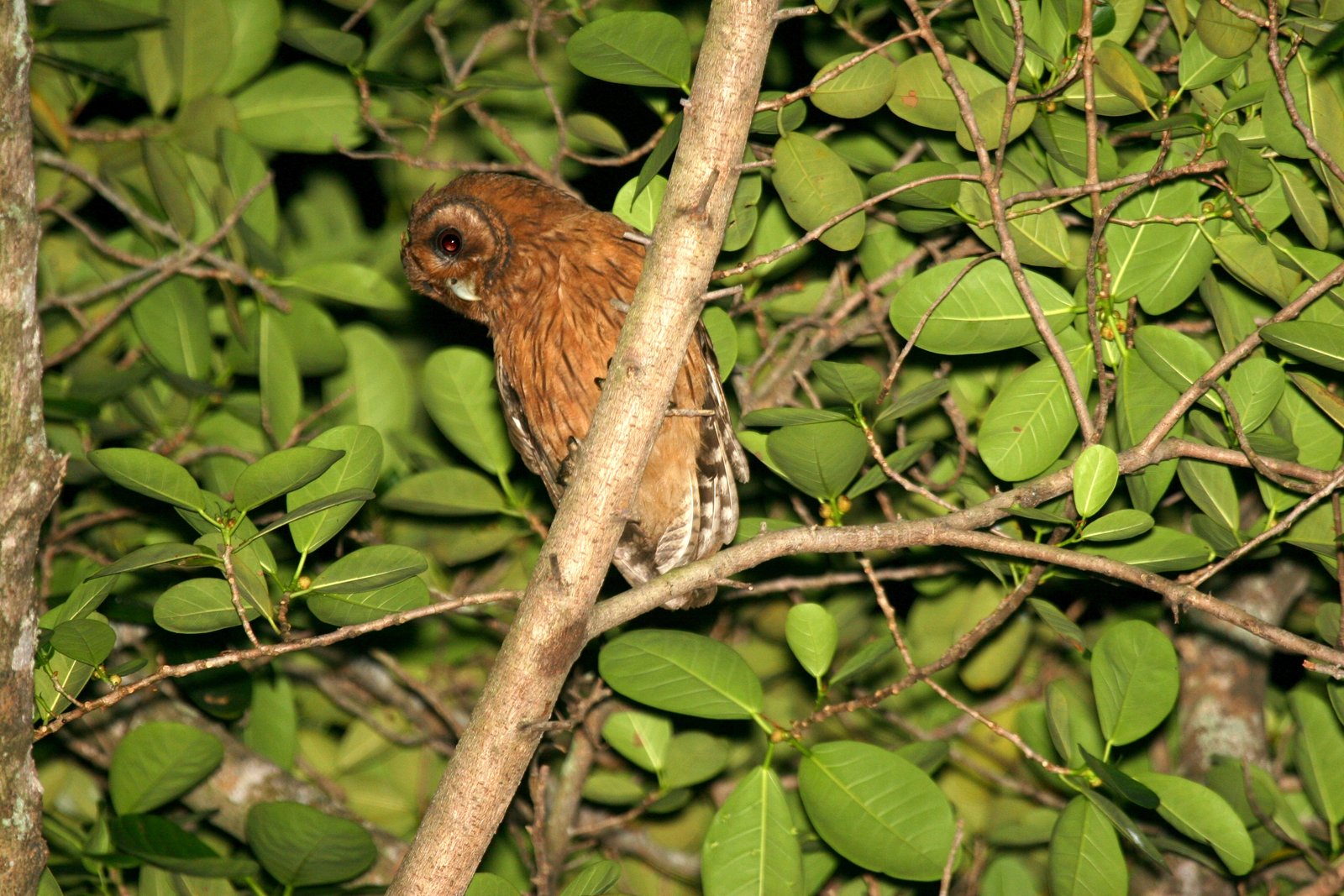
The Jamaican Owl occurs only in Jamaica and is the island's only owl with ear tufts. For a long time it was placed in its own genus, Pseudoscops; DNA studies now place it in Asio, alongside Stygian and Striped Owls. It is nocturnal and found throughout the island wherever there are trees.
Voice
A low, guttural growl, grrrr, and a high, quavering call, whoooo. Also various rasping and barking sounds, especially near the nest.
Recording: Bobby Wilcox — CC BY-NC-SA 4.0 · converted to mono · xeno-canto
Identification
27–34 cm, medium-sized, with long, distinct ear tufts. The facial disc is rufous with a blackish, white-flecked rim; the eyes are dark brown. The upperparts are warm rufous-brown with fine dark vermiculation and streaks. Breast and belly are paler rufous to buff with narrow dark streaks. The tail is rufous with dark bars. Juveniles are paler, greyish-brown on the back and pale cinnamon below.
Confusion species
American Barn Owl Tyto furcata is the only other owl in Jamaica; it is paler, with a white heart-shaped disc without ear tufts and long legs. Northern Potoo Nyctibius jamaicensis also perches on posts and branches at night, but has no ear tufts, a broad flat head with a tiny bill and a long tail.
Habitat
Open woodland, forest edge, plantations and gardens with large trees, mainly in the lowlands and hills up to about 600 m; also in parks and villages. It eats mainly large insects, also spiders, frogs, lizards, rodents and the occasional bird. It nests in tree cavities or in a concealed tree fork, usually laying two eggs.
Where the bird is most at home, classified by the vegetation types of the Caribbean.






Range and movements
Endemic to Jamaica, where it occurs across the island and is locally fairly common. Not recorded elsewhere in the region.
- Resident
- dark = core range, pale = thinly spread
How and when to look
Best at dusk along forest edges and in gardens with large trees; in some parks and nature lodges the species uses regular roosts. Listen for the low growl, which carries further than expected.
Conservation status
Not threatened. The species is widespread and adapts to farmland with trees, but forest clearance has locally reduced its habitat and numbers.
Scientific name
Asio grammicus | (Gosse, 1847) (GBIF: Pseudoscops grammicus)
Gosse described the species in 1847 as Ephialtes grammicus; because it was later moved to another genus, the author and year stand in brackets. The genus Asio was introduced in 1760 by Brisson. Asio is the Latin name of a horned or eared owl. grammicus comes from the Greek grammikos 'linear' (grammē 'line'), after the fine streaks below. The specimen the first description was based on came from Tait-Shafton, Jamaica.