All species › Passerines › New World blackbirds › Puerto Rican Oriole
Puerto Rican Oriole | Icterus portoricensis
Puerto Ricaanse troepiaal | Turpial puertorriqueño
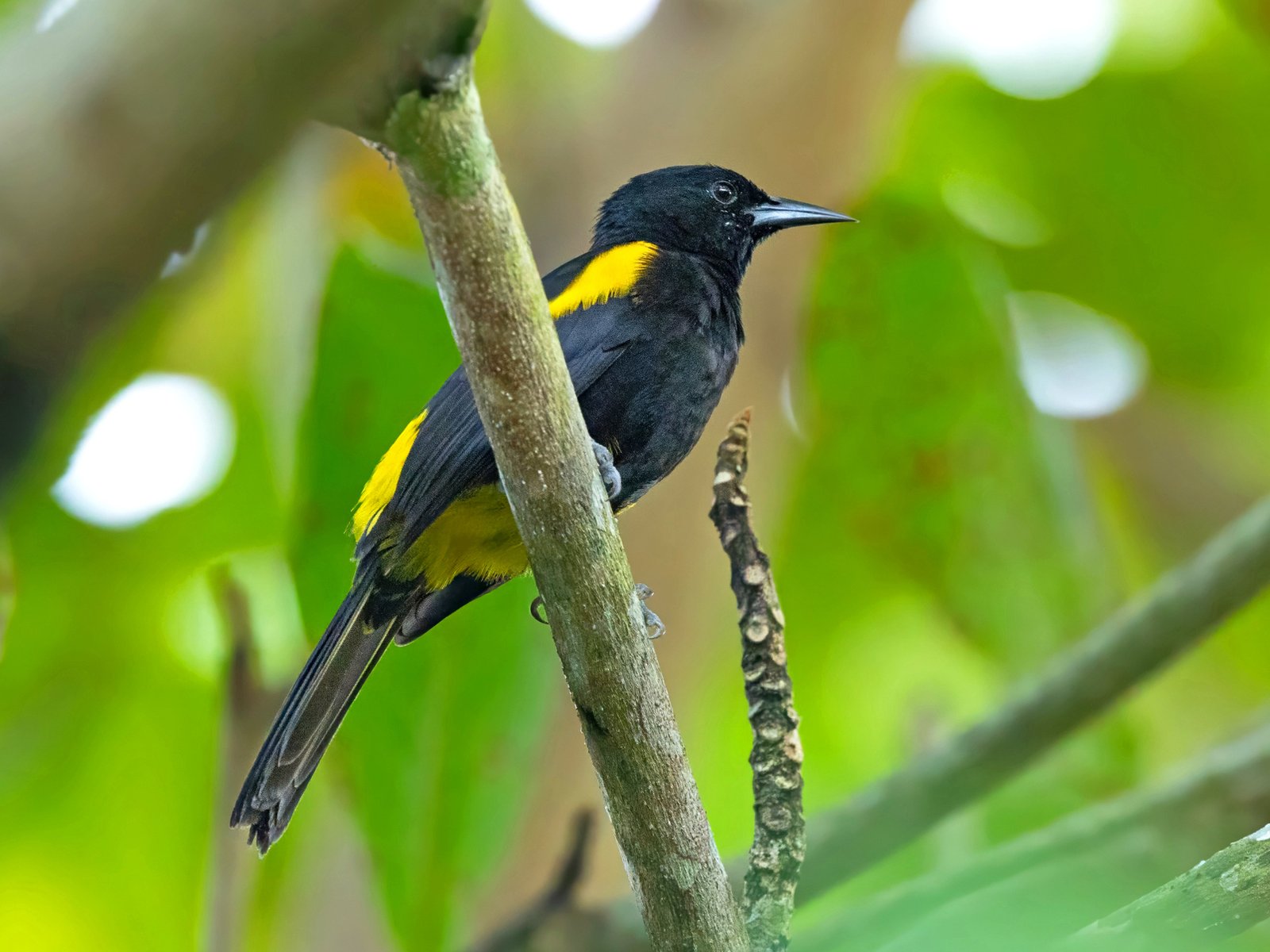
The Puerto Rican Oriole is a black oriole with yellow accents, found only in Puerto Rico. It was long included in the Greater Antillean Oriole, together with the forms of Cuba, Hispaniola and the Bahamas, but has been treated as a separate species since 2010. It is closely tied to palms, both for foraging and for nesting. In Puerto Rico it is called calandria.
Voice
A sharp keek or check and a softer chup. The song is a varied series of rising and falling whistles with buzzy and chattering elements; both sexes sing.
Recording: Michelle Moyer — CC BY-NC-SA 4.0 · converted to mono · xeno-canto
Identification
20–22 cm, slender, with a fairly long tail and a pointed, slightly decurved bill. Adults are mostly glossy black, with yellow on the shoulder, lower back, rump, lower belly and undertail coverts. Of the related island forms, this species shows the least yellow on the back; the upper rump is black. The sexes are alike. Juveniles are olive-green to yellowish olive, with a yellowish lower back and often a rusty wash on the head and breast; immatures gradually acquire black patches.
Confusion species
Yellow-shouldered Blackbird Agelaius xanthomus also has yellow shoulders but is otherwise all black, without yellow on the rump or belly, and has a shorter, straight bill. Greater Antillean Grackle Quiscalus niger and Shiny Cowbird Molothrus bonariensis are all black. The introduced Venezuelan Troupial Icterus icterus is larger and orange, with a white wing patch and blue bare skin around the eye. Baltimore Oriole Icterus galbula, a rare winter visitor, is orange with a black head and white wing bars.
Habitat
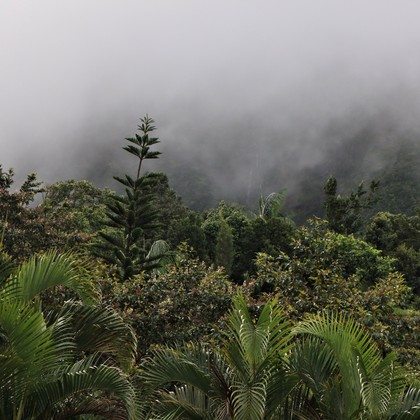
Forest from sea level to about 1,000 m, especially where palms grow: dry and moist broadleaf forest, montane forest, mangroves, coconut plantations, palm groves and gardens. It eats insects, fruit, nectar and flowers, often searching palm fronds. The nest is a woven basket of palm fibres hanging beneath a palm frond. Breeding is mainly from February to July.
Where the bird is most at home, classified by the vegetation types of the Caribbean.





Range and movements
Only in Puerto Rico, widespread across the island from the lowlands into the mountains. The species does not occur outside Puerto Rico.
- Resident
- dark = core range, pale = thinly spread
How and when to look
Palms in parks, gardens and forest edges are the best places; the birds often forage on the underside of palm fronds and may then show only the yellow of the rump and shoulder. The sharp check call gives them away.
Conservation status
Not threatened, but the species suffers from brood parasitism by Shiny Cowbird, especially in the coastal lowlands.
Scientific name
Icterus portoricensis | Bryant, 1866
Bryant described the species in 1866 and placed it straight away in the genus where it still stands. The genus Icterus was introduced in 1760 by Brisson. Icterus is from Ancient Greek ikteros, a yellow bird usually taken to be the golden oriole, the sight of which was thought to cure jaundice. portoricensis is Latin for 'of Puerto Rico', the island where the species lives. The specimen the first description was based on came from Puerto Rico.