All species › Waders, gulls and terns › Skuas › Pomarine Jaeger
Pomarine Jaeger | Stercorarius pomarinus
Middelste jager | Págalo pomarino
The Pomarine Jaeger is the largest and heaviest of the three small skuas. It breeds on the Arctic tundra and winters on tropical seas, including those around the Caribbean islands. There it lives almost entirely at sea and is mostly seen during seawatches from headlands and from boats. It steals fish from terns, gulls and boobies, but also catches fish itself and takes carrion.
Voice
Almost silent away from the breeding grounds. At the breeding site and in disputes a hard, nasal wehk and a series of harsh calls.
Recording: Benjamin Drillat — CC BY-NC-SA 4.0 · converted to mono · xeno-canto
Identification
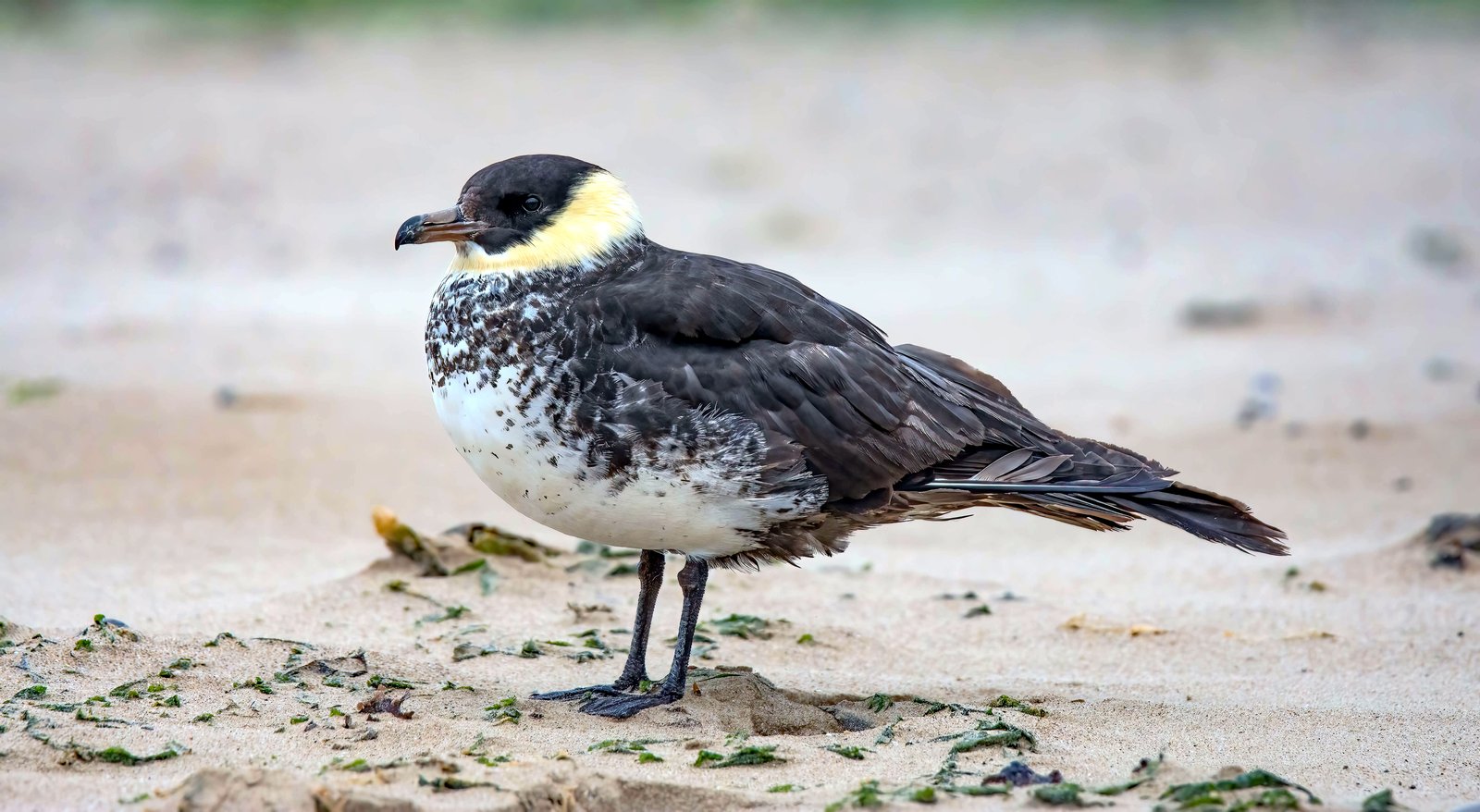
46–51 cm, plus up to 10 cm of elongated central tail feathers in breeding adults. Stocky, with a deep chest, broad wing base and a heavy, two-toned bill with a pale base and dark tip. In adults the elongated central feathers are broad, blunt and twisted, like spoons. There are pale and dark morphs. Pale adults have a black cap reaching below the bill base, yellowish cheeks, a dark, mottled breast band and barred flanks; dark birds are uniformly blackish brown. Juveniles are cold dark brown, heavily barred on rump and undertail, with short, blunt central tail feathers. In flight there is a clear white flash at the base of the primaries; juveniles also show a second pale patch on the underwing at the greater primary coverts.
Confusion species
Parasitic Jaeger Stercorarius parasiticus is slimmer, with a finer bill, a smaller cap, pointed central tail feathers and a lighter, more agile flight; juvenile Parasitics are often warmer rusty brown and lack the second pale underwing patch. Long-tailed Jaeger Stercorarius longicaudus is smaller and slimmer still. South Polar Skua Stercorarius maccormicki is larger, with broader wings, a shorter tail and large white wing flashes. A young Laughing Gull Leucophaeus atricilla lacks the white primary bases and flies differently.
Habitat
Open sea, often over the edge of the continental shelf and near flocks of feeding terns, boobies and shearwaters; rarely enters bays or harbours. Rests on the water. It chases other seabirds until they drop their catch, catches fish itself and scavenges behind fishing boats.
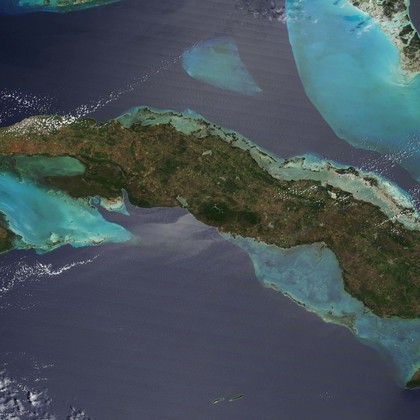
Where the bird is most at home, classified by the vegetation types of the Caribbean.

Range and movements
Passage migrant and winter visitor in the waters around the whole region. Regularly reported around the Bahamas, the Dominican Republic, Jamaica and Guadeloupe; rare off Cuba, and only a few records are known from Puerto Rico, Martinique, Barbados and Trinidad. Because the species stays well offshore its distribution is incompletely known. Beyond the region it breeds on the tundra of northern Russia, Alaska and Arctic Canada and winters on tropical and subtropical seas, in the Atlantic mainly off West Africa and in the western tropical Atlantic.
- Resident
- Summer visitor (c. Oct–Mar)
- Winter visitor (c. Apr–Sep)
- Passage (Mar–Apr, Oct–Nov)
- dark = core range, pale = thinly spread
How and when to look
The best chances are on seawatches during migration from projecting headlands on the eastern side of the islands, with an onshore wind, and on pelagic trips. Tail length and shape are unreliable in juveniles; structure, bill thickness and wingbeat, which is slower and more gull-like than in Parasitic Jaeger, are more useful.
Conservation status
Not threatened. The world population is large and the breeding grounds are remote. Numbers and breeding success fluctuate strongly with lemming cycles on the tundra. At sea, birds are sometimes caught in fishing gear.
Scientific name
Stercorarius pomarinus | (Temminck, 1815)
Temminck described the species in 1815 as Lestris pomarinus; because it was later moved to another genus, the author and year stand in brackets. The genus Stercorarius was introduced in 1760 by Brisson. Stercorarius is Latin for 'of dung', from stercus 'dung': the food disgorged by seabirds when pursued by skuas was once taken for excrement. pomarinus contracts Greek pōma 'lid' and rhis 'nostrils': the nostrils lie beneath the horny cere on the bill. The specimen the first description was based on came from arctic Europe.