All species › Passerines › Tyrant flycatchers › Piratic Flycatcher
Piratic Flycatcher | Legatus leucophaius
Piraattiran | Papamoscas pirata
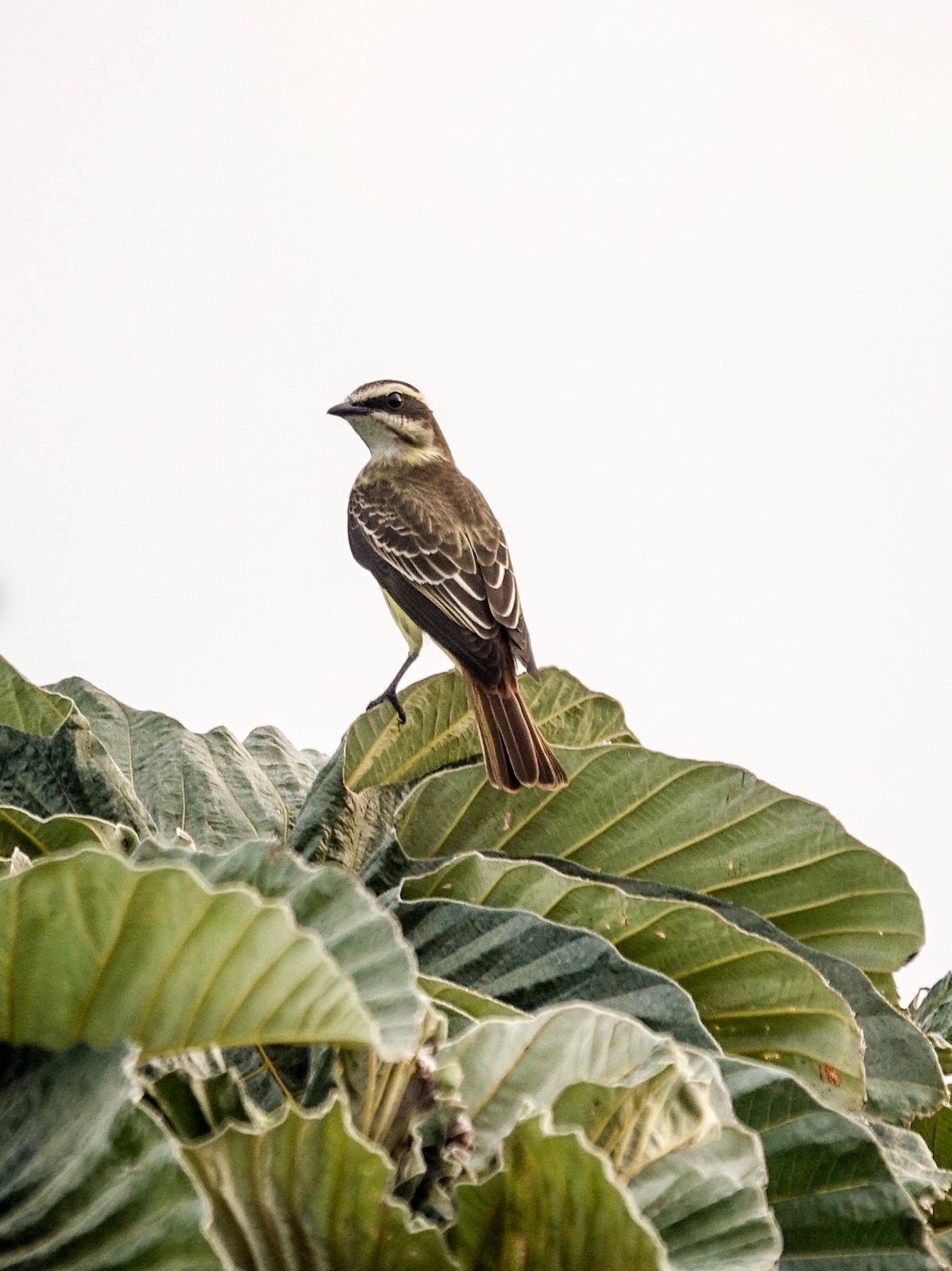
The Piratic Flycatcher is a small, streaked flycatcher of the Neotropical mainland that occurs in the Caribbean on Trinidad and Tobago. It builds no nest of its own but takes over the closed or hanging nests of other birds, especially oropendolas, caciques and other flycatchers. Its monotonous whistled call is a familiar sound at forest edges in the breeding season.
Voice
A loud, high, rising and falling whistled wseeEEEee, often repeated for long periods from a high bare branch; also a rolling pee-ri-ri-ri, mainly around the nest.
Recording: Juan Freile — CC BY-NC-SA 4.0 · converted to mono · xeno-canto
Identification
14–17 cm, compact, with a short, broad black bill. The crown is blackish with a concealed yellow crown patch. A whitish supercilium runs round the nape, the cheek is dark and a white throat is bordered by a dark malar stripe. The upperparts are plain dark grey-brown, without rufous in wings or tail. The underparts are yellowish-white with blurry dark streaks on breast and flanks. Juveniles lack the yellow crown patch and are browner.
Confusion species
Variegated Flycatcher Empidonomus varius has a similar head pattern but is larger, with obvious pale feather edges on the back, a rufous rump and tail edges, and sharper breast streaking. Streaked Flycatcher Myiodynastes maculatus is much larger and heavier-billed, with streaked upperparts and a rufous tail. Great Kiskadee Pitangus sulphuratus is much larger, with bright yellow unstreaked underparts.
Habitat
Edges and clearings of moist forest, tall trees in open country, cocoa and other plantations with shade trees, and gardens, especially where oropendolas and caciques nest. It hunts insects from a high perch but also eats much fruit, such as mistletoe berries. A pair drives the builders from a nest by harassing them repeatedly, removes their eggs and then lays its own.
Where the bird is most at home, classified by the vegetation types of the Caribbean.





Range and movements
Trinidad and Tobago. Outside the region from Mexico through Central America to northern Argentina; the northernmost and southernmost populations move away outside the breeding season.
- Resident
- dark = core range, pale = thinly spread
How and when to look
In the breeding season at forest edges and near oropendola colonies in Trinidad's Northern Range, for example around the Asa Wright Nature Centre. The persistent whistle from a bare treetop gives the bird away.
Conservation status
Not threatened. The species has a very large range and tolerates open and disturbed land with scattered tall trees.
Scientific name
Legatus leucophaius | (Vieillot, 1818)
Vieillot described the species in 1818 as Platyrhynchos leucophaius; because it was later moved to another genus, the author and year stand in brackets. The genus Legatus was introduced in 1859 by Sclater. Legatus is Latin for 'envoy, governor', from legare 'to appoint'; why Sclater chose the name is not known. leucophaius is Greek, from leukos 'white' and phaios 'dusky': 'whitish-grey', after the plumage. The specimen the first description was based on came from Cayenne, French Guiana.