All species › Passerines › Tyrant flycatchers › Bright-rumped Attila
Bright-rumped Attila | Attila spadiceus
Goudstuitattila | Atila polimorfo
The Bright-rumped Attila is a large, big-headed flycatcher of mainland tropical forests that occurs in the Caribbean only on Trinidad. It keeps hidden in the middle storey and canopy and is heard far more often than seen. Its plumage is highly variable, from olive-green to rufous, hence the Spanish name atila polimorfo.
Voice
A loud, repeated beat-it, beat-it and a plaintive rising series ooo weery weery weery woo, often throughout the day from the canopy.
Recording: JAYRSON ARAUJO DE OLIVEIRA — CC BY-NC-SA 4.0 · shortened to the first 60 s, mono · xeno-canto
Identification
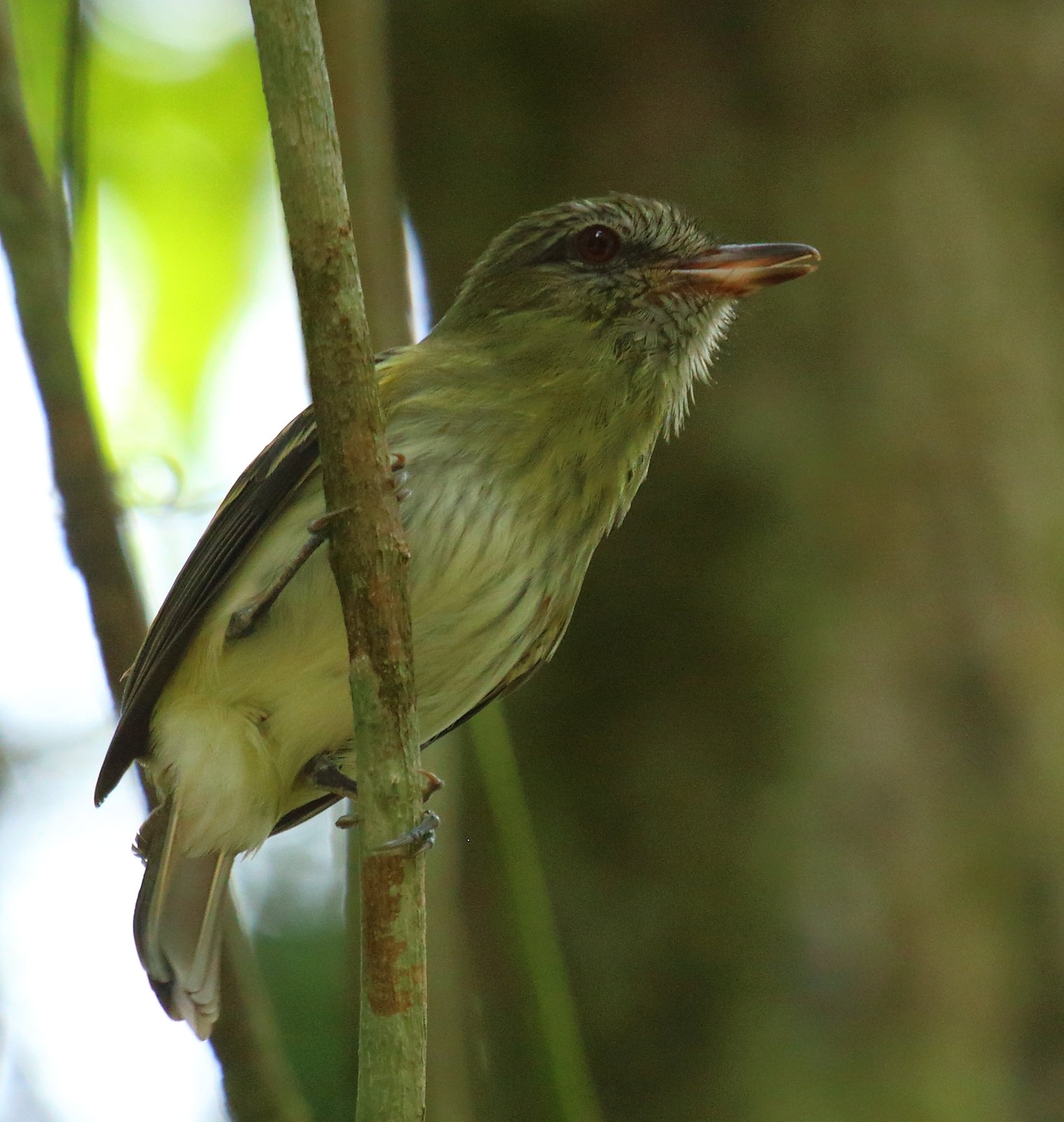
17–20 cm, with a large head, a square tail and a heavy, hook-tipped bill. The iris is red to orange-brown. Plumage varies from olive-green to rufous, but the rump is always bright yellow to ochre-yellow and contrasts with back and tail. Throat and breast are faintly streaked dark, the belly whitish to yellow. The wings are dark with pale edges to the coverts, which may form wing bars. The sexes are alike.
Confusion species
Myiarchus species such as Dusky-capped Flycatcher Myiarchus tuberculifer and Brown-crested Flycatcher Myiarchus tyrannulus have a dark iris, a grey unstreaked throat and breast and no yellow rump. Cocoa Thrush Turdus fumigatus is uniformly rufous-brown, without streaks or yellow rump, and has a slender straight bill. Streaked Flycatcher Myiodynastes maculatus is heavily streaked all over and has a rufous tail.
Habitat
Moist lowland and hill forest, mature secondary forest, forest edges and cocoa plantations with shade trees. It hunts large insects, small lizards and frogs in the middle storey and canopy, and also eats fruit. The nest is placed in a cavity, niche or epiphyte.
Where the bird is most at home, classified by the vegetation types of the Caribbean.




Range and movements
In the Caribbean only on Trinidad, in the forested parts of the island, especially the Northern Range. Outside the region from north-western Mexico through Central America to Ecuador, Bolivia and south-eastern Brazil.
- Resident
- dark = core range, pale = thinly spread
How and when to look
In the forest of Trinidad's Northern Range, where the loud call is often heard early in the morning. The bird sits still in the foliage; the yellow rump shows best when it flies off.
Conservation status
Not threatened. The species has a very large range and tolerates secondary forest and plantations with shade trees.
Scientific name
Attila spadiceus | (Gmelin, 1789)
Gmelin described the species in 1789 as [Muscicapa] spadicea; because it was later moved to another genus, the author and year stand in brackets. The genus Attila was introduced in 1831 by Lesson. Attila is named after Attila the Hun, who attacked Rome and Orléans in the 5th century, after the fierce, predatory nature of these birds. spadiceus is Latin for 'chestnut-brown, date-coloured', after the rufous tones in the plumage. The specimen the first description was based on came from Cayenne, French Guiana.