All species › Passerines › New World warblers › Pine Warbler
Pine Warbler | Setophaga pinus
Dennenzanger | Reinita del pinar
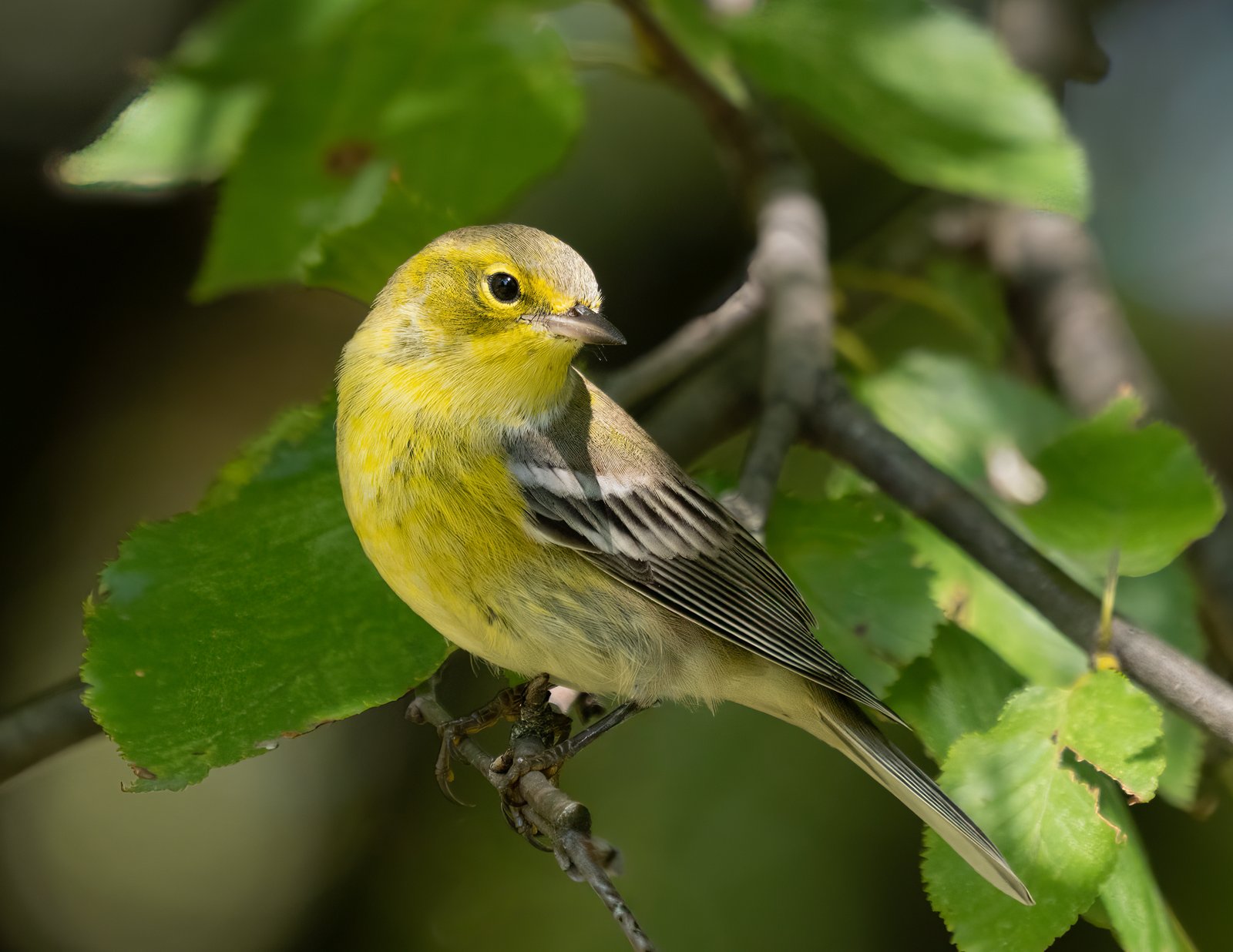
The Pine Warbler is a fairly large, plainly marked wood-warbler that, as the name says, is tied to pines. Two resident subspecies of its own live in the Caribbean: achrustera in the Bahamas and chrysoleuca on Hispaniola.
Voice
The song is a musical, even trill of short, clear notes, heard throughout the year. The call is a soft, slightly slurred chip.
Recording: Rory Nefdt — CC BY-NC-SA 4.0 · converted to mono · xeno-canto
Identification
13–14.5 cm, with a fairly long, pointed bill and a long tail. Males are olive-green above, with a bright yellow throat and breast, faint olive streaks on the breast sides and a white belly and undertail. Indistinct yellow spectacles and a dark eye-line give the face little pattern. The wings are grey with two white wing bars, and the outer tail feathers have white spots. Females and young birds are olive-brown to grey-brown above and paler, sometimes barely yellow, below.
Confusion species
Prairie Warbler Setophaga discolor is smaller, with black flank streaks, a yellow face with dark markings and a frequently wagged tail. Olive-capped Warbler Setophaga pityophila and Bahama Warbler Setophaga flavescens are grey above, with an olive-yellow cap and a black mask respectively. Vireos such as White-eyed Vireo Vireo griseus have a thicker, hooked bill and move more slowly. Dull females resemble Bay-breasted Warbler Setophaga castanea and Blackpoll Warbler Setophaga striata in autumn plumage, but those have a streaked back.
Habitat
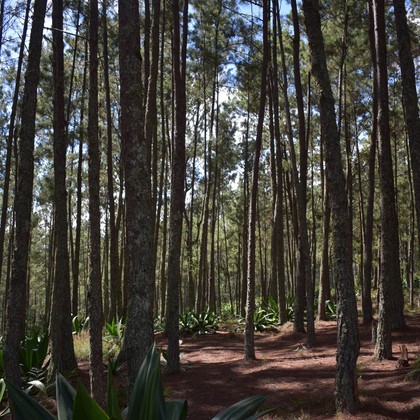
Pine forest, both in the lowlands of the Bahamas and in the mountains of Hispaniola. It takes insects from branches and needle clusters, but also from trunks and the ground; outside the breeding season it also eats pine seeds.
Where the bird is most at home, classified by the vegetation types of the Caribbean.
Range and movements
Resident in the pine forests of Grand Bahama, Abaco, Andros and New Providence, and on Hispaniola in the pine forest of the Cordillera Central and the Sierra de Bahoruco (Dominican Republic) and the Massif de la Selle (Haiti). North American migrants are rarely recorded in winter in the northwest of the region. Elsewhere the species breeds in eastern North America.
- Resident
- Winter visitor (c. Apr–Sep)
- Passage (Mar–Apr, Oct–Nov)
- dark = core range, pale = thinly spread
How and when to look
In the Bahamas in almost any pine forest on Grand Bahama or Abaco; on Hispaniola in the pine forest of Valle Nuevo or the Sierra de Bahoruco. The trill often comes from high in the pines.
Conservation status
Not threatened. The species is numerous in North America; the Caribbean populations are smaller and depend on the survival of the pine forest.
Scientific name
Setophaga pinus | (Linnaeus, 1766)
Linnaeus described the species in 1766 as Certhia pinus; because it was later moved to another genus, the author and year stand in brackets. The genus Setophaga was introduced in 1827 by Swainson. Setophaga is Greek, from sēs, sētos 'moth' and -phagos '-eating': 'moth-eater'. pinus is Latin for 'pine', after the pine woods the species inhabits. The specimen the first description was based on came from Georgia, United States.