All species › Passerines › New World warblers › Olive-capped Warbler
Olive-capped Warbler | Setophaga pityophila
Olijfkapzanger | Reinita coroniverde
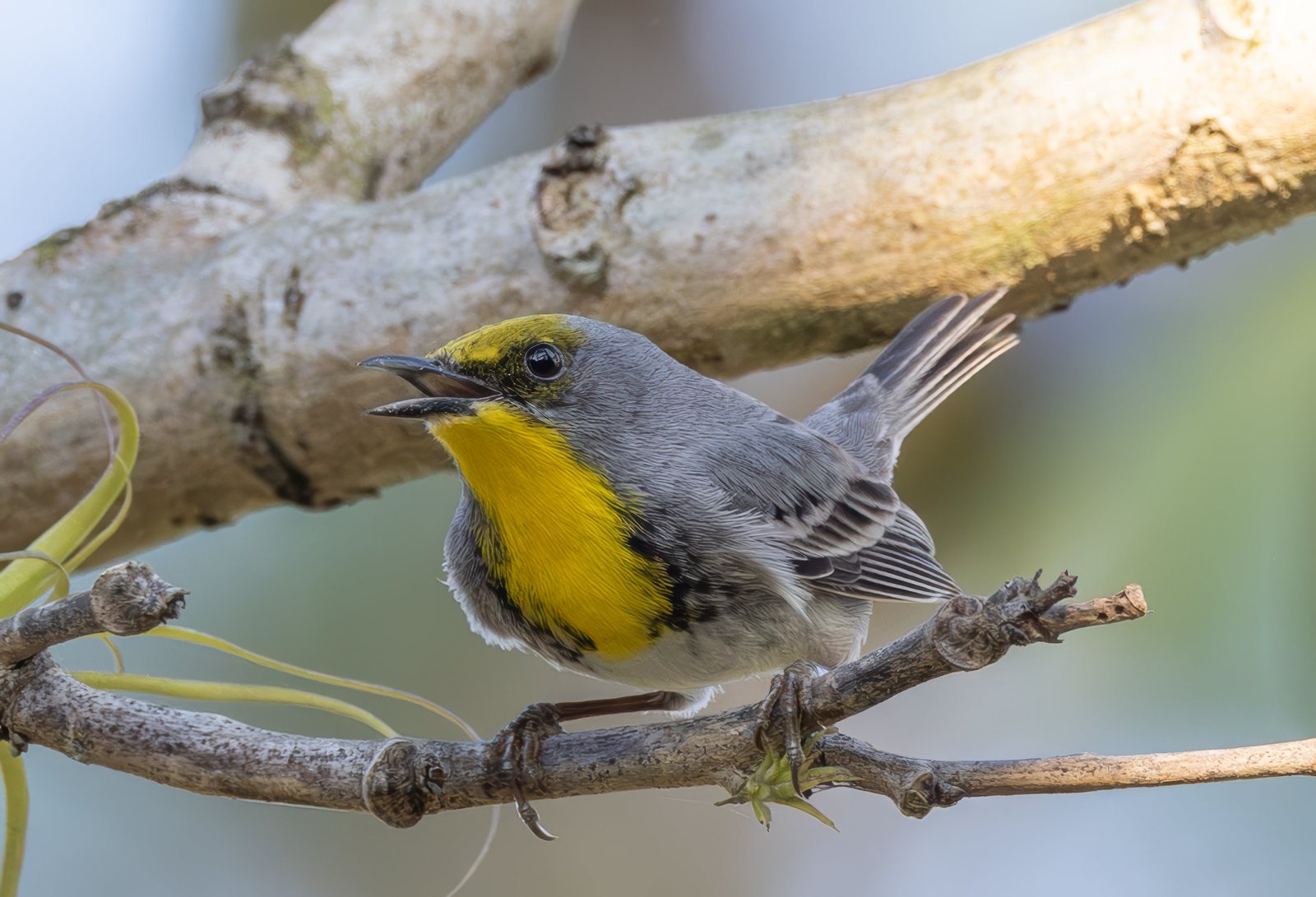
The Olive-capped Warbler is a small wood-warbler that lives almost exclusively in pine forest and is found only in the pinewoods of Cuba and the northern Bahamas. Within that limited area it is locally common.
Voice
The song is high, melodious and whistled, usually a series of about eight quick notes. The call is a short tsip.
Recording: Nils Navarro — CC BY-NC-SA 4.0 · converted to mono · xeno-canto
Identification
12.5–13 cm. Crown olive-yellow, the face slate-grey with black lores and a thin yellow line above the lores to the eye. The upperparts are slate-grey with two white wing bars; the tail is grey with white outer feathers. Throat and breast are yellow, the belly and undertail white, with black streaks on the sides of the breast. Females are duller. Juveniles are brownish on the head and upperparts, with indistinct wing bars and paler underparts.
Confusion species
Yellow-throated Warbler Setophaga dominica, a winter visitor, has a black ear patch, a white supercilium and a white neck patch. Bahama Warbler Setophaga flavescens shares the pine forest on Abaco but is larger, with a black mask, a long bill and a yellow belly. Pine Warbler Setophaga pinus, in the same forest in the Bahamas, is olive-green above and has no olive-yellow cap.
Habitat
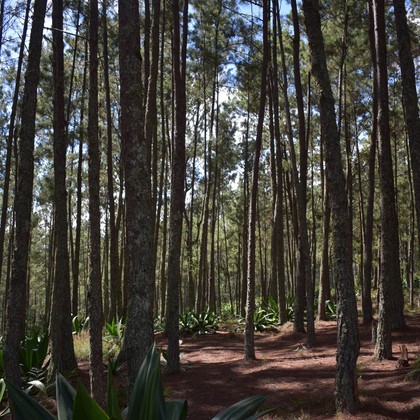
Almost exclusively pine forest, from sea level high into the mountains; occasionally in adjacent mixed pine and broadleaf forest. It searches for insects among the needle clusters, on branches and on trunks, often high in the pines.
Where the bird is most at home, classified by the vegetation types of the Caribbean.
Range and movements
In Cuba in the pine forests of the west (Pinar del Río province) and the east (Holguín, Santiago de Cuba and Guantánamo). In the Bahamas on Grand Bahama, Great Abaco and Little Abaco. The species does not occur outside these islands.
- Resident
- dark = core range, pale = thinly spread
How and when to look
In Cuba the pine forest of the Sierra de los Órganos in Pinar del Río, or the pinewoods of Mayarí and Moa in the east; in the Bahamas the pine forest of Abaco. Away from pine forest the species is almost never found.
Conservation status
Not threatened. The species is locally common, but its dependence on pine forest makes it vulnerable to logging, fires and hurricanes; the population is thought to be declining.
Scientific name
Setophaga pityophila | (Gundlach, 1855)
Gundlach described the species in 1855 as Sylvicola pityophila; because it was later moved to another genus, the author and year stand in brackets. The genus Setophaga was introduced in 1827 by Swainson. Setophaga is Greek, from sēs, sētos 'moth' and -phagos '-eating': 'moth-eater'. pityophila is Greek, from pitus 'pine' and philos 'loving': 'pine-loving', after the pine forests it inhabits. The specimen the first description was based on came from Cuba.