All species › Falcons › Falcons › Orange-breasted Falcon
Orange-breasted Falcon | Falco deiroleucus
Bonte slechtvalk | Halcón pecho rufo
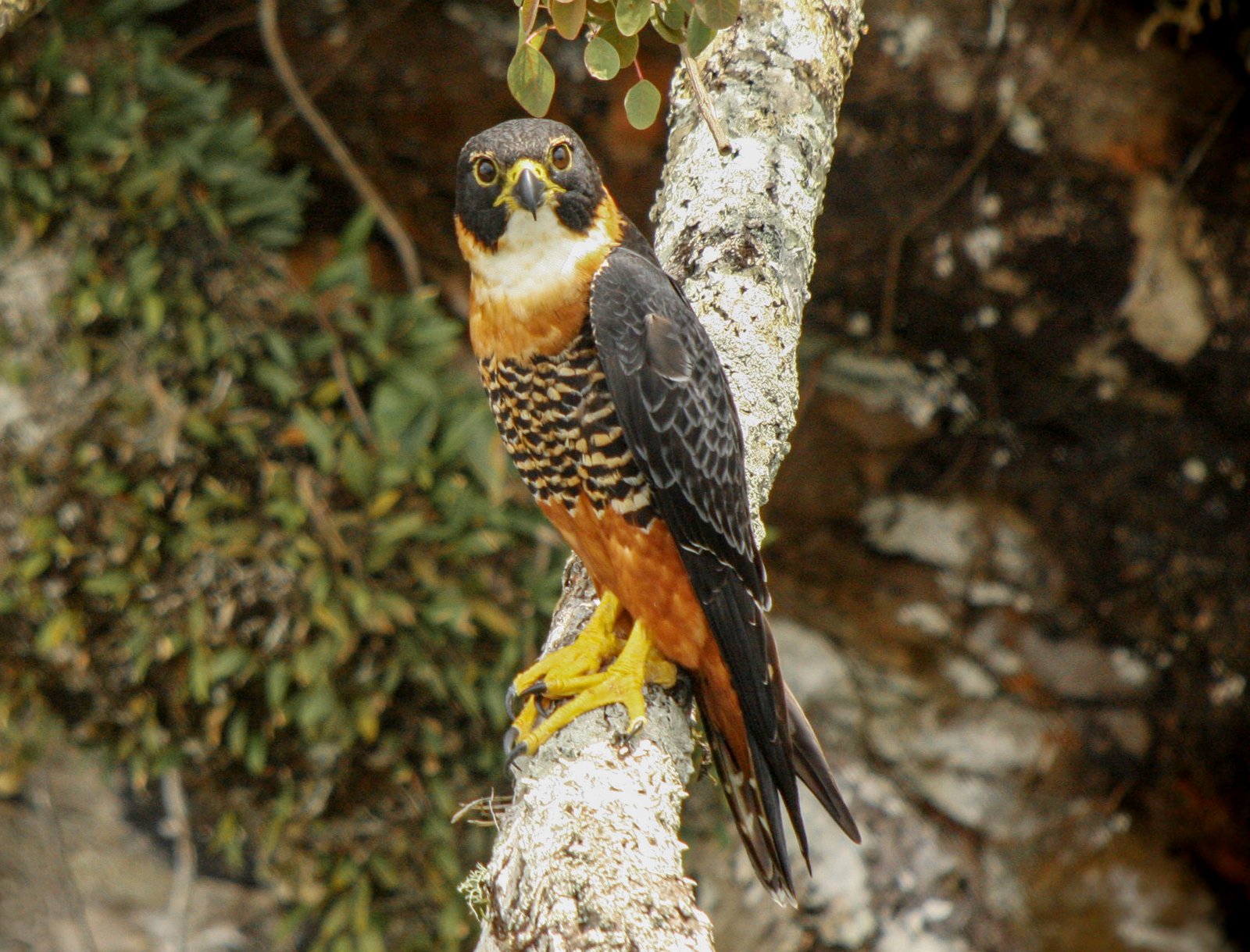
The Orange-breasted Falcon is a powerful, rare falcon of undisturbed tropical forest with cliffs, from Central America to northern Argentina. It closely resembles a large, heavy Bat Falcon, its closest relative, and hunts birds over the canopy in fast flight from a high lookout. On Trinidad it is so rare that its status there remains unclear.
Voice
Noisy mainly in the breeding season. A rapidly repeated, piercing kee-kee-kee or kyowh-kyowh-kyowh when disturbed; soft piping and chirping notes in courtship.
Recording: Dante Buzzetti — CC BY-NC-SA 4.0 · converted to mono · xeno-canto
Identification
35–40 cm, compact and heavily built, with a large head, a stout bill, large, strong feet and a rather broad wing base. Head and upperparts are blue-black. Throat and neck sides are white, merging into an orange-rufous band on the upper breast. The lower breast is black with coarse rufous to buff bars; belly, thighs and undertail coverts are orange-rufous. Cere, eye-ring and legs are yellow. The female is much larger and heavier than the male; the size difference between the sexes is greater than in any other falcon. Juveniles are browner above and paler buff below, with dark barring on the breast and black spots on the thighs.
Confusion species
Bat Falcon Falco rufigularis is smaller, with smaller feet, a white to buff throat and upper breast without an orange band, and fine white bars on the black breast; young Bat Falcons already have rufous thighs. Size alone is unreliable, as a small male Orange-breasted Falcon is hardly larger than a large female Bat Falcon. Peregrine Falcon Falco peregrinus has pale, barred underparts and a broad moustache. Aplomado Falcon Falco femoralis is slim and long-tailed, with a white supercilium and a pale breast.
Habitat
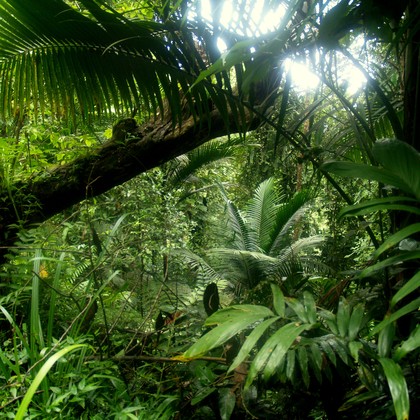
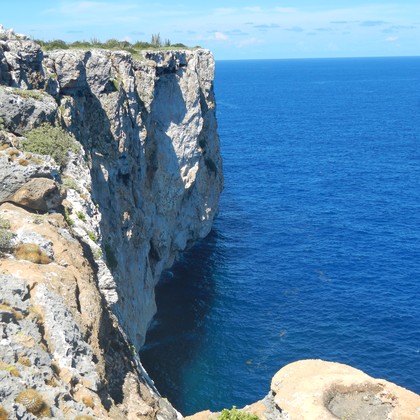
Extensive, undisturbed lowland and montane rainforest and semi-evergreen forest, preferably with cliffs or steep slopes for nesting; sometimes also a mosaic of forest and clearings. It perches high on a bare tree or rock ledge and takes birds such as pigeons, parrots and swifts in the air. It nests on ledges and in holes in cliffs, sometimes in tree cavities.
Where the bird is most at home, classified by the vegetation types of the Caribbean.

Range and movements
Very rare on Trinidad. A few specimens and egg sets from the first half of the 20th century are known, but without good locality data; later sightings are scarce and come mainly from the Northern Range. Whether a small breeding population exists or the birds are wanderers from the South American mainland is unclear. Not known from Tobago. Outside the region locally from southern Mexico, Belize and Guatemala through Panama and northern South America, east of the Andes, to northern Argentina.
- Resident
- dark = core range, pale = thinly spread
How and when to look
Sightings on Trinidad are very rare; almost every dark falcon with a rufous belly there turns out to be a Bat Falcon. Features to document are the orange band on the upper breast, the coarse breast barring, the heavy build and the large feet. Good photographs are needed for acceptance by the Trinidad and Tobago rarities committee.
Conservation status
Scarce and highly fragmented worldwide, with a population thought to be declining. The main threat is forest clearance; in Central America the species has disappeared from several countries. Black Vultures take over nest sites. In Belize the population is supported with captive-bred birds.
Scientific name
Falco deiroleucus | Temminck, 1825
Temminck described the species in 1825 and placed it straight away in the genus where it still stands. The genus Falco was introduced in 1758 by Linnaeus. Falco is Late Latin for 'falcon', from falx, falcis 'sickle', after the sickle-shaped claws of the bird. deiroleucus is Greek, from deirē 'neck, throat' and leukos 'white', after the white throat. The specimen the first description was based on came from São Francisco Island, Santa Catarina, Brazil.