All species › Falcons › Falcons › Bat Falcon
Bat Falcon | Falco rufigularis
Vleermuisvalk | Halcón murcielaguero
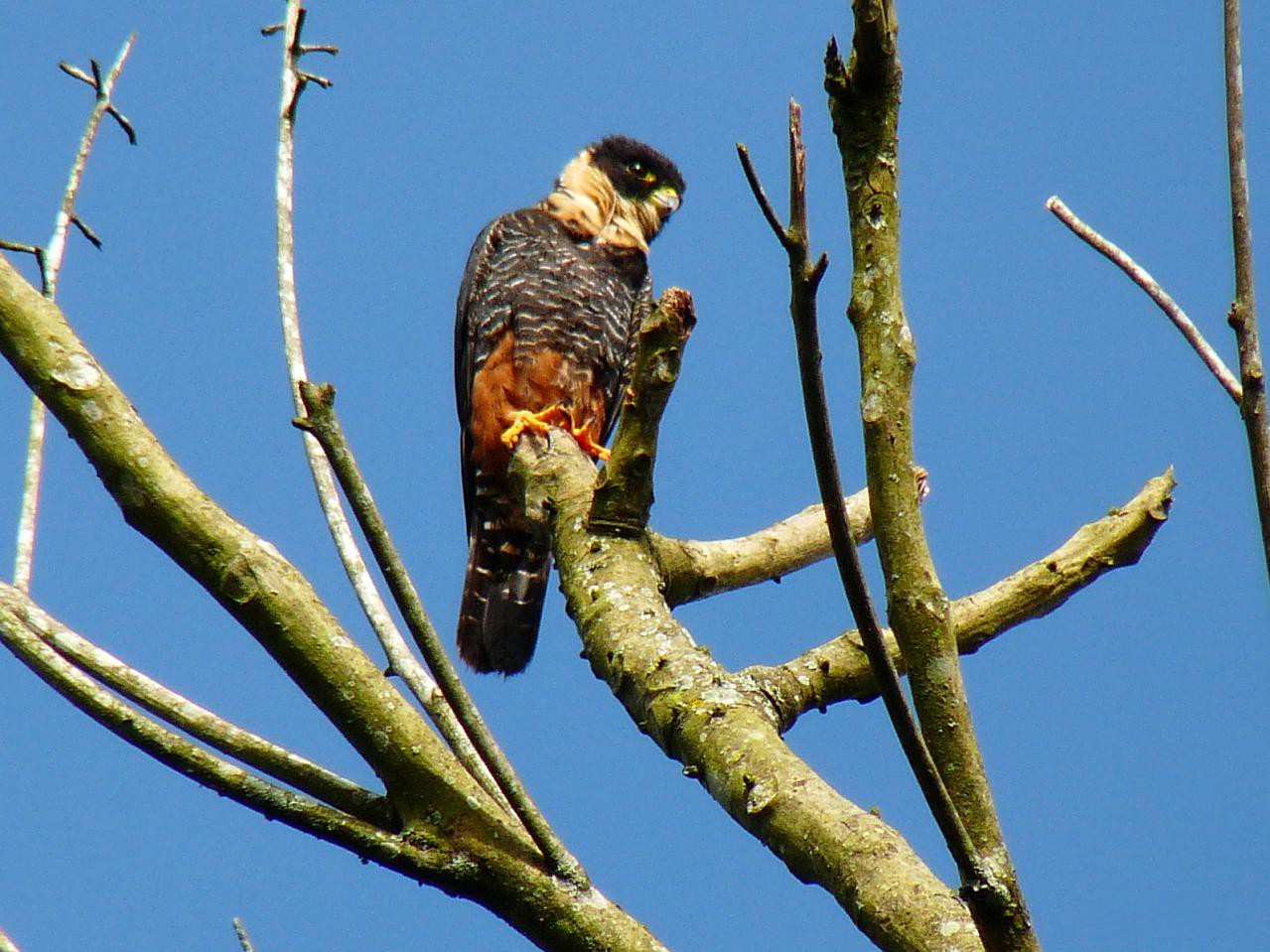
The Bat Falcon is a small, dark falcon of forest edges in tropical America, resident in the region only on Trinidad. As its name suggests it hunts bats at dusk, but during the day it also catches swifts, swallows, other small birds and large insects in the air. Pairs often use the same tall, bare tree for years.
Voice
A rapid, high series kee-kee-kee-kee or kew-kew-kew, mainly at the nest; the male calls higher than the female.
Recording: Jacob Wijpkema — CC BY-NC-SA 4.0 · converted to mono · xeno-canto
Identification
23–30 cm, compact, with long, pointed wings, a rather short tail and a large head. Head and upperparts are blue-black, the throat, upper breast and a narrow collar white to buff. The breast is black with fine white bars, forming a dark band; belly, thighs and undertail coverts are rufous. The tail has narrow white bars. The legs are yellow. The female is clearly larger than the male. Juveniles have a buffier throat and a less rufous belly.
Confusion species
Merlin Falco columbarius is streaked below and lacks the contrast between white throat and rufous belly. Peregrine Falcon Falco peregrinus is much larger, with a broad moustache and pale, barred underparts. Aplomado Falcon Falco femoralis is slimmer and long-tailed, with a white supercilium and a dark belly band above rusty thighs. American Kestrel Falco sparverius has a rufous back.
Habitat
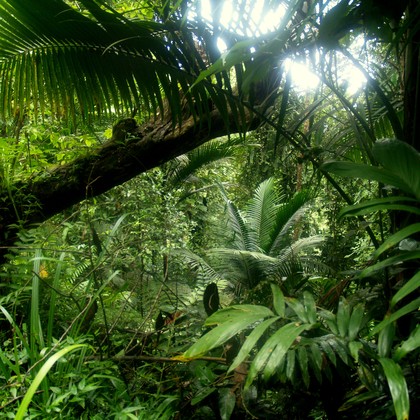
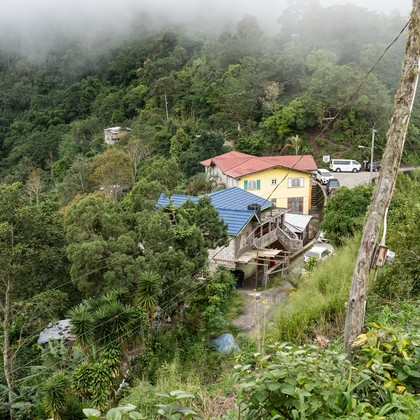
Edges and clearings of humid and semi-evergreen forest, forested streams, open plantations with tall shade trees and wooded villages, from the lowlands into the mountains. It perches in the open on a tall bare branch or mast and attacks prey in the air, mainly in early morning, at dusk and until after sunset. It nests in tree cavities, old nests or holes in buildings.
Where the bird is most at home, classified by the vegetation types of the Caribbean.



Range and movements
Scarce resident on Trinidad, mainly in the Northern Range and along forest edges in the north and centre of the island. A vagrant to Tobago. Outside the region from Mexico through Central America to northern Argentina.
- Resident
- dark = core range, pale = thinly spread
How and when to look
Best in the Arima Valley and other valleys of the Northern Range, in early morning or at dusk, by scanning tall, bare trees above the forest. An occupied lookout tree is often used daily.
Conservation status
Not threatened. The species is widespread and tolerates open, partly cleared landscapes as long as tall trees remain.
Scientific name
Falco rufigularis | Daudin, 1800
Daudin described the species in 1800 and placed it straight away in the genus where it still stands. The genus Falco was introduced in 1758 by Linnaeus. Falco is Late Latin for 'falcon', from falx, falcis 'sickle', after the sickle-shaped claws of the bird. rufigularis is Latin, from rufus 'rufous' and gula 'throat': 'red-throated', although adults' throats are mostly whitish to buff. The specimen the first description was based on came from Cayenne, French Guiana.