All species › Passerines › Weavers › Northern Red Bishop
Northern Red Bishop | Euplectes franciscanus
Oranje wever | Obispo anaranjado
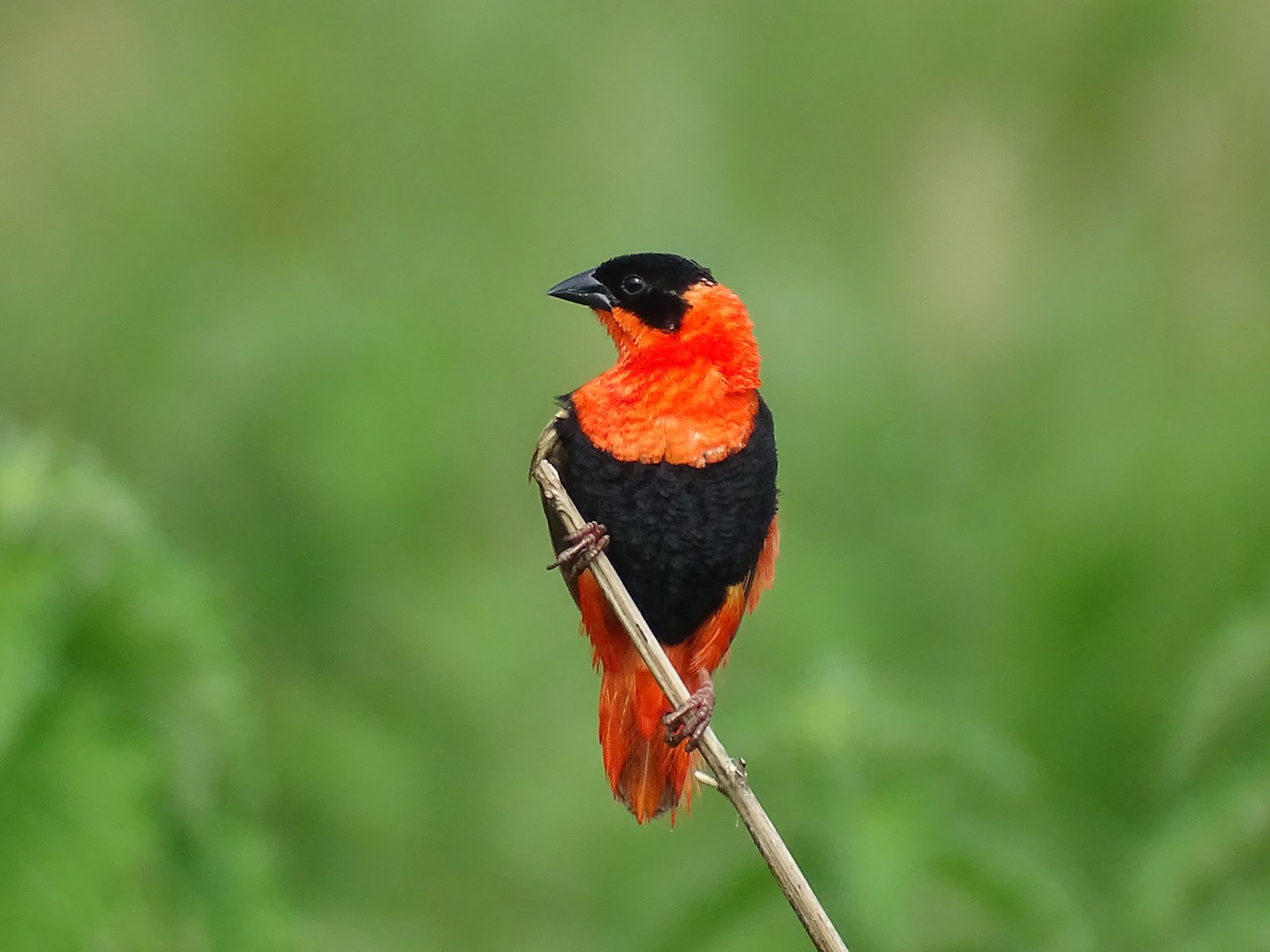
The Northern Red Bishop is a small, stocky weaver from the savanna belt of Africa north of the equator. In the Caribbean it descends from escaped and released cage birds. It has been known on Puerto Rico since 1971; on Jamaica birds escaped in 1988 from a cage blown away by Hurricane Gilbert. The breeding male fluffs up its orange-red feathers and flies low over its territory like a bumblebee.
Voice
The male's song, from a reed plume or grass stem, is a monotonous, sizzling and buzzing twitter, mixed with dry ticks. The call is a short tchip. Outside the breeding season the male sings little or not at all.
Recording: Sun Madakan — CC BY-NC-SA 4.0 · shortened to the first 60 s, mono · xeno-canto
Identification
10–11 cm, with a short tail and a conical bill. The breeding male has a black forehead, face and crown and a black belly; hindcrown, nape, back, throat, breast and the long under- and uppertail coverts are orange-red. Wings and tail are brown, the bill black. The female and non-breeding male are brown with heavy dark streaking above, a pale buff supercilium and pale underparts finely streaked on breast and flanks; the bill is then horn-coloured. Males may be seen in every stage of moult.
Confusion species
Females and non-breeding birds are hardly separable in the field from those of Yellow-crowned Bishop Euplectes afer; the company of breeding males helps with identification. The female Pin-tailed Whydah Vidua macroura has a red bill and a more boldly striped head. Grasshopper Sparrow Ammodramus savannarum has a flatter head, a more pointed bill and an unstreaked buff breast. The male Red Avadavat Amandava amandava is red with white spots and has a red bill.
Habitat
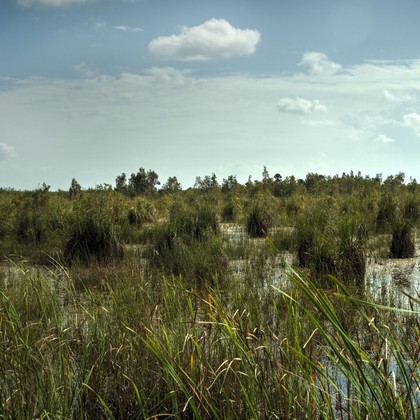
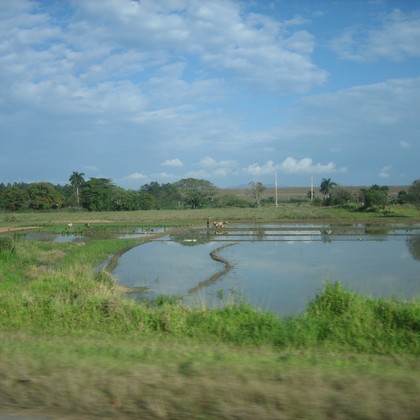
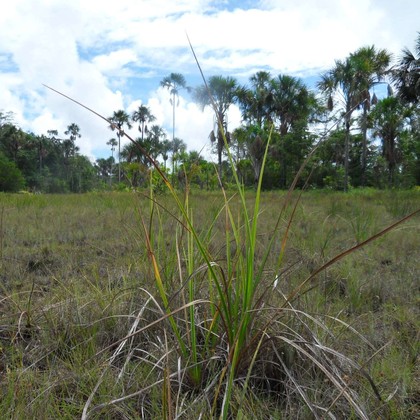
Sugarcane fields with grassy margins, tall wet grass, reeds along water, rice fields and rank grassland in the lowlands. It feeds mainly on grass seeds. The male builds several globular grass nests in dense reeds or cane, often near water, and mates with several females; only the female incubates and feeds the young.
Where the bird is most at home, classified by the vegetation types of the Caribbean.


Range and movements
On Puerto Rico fairly scarce along the north coast, from San Juan to Arecibo; rare on Vieques. On Jamaica scarce, mainly in the cane fields near Caymanas in St Catherine. Introduced and established on Guadeloupe, including Marie-Galante, and Martinique. A few records come from St. Croix, and the species is listed for Barbados in the literature without recent reports. On Cuba only a female collected near Varadero in 1959, also the first weaver for the island. Native from Senegal to Ethiopia and Uganda; also introduced to California.
- Resident
- dark = core range, pale = thinly spread
How and when to look
On Puerto Rico in the grassy margins of cane fields and wet grassland along the north coast. Breeding males are seen mainly from May to August, when they sing from tall stems and perform display flights.
Conservation status
Not globally threatened. An introduced species in the Caribbean. Little is known about its effects on native species.
Scientific name
Euplectes franciscanus | (Isert, 1789)
Isert described the species in 1789 as Loxia franciscana; because it was later moved to another genus, the author and year stand in brackets. The genus Euplectes was introduced in 1829 by Swainson. Euplectes joins Greek eu 'fine, good' to New Latin plectes 'weaver'. franciscanus is New Latin for 'Franciscan'; according to Jobling an allusion to the 'scarlet' robes of the Franciscans, although that order actually wore brown or grey. The specimen the first description was based on came from Accra, Ghana.