All species › Passerines › Weavers › Village Weaver
Village Weaver | Ploceus cucullatus
Grote textorwever | Tejedor Común
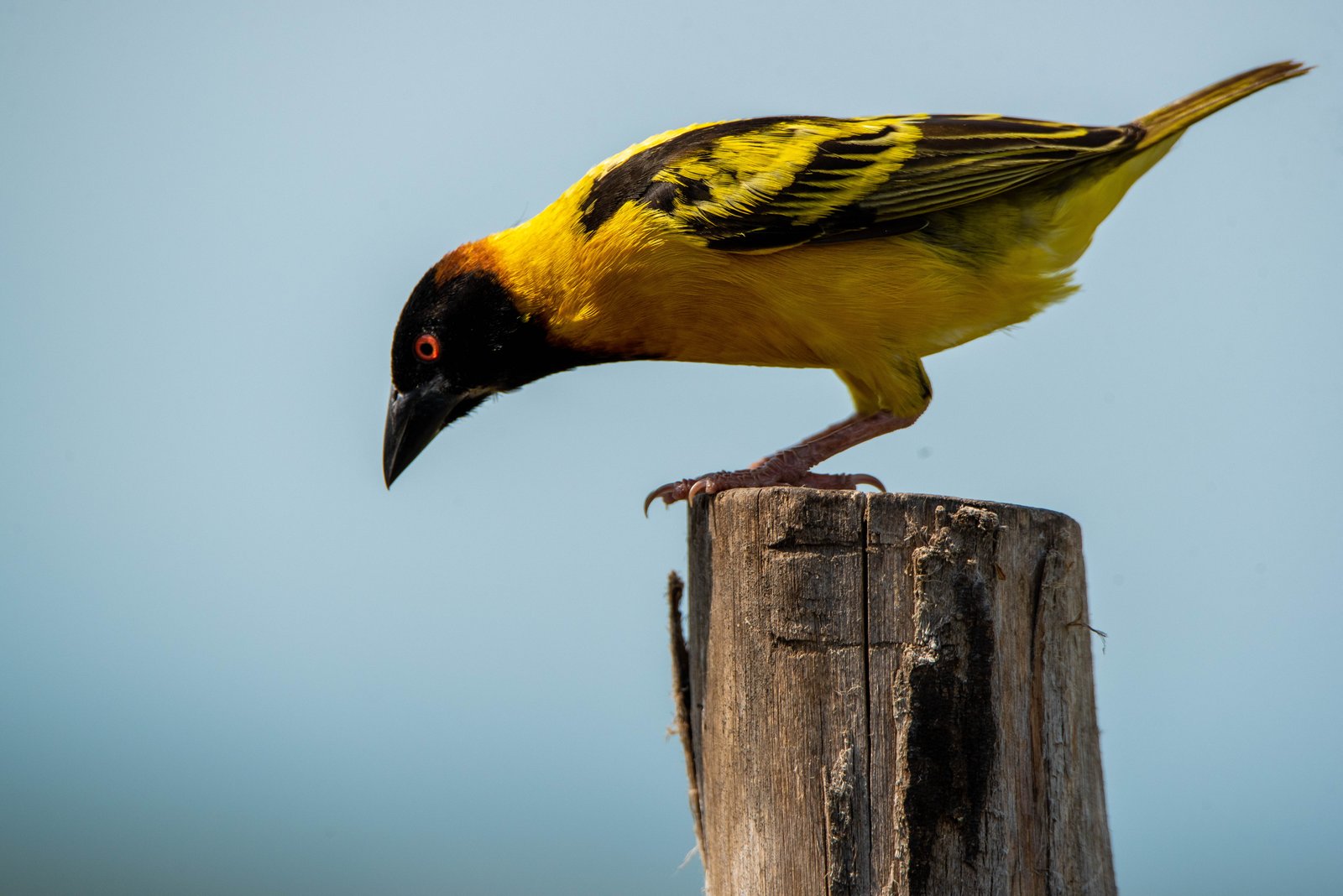
The Village Weaver is a stocky yellow weaver from Africa south of the Sahara. It has lived on Hispaniola since the late eighteenth century, probably arriving from West Africa. In the Dominican Republic it is called madam sagá, in Haiti madan sara. Birds breed in noisy colonies, sometimes with dozens of hanging woven nests in a single tree.
Voice
Colonies produce a constant chatter of short, rattling and hissing notes. The male's song is a jumbled series of harsh notes ending in a buzzy, wheezing whistle. The call is a short chak. When displaying, the male hangs beneath his nest, fluttering his wings and singing.
Recording: JJSUN — CC BY-NC-SA 4.0 · converted to mono · xeno-canto
Identification
15–17 cm, stocky, with a heavy, conical black bill and, in adults, a red eye. The breeding male has a black head and throat, bordered chestnut on the nape and sides of the neck. The mantle is yellow spotted with black, the wings black with yellow edges, the tail olive-green and the underparts bright yellow. The female is olive-green above with dark streaks on the back, with a yellow supercilium and throat, a yellowish breast and a whitish belly; the wings are black with yellow edges, as in the male. The non-breeding male resembles the female but is greyer on the back. Juveniles are duller, with a brown eye.
Confusion species
There is no other weaver on Hispaniola. Hispaniolan Oriole Icterus dominicensis is also black and yellow, but slimmer, with a thin, pointed bill, a long black tail and a black back. On Trinidad the male Yellow-hooded Blackbird Chrysomus icterocephalus shows the reverse pattern: a yellow head on a black body. Saffron Finch Sicalis flaveola is smaller, plain yellow with an orange crown and no black in the wing.
Habitat
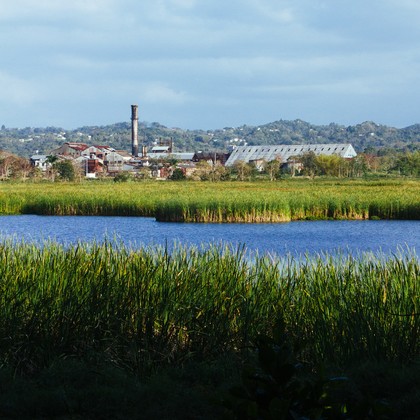
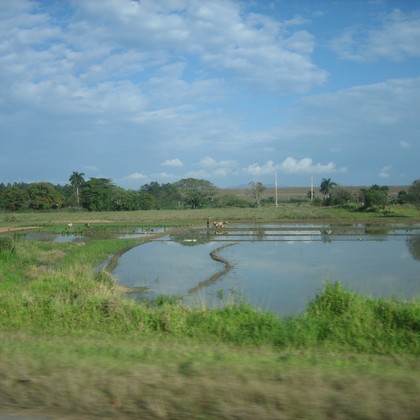
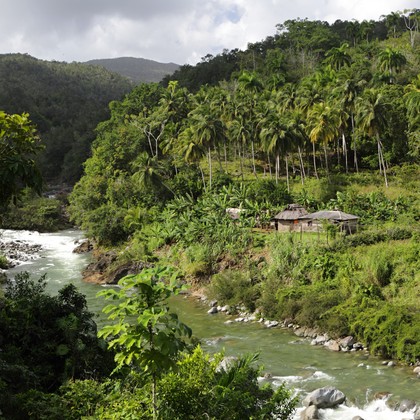
Open country with large trees close to people: villages, gardens, parks, yards, fields, rice paddies and riverbanks in the lowlands. It eats mainly seeds, including rice and maize, as well as insects. It is regarded as a pest of rice. The male weaves the nest from strips of palm or grass leaf, with the entrance at the bottom; colonies often hang in palms, which are partly stripped bare in the process.
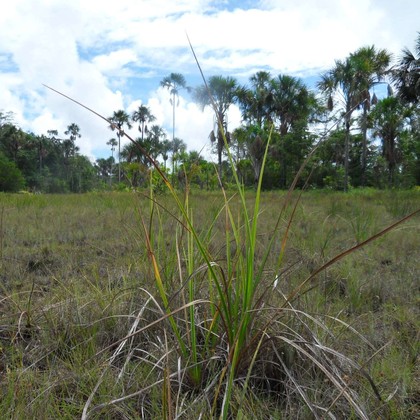
Where the bird is most at home, classified by the vegetation types of the Caribbean.


Range and movements
Common on Hispaniola, in both the Dominican Republic and Haiti, mainly in the lowlands. Introduced and established on Martinique. On Trinidad a small group has been present at Caroni Rice Fields since about 2014, with a single record elsewhere on the island. An established population is mentioned for Puerto Rico in the literature, but recent records are lacking. Native to much of Africa south of the Sahara; also introduced to Mauritius and Réunion, Venezuela and Portugal.
- Resident
- dark = core range, pale = thinly spread
How and when to look
In the Dominican Republic it occurs almost everywhere in the lowlands, including towns and hotel grounds. Colonies are located by sound and often hang in palms along roads and near villages. On Trinidad, Caroni Rice Fields is the place to look for it.
Conservation status
Not globally threatened. An introduced species in the Caribbean. Common on Hispaniola and considered harmful to agriculture; little is known about its effects on native birds.
Scientific name
Ploceus cucullatus | (Müller, 1776)
Müller described the species in 1776 as Oriolus cucullatus; because it was later moved to another genus, the author and year stand in brackets. The genus Ploceus was introduced in 1816 by Cuvier, GLCFD. Ploceus is Greek, from plokeus 'braider', from plekō 'to plait', after the woven nests. cucullatus is Latin for 'hooded', from cucullus, 'hood' — for the male's black head. The specimen the first description was based on came from Senegal.