All species › Passerines › Weavers › Yellow-crowned Bishop
Yellow-crowned Bishop | Euplectes afer
Napoleonwever | Obispo coronigualdo
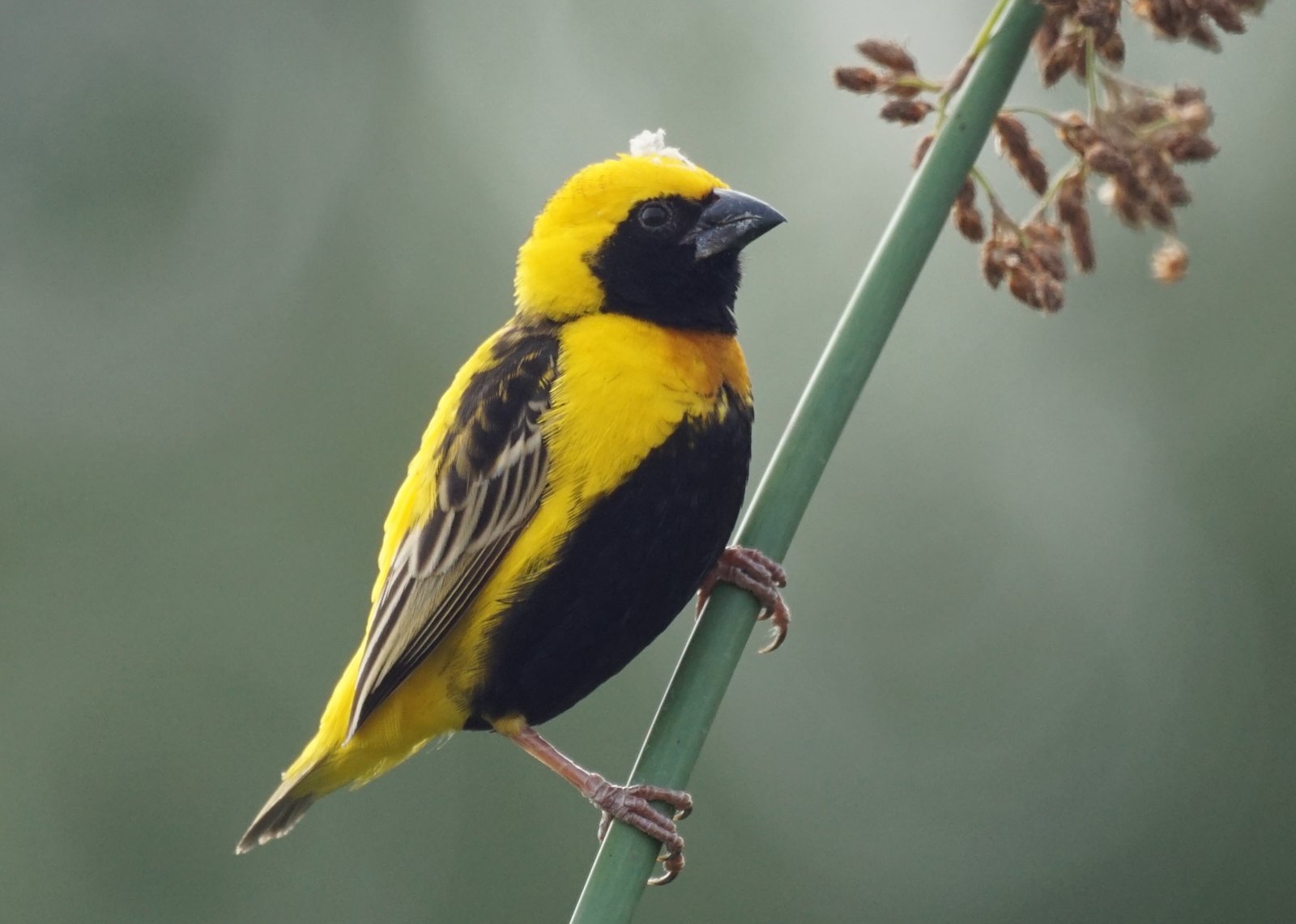
The Yellow-crowned Bishop is one of the smallest weavers, native to Africa south of the Sahara. In the Caribbean it descends from escaped cage birds: it has been known on Puerto Rico since 1971 and on Jamaica since Hurricane Gilbert blew away a cage of birds in 1988. The breeding male is golden yellow and black and draws attention with its slow, buzzing display flight over the reeds. On Puerto Rico it is also called napoleón tejedor.
Voice
A high, rasping and buzzing, insect-like zzzzzz, mixed with short zit-zit notes, from a stem or in flight. In display the male raises its yellow back feathers and flies slowly, with rapid wingbeats, over its territory.
Recording: Jorge Leitão — CC BY-NC-SA 4.0 · converted to mono · xeno-canto
Identification
9.5–10.5 cm, small and short-tailed, with a conical bill. The breeding male has a bright yellow crown, forehead and hindcrown, a yellow back and rump and a yellow shoulder patch. Face, throat, breast and belly are black, and a broad black band crosses the hindneck. Wings and tail are brown, the bill black. The female is pale brown above with dark streaks, with a pale supercilium and whitish underparts finely streaked dark on breast and flanks. The non-breeding male resembles the female.
Confusion species
The breeding male has no similar species in the region. Saffron Finch Sicalis flaveola is yellow with an orange crown but shows no black on head or underparts. Females and non-breeding birds closely resemble in the field those of Northern Red Bishop Euplectes franciscanus; look for breeding males in the flock. The female Pin-tailed Whydah Vidua macroura has a red bill.
Habitat
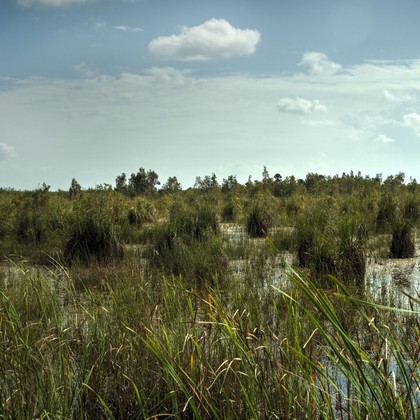
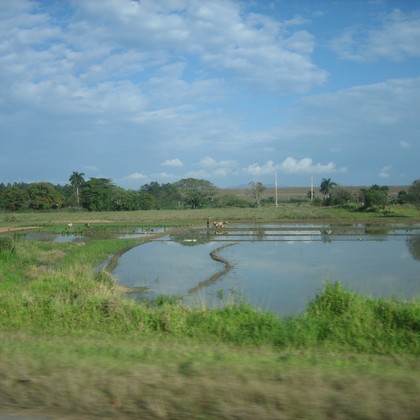
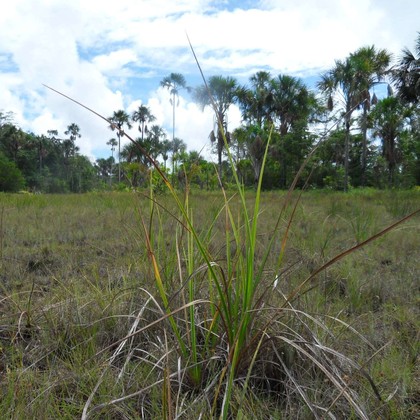
Freshwater marshes with tall grass, reeds and sedges, wet fields, rice fields, the edges of lagoons and rivers and rank grassland near water, including sewage ponds. It eats grass seeds. The male builds several oval grass nests low among grass stems, sedges or small shrubs; the female incubates alone.
Where the bird is most at home, classified by the vegetation types of the Caribbean.

Range and movements
On Puerto Rico fairly scarce, mainly in marshes around San Juan, including the Río Piedras botanical garden and Torrecillas, at Laguna Cartagena and Lajas, in the fields at Ponce airport, in the Humacao nature reserve and locally near Canóvanas and Río Grande. On Jamaica scarce, at a few wetlands near Kingston in St Catherine: the Caymanas dyke ponds, the Flashes and the Portmore sewage ponds. Native to much of Africa south of the Sahara; also introduced to Venezuela, Portugal, Spain and Japan.
- Resident
- dark = core range, pale = thinly spread
How and when to look
On Jamaica at the Portmore sewage ponds, on Puerto Rico at Laguna Cartagena and in the marshes around San Juan. Breeding males can be found by their display flight and buzzing song over tall grass.
Conservation status
Not globally threatened. An introduced species in the Caribbean. Little is known about its effects on native species.
Scientific name
Euplectes afer | (Gmelin, 1789)
Gmelin described the species in 1789 as Loxia afra; because it was later moved to another genus, the author and year stand in brackets. The genus Euplectes was introduced in 1829 by Swainson. Euplectes joins Greek eu 'fine, good' to New Latin plectes 'weaver'. afer is Latin for 'African'. The specimen the first description was based on came from Senegal.