All species › Waterfowl › Ducks and geese › Muscovy Duck
Muscovy Duck | Cairina moschata
Muskuseend | Pato real
The Muscovy Duck is a large, heavy duck of tropical America with a bare red face. It is not native to the islands: the birds living there by ponds, villages and farms are domestic or feral animals of a species domesticated in South America long before Europeans arrived. Only on Trinidad are wild birds from the mainland occasionally seen.
Voice
Mostly silent. The male hisses softly, especially in threat and display; the female gives a soft short quack or a chirping twitter, for instance to her young.
Recording: Manuel Grosselet — CC BY-NC-SA 4.0 · converted to mono · xeno-canto
Identification
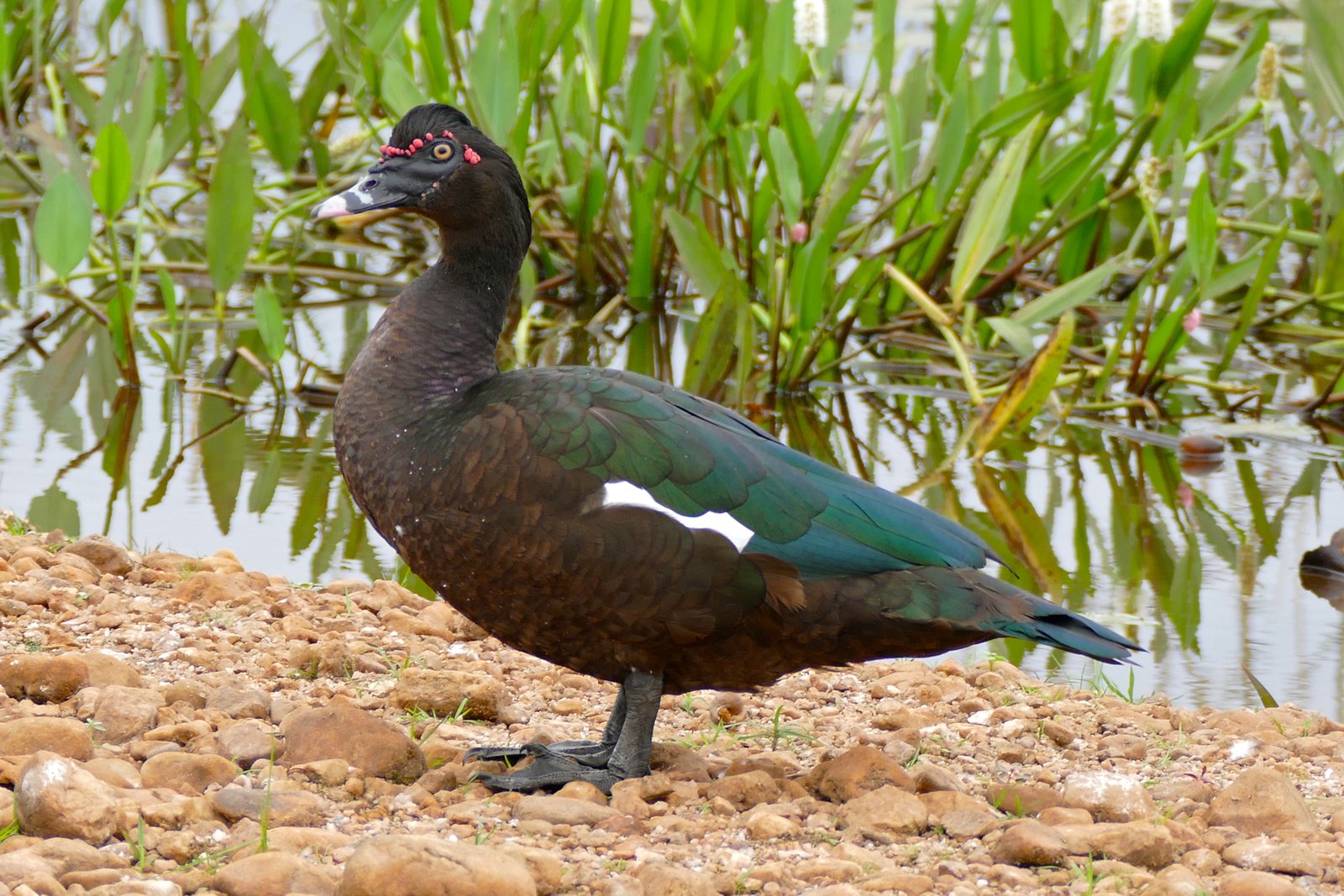
66–84 cm; the male is much larger than the female. The wild form is black with a green and purple gloss and large white patches on the forewing, clearly visible in flight. The male has bare blackish to red skin around the eye, a knob at the base of the bill and a short crest that it can raise. The female is smaller and duller, with little bare skin. Domestic and feral birds vary greatly: all white, pied black and white, grey or brown, often with much red, warty skin on the face. They stand low on the legs, have a long broad tail and walk with a waddle.
Confusion species
With its size, bare red facial skin and build the Muscovy is distinguished from other ducks. Domestic ducks of Mallard type Anas platyrhynchos are smaller and lack the bare skin; hybrids between the two occur and show features of both. Comb Duck Sarkidiornis sylvicola, a vagrant to Trinidad, is also black and white and the male has a knob on the bill, but it has a white head and neck speckled with black and white underparts.
Habitat
Domestic and feral birds live by ponds, ditches, rivers and reservoirs in and around villages, towns and farms, and often roam yards and pasture. Wild birds on the mainland live in wooded swamps, along rivers and by lagoons, and nest in tree holes. It eats plants, seeds, small animals and scraps.
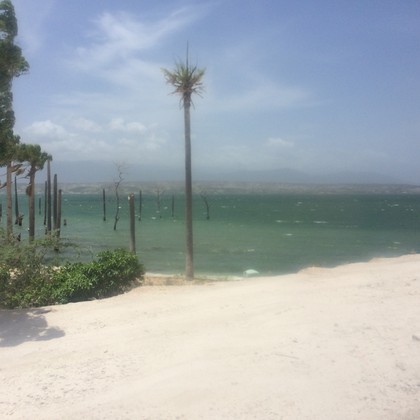
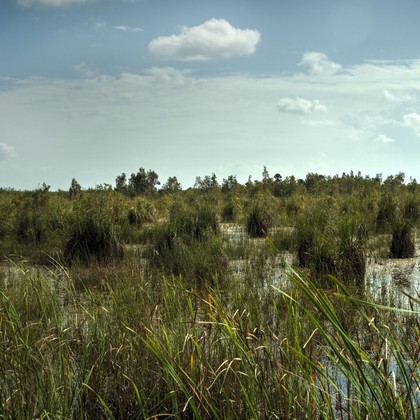
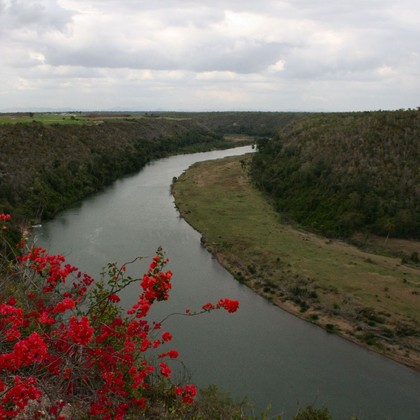
Where the bird is most at home, classified by the vegetation types of the Caribbean.


Range and movements
Domestic and feral birds occur on a large share of the islands, by farms and ponds, and breed there; in Cuba the species is regarded as introduced and breeding. Wild birds from the South American mainland are occasionally seen on Trinidad. Native to Central and South America, from Mexico to Peru, northern Argentina and Uruguay; feral populations live in the United States and Europe, among other places.
- Resident
- dark = core range, pale = thinly spread
How and when to look
Muscovies are often seen at village ponds and farms on most islands. A bird with the plain black, white-winged plumage of the wild form at a remote site on Trinidad may be a wild vagrant; away from Trinidad it is almost certainly an escaped or feral bird.
Conservation status
Not threatened globally, although wild populations have declined in parts of the range through hunting and the loss of waterside forest. In the Caribbean an alien: the birds are domestic or feral and sometimes interbreed with domestic ducks.
Scientific name
Cairina moschata | (Linnaeus, 1758)
Linnaeus described the species in 1758 as Anas moschata; because it was later moved to another genus, the author and year stand in brackets. The genus Cairina was introduced in 1822 by Fleming. Cairina derives from old names such as 'Cairo duck', given in the mistaken belief that the bird came from Egypt; it actually comes from tropical America. moschata is New Latin for 'of Muscovy' (Russia) or, on another reading, 'musky'; the duck in fact comes from tropical America. The specimen the first description was based on came from Brazil (later designated; originally 'India').