All species › Waders, gulls and terns › Sandpipers and snipes › Marbled Godwit
Marbled Godwit | Limosa fedoa
Marmergrutto | Aguja canela
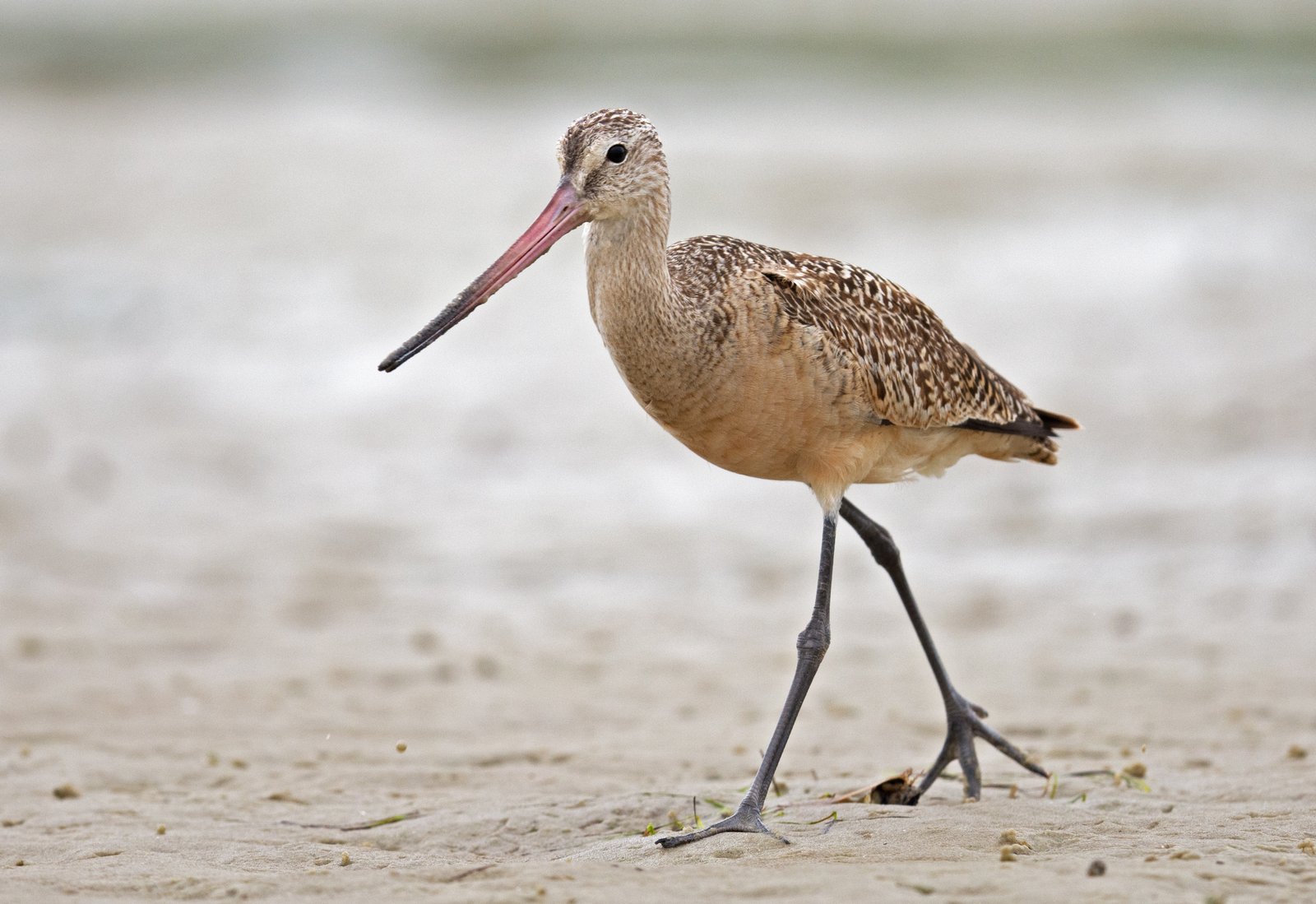
The Marbled Godwit is the largest American godwit, a cinnamon-brown shorebird with a long, slightly upturned bill. It breeds on the prairies of the northern United States and Canada and winters mainly on the coasts of the southern United States and Mexico. The Caribbean lies at the edge of its winter range; only in the Bahamas is it seen regularly.
Voice
A loud, nasal ka-wek or ker-wek, often repeated, and a laughing ka-ka-ka when alarmed.
Recording: Nancy Salem — CC BY-NC-SA 4.0 · converted to mono · xeno-canto
Identification
40–50 cm, of which 8–13 cm is bill. The bill is long, straight or slightly upturned, pink at the base and dark at the tip. The plumage is warm cinnamon-brown; the upperparts are spotted and barred dark, giving a marbled pattern. In non-breeding plumage the underparts are almost plain pale cinnamon, in breeding plumage finely barred dark. The legs are dark. In flight the cinnamon primaries and cinnamon-rufous underwing stand out; there is no white wing-bar and no white rump. The sexes are alike; females are larger and longer-billed.
Confusion species
Hudsonian Godwit Limosa haemastica is smaller and grey in non-breeding plumage, with a white wing-bar, black underwing and white tail band. Hudsonian Whimbrel Numenius hudsonicus is greyer, with a decurved bill and crown stripes. Willet Tringa semipalmata is grey, with a shorter straight bill and black-and-white wings.
Habitat
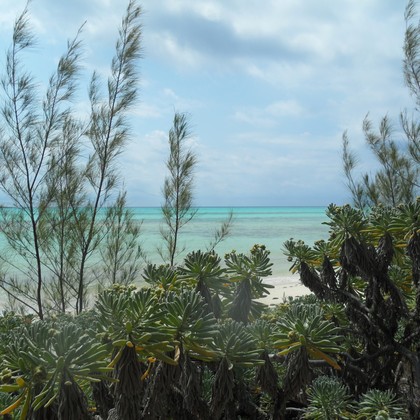
Mudflats and mudbanks, shallow saline lagoons, salt ponds and sandy beaches with muddy patches, sometimes near mangroves. It feeds by walking through shallow water and probing deep into the mud with its long bill for worms, bivalves and crustaceans.
Where the bird is most at home, classified by the vegetation types of the Caribbean.



Range and movements
In the Bahamas a scarce but regular winter visitor, on Cuba scarce to rare and mainly along the north coast. Rare elsewhere: there are records from the Cayman Islands, Jamaica, Hispaniola, Puerto Rico, the Virgin Islands, a few Lesser Antilles, the ABC Islands, San Andrés and Trinidad. Outside the region it breeds on the northern prairies of the United States and Canada, with small populations at James Bay and in Alaska, and winters along the coasts of the United States, Mexico and Central America, in small numbers to north-western South America.
- Resident
- Winter visitor (c. Apr–Sep)
- Passage (Mar–Apr, Oct–Nov)
- dark = core range, pale = thinly spread
How and when to look
In the Bahamas and on the northern cays of Cuba, large mudflats with other shorebirds are the best places. A lone Marbled Godwit often joins Willets or whimbrels and then stands out by its long, upturned, pink-based bill.
Conservation status
Vulnerable according to the IUCN. The breeding population is sensitive to the loss of prairie and wetlands on the breeding grounds, and the species depends on a small number of large intertidal areas in winter. In the Caribbean it is too scarce to play a role of its own in conservation.
Scientific name
Limosa fedoa | (Linnaeus, 1758)
Linnaeus described the species in 1758 as Scolopax Fedoa; because it was later moved to another genus, the author and year stand in brackets. The genus Limosa was introduced in 1760 by Brisson. Limosa is Latin for 'muddy', from limus 'mud'. fedoa may be an Old English name for a godwit, mentioned by William Turner in 1544; its origin is otherwise unknown. The specimen the first description was based on came from Hudson Bay, Canada.