All species › Passerines › Vireos › Mangrove Vireo
Mangrove Vireo | Vireo pallens
Mangrovevireo | Vireo manglero
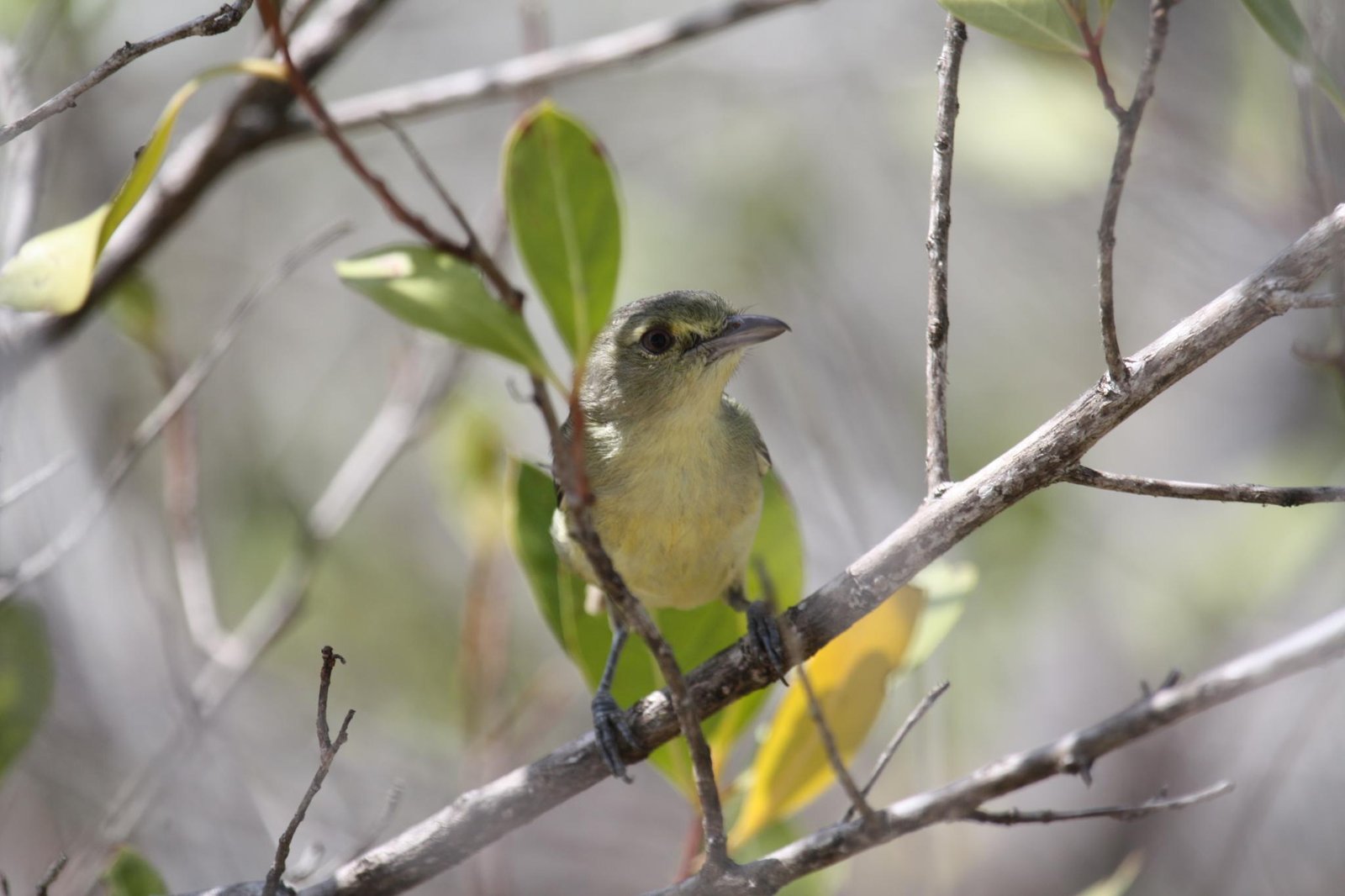
The Mangrove Vireo is a small, unobtrusive vireo of the coasts of Mexico and Central America. In the area covered by this guide only the subspecies approximans occurs, on Providencia and adjacent Santa Catalina off the coast of Nicaragua. These birds were long placed with Thick-billed Vireo and were treated by some authors as a separate species, Providencia Vireo; since the late 2010s mainstream checklists have placed them in Mangrove Vireo.
Voice
The song varies greatly between populations and usually consists of a series of rapid, scratchy or chipping notes. It also gives nasal or buzzy scolds and mewing calls.
Recording: Alán Palacios — CC BY-NC-SA 4.0 · converted to mono · xeno-canto
Identification
11–12 cm, small and compact, with a fairly short, stout bill. The upperparts are greenish brown to olive-grey, with a pale, buffy or yellowish supraloral line. The wing coverts are dark grey with two yellowish-white wing bars, and the flight feathers have narrow greenish-yellow edges. The chin is whitish yellow and the underparts greyish with a faint yellow tinge on the flanks. The iris is pale, straw-brown to dirty white, and the legs blue-grey. The sexes are alike. Subspecies differ in the amount of yellow.
Confusion species
San Andres Vireo Vireo caribaeus lives only on neighbouring San Andrés and does not occur on Providencia. Black-whiskered Vireo Vireo altiloquus also breeds on Providencia but is much larger, without wing bars, with a white supercilium, a black malar stripe and a red iris. White-eyed Vireo Vireo griseus has clear yellow spectacles and, in adults, a bright white iris. Mangrove Warbler Setophaga petechia is much yellower, with a thin bill.
Habitat
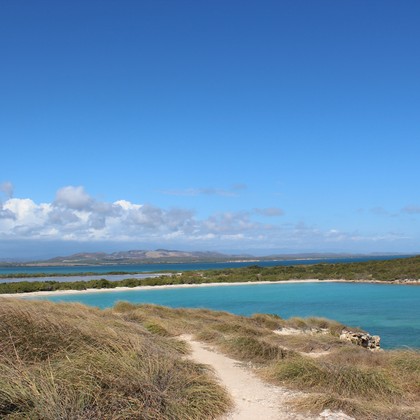
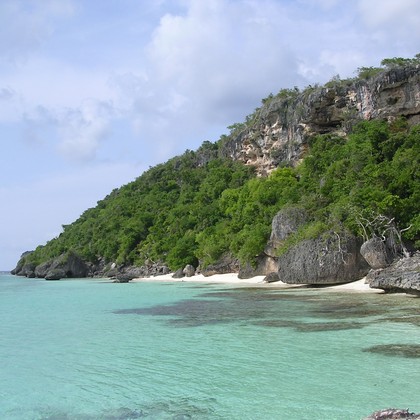
Mangrove and the scrub behind it, but on the islands of the western Caribbean also dry forest, coastal scrub, regrowth on abandoned fields and pastures and the edges of secondary forest. It searches dense low to mid-level vegetation for insects and often stays hidden.
Where the bird is most at home, classified by the vegetation types of the Caribbean.



Range and movements
In the area of this guide only on Providencia and Santa Catalina (Colombia). On San Andrés it is replaced by San Andres Vireo. Elsewhere from north-western Mexico along the Pacific coast, and from the Yucatán Peninsula along the Caribbean coast, to Costa Rica, with island populations including the Bay Islands of Honduras.
- Resident
- Winter visitor (c. Apr–Sep)
- Passage (Mar–Apr, Oct–Nov)
- dark = core range, pale = thinly spread
How and when to look
On Providencia in almost any scrub and along the edges of the mangroves; the repeated scratchy song gives it away. Because older sources and observation databases may list these birds under Thick-billed Vireo or as Providencia Vireo, it is worth checking all three names when looking up records.
Conservation status
Not threatened as a species. The population on Providencia and Santa Catalina is small because of the small land area and vulnerable to loss of scrub and mangrove and to hurricanes; no reliable estimates of its size are known.
Scientific name
Vireo pallens | Salvin, 1863
Salvin described the species in 1863 and placed it straight away in the genus where it still stands. The genus Vireo was introduced in 1808 by Vieillot. Vireo was used by Latin authors for a small, green, migratory bird, probably the Eurasian golden oriole, though the European greenfinch has also been suggested. pallens is Latin for 'pale', after the drab, low-contrast plumage. The specimen the first description was based on came from Realejo, Nicaragua (disputed; possibly Puntarenas, Costa Rica).