All species › Cuckoos › Cuckoos › Mangrove Cuckoo
Mangrove Cuckoo | Coccyzus minor
Mangrovekoekoek | Cuclillo de manglar
The Mangrove Cuckoo is the most widespread native cuckoo of the Caribbean: it lives year-round on almost every island, from the Bahamas and Cuba to the ABC Islands, Trinidad and Tobago and San Andrés. Despite its name it is by no means tied to mangroves here; on the larger islands it also inhabits dry forest, scrub, plantations and montane forest. It moves slowly and quietly through the foliage and is heard more often than seen.
Voice
The call is a series of guttural, nasal gawk gawk gawk gawk gauk gauk notes, the last ones fuller in tone. Also a single whit. It calls mainly in the breeding season, usually from dense foliage; outside that period it can stay silent for long spells.
Recording: GABRIEL LEITE — CC BY-NC-SA 4.0 · shortened to the first 60 s, mono · xeno-canto
Identification
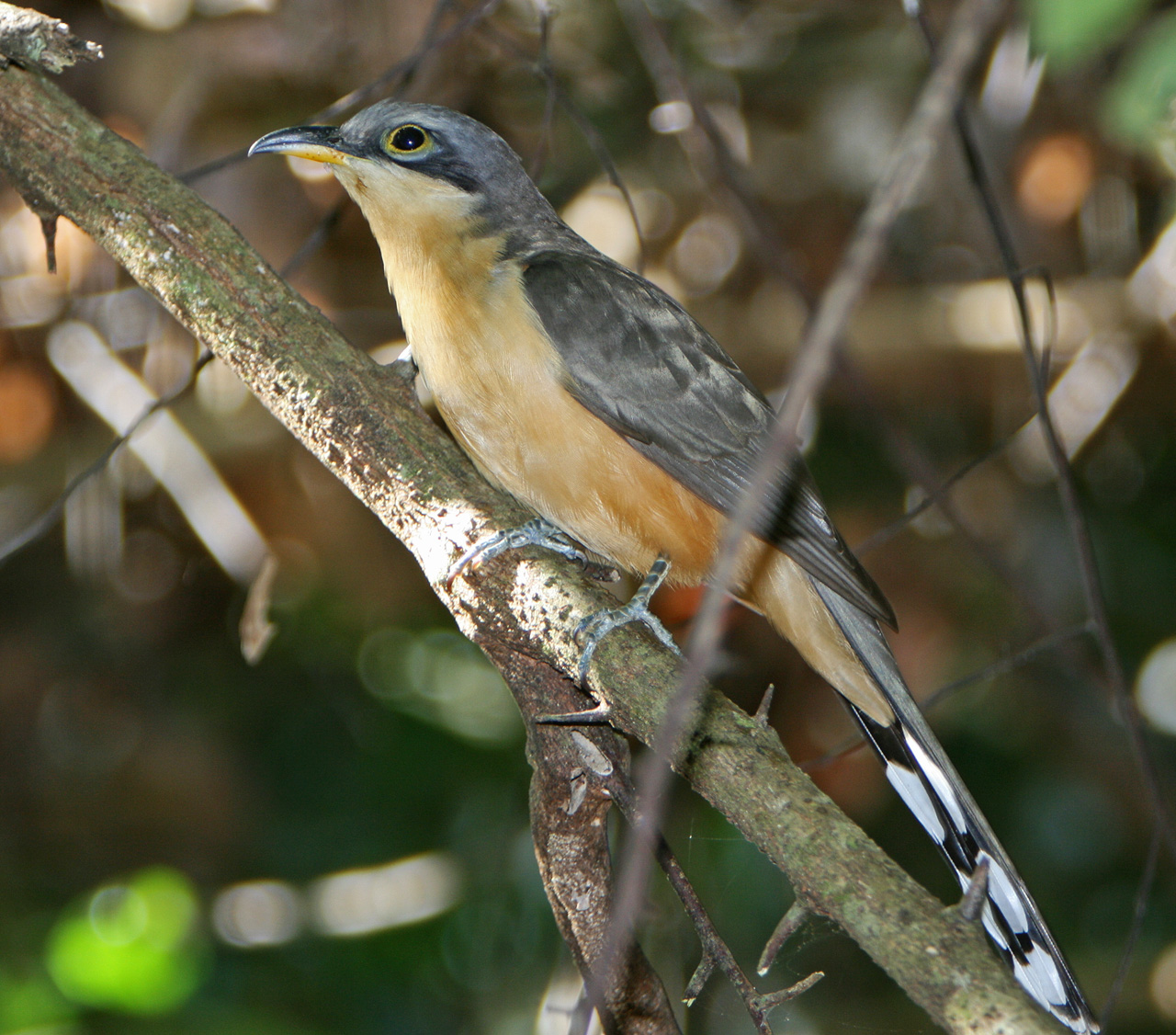
28–34 cm, more than half of it tail. Slender, with a slightly decurved bill: the upper mandible is black, the lower mandible largely yellow with a dark tip. The upperparts are grey-brown, the crown slightly greyer. A black mask runs through the eye and ear-coverts, with a narrow yellow eye-ring. Throat and breast are pale buff, the belly and undertail coverts a warmer buff to salmon-brown. The wing is plain brown, without a rufous patch in the primaries. From below the tail is black with broad white tips that form a pattern of blocks. The sexes are alike; juveniles have a fainter mask.
Confusion species
Yellow-billed Cuckoo Coccyzus americanus is pure white below, lacks the black mask and shows a rufous patch in the primaries in flight. Black-billed Cuckoo Coccyzus erythropthalmus, a rare passage migrant, is also white below, with an all-black bill, a red eye-ring and narrow white tail tips. On Trinidad and San Andrés there is also Dark-billed Cuckoo Coccyzus melacoryphus, which is smaller, with a grey crown, grey neck sides and an all-dark bill.
Habitat
Mangroves and coastal woodland, but on most islands also dry deciduous forest, thorn scrub, coastal scrub, limestone hills, coffee plantations and moist forest up into the mountains; in Puerto Rico it occurs at all elevations. It eats mainly caterpillars and grasshoppers, as well as other insects and their larvae, spiders, snails, small lizards, eggs and nestlings, and some fruit. The nest is a loose platform of twigs low in a tree or bush, in mangroves often two to three metres above the water; the clutch is usually two eggs.
Where the bird is most at home, classified by the vegetation types of the Caribbean.





Range and movements
Resident on almost every island in the region: the Bahamas and the Turks and Caicos Islands, Cuba, the Cayman Islands, Jamaica, Hispaniola, Puerto Rico and the Virgin Islands, the Lesser Antilles from Anguilla and Sint Maarten to Grenada, the ABC Islands, Trinidad and Tobago and San Andrés. Outside the region it occurs in southern Florida, along both coasts of Mexico, in Central America and along the Atlantic coast of South America to the mouth of the Amazon.
- Resident
- Summer visitor (c. Oct–Mar)
- Winter visitor (c. Apr–Sep)
- Passage (Mar–Apr, Oct–Nov)
- dark = core range, pale = thinly spread
How and when to look
In Puerto Rico the species is common in many places, from dry coastal forest to montane forest; on the smaller islands mangroves and dry scrub along quiet bays offer the best chance. The call in the early morning is the quickest lead. The bird itself often sits motionless deep inside a tree and is noticed only when it flies to another branch and the black-and-white tail pattern flashes.
Conservation status
Not threatened. Habitat is lost locally through the clearing of mangroves and coastal development, but because it also lives in dry forest, scrub and plantations it depends on mangroves less than its name suggests.
Scientific name
Coccyzus minor | (Gmelin, 1788)
Gmelin described the species in 1788 as Cuculus minor; because it was later moved to another genus, the author and year stand in brackets. The genus Coccyzus was introduced in 1816 by Vieillot. Coccyzus is Greek, from kokkuzō 'to cry cuckoo', after the cuckoo's call. minor is Latin for 'smaller'. The specimen the first description was based on came from Cayenne, French Guiana.