All species › Cuckoos › Cuckoos › Black-billed Cuckoo
Black-billed Cuckoo | Coccyzus erythropthalmus
Zwartsnavelkoekoek | Cuclillo piquinegro
The Black-billed Cuckoo breeds in southern Canada and the northern and eastern United States and winters in north-western South America. Its migration route runs largely over Central America, so it reaches the Caribbean only at the western edge and in small numbers. Most records are from October, from the Cayman Islands, Cuba, the Bahamas and San Andrés.
Voice
Usually silent on migration. The song on the breeding grounds is a rhythmic, hollow coo-coo-coo in groups of two to five notes, repeated for long periods. Also soft clucking and rattling sounds.
Recording: Jeff Stewart — CC BY-NC-SA 4.0 · converted to mono · xeno-canto
Identification
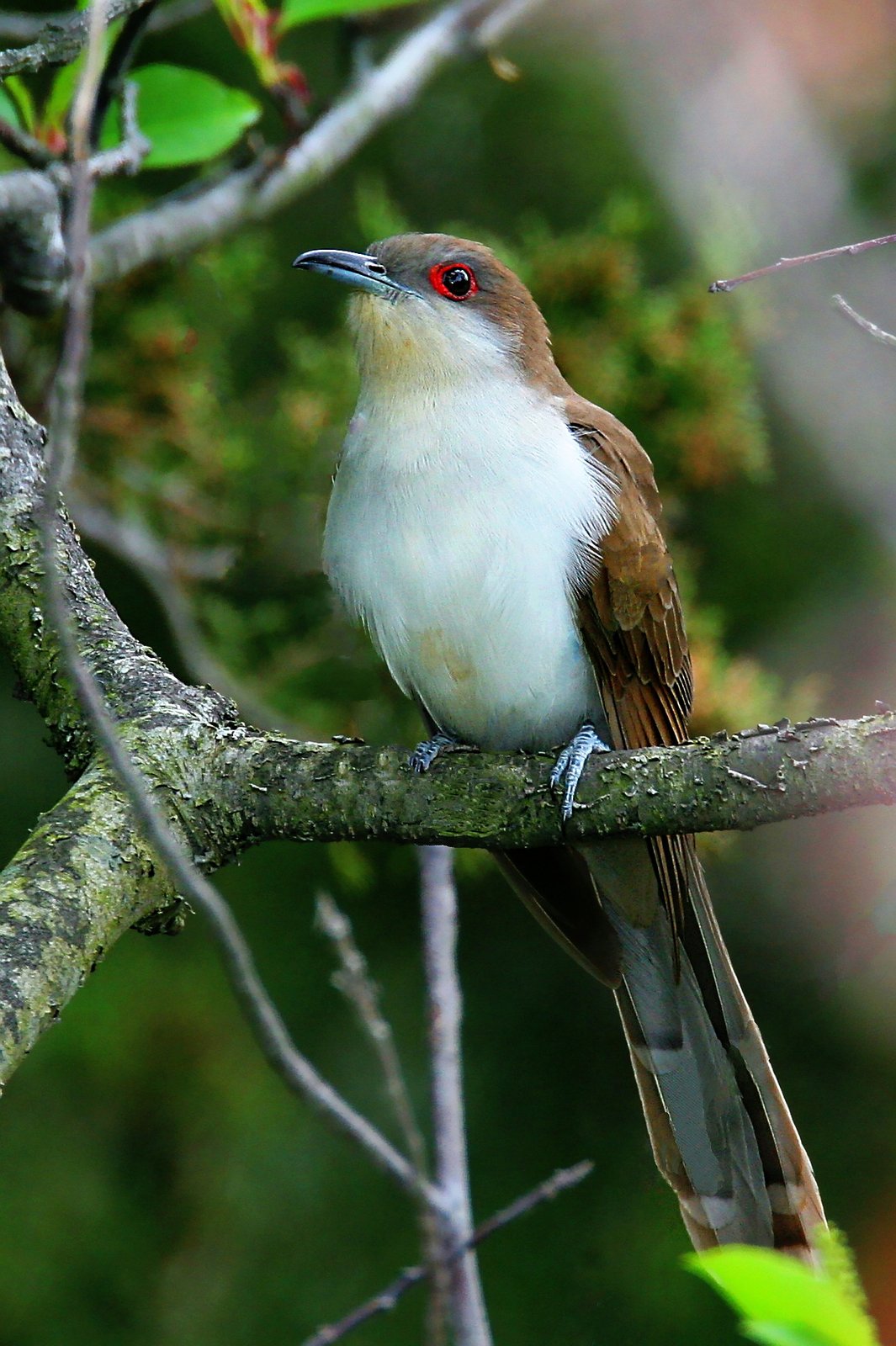
28–31 cm, slender and long-tailed. Plain grey-brown above, white to dingy white below, without a buff tinge. The bill is all black and slightly decurved; adults have a narrow ring of red bare skin around the eye. From below the tail is grey with narrow white tips and a dark band before them, lacking the broad white blocks of related species. The wing shows at most a faint warm wash, no obvious rufous patch. Juveniles have a pale yellow to greyish eye-ring, more rufous in the primaries and fainter white tail tips, and so look more like Yellow-billed Cuckoo.
Confusion species
Yellow-billed Cuckoo Coccyzus americanus, far commoner in the region, has a yellow lower mandible, a yellow eye-ring, a clear rufous patch in the primaries and a black undertail with broad white spots. Mangrove Cuckoo Coccyzus minor has a black mask, a buff belly and also a yellow lower mandible. Dark-billed Cuckoo Coccyzus melacoryphus of Trinidad and San Andrés also has a dark bill, but a grey crown, a dark mask and buff underparts.
Habitat
On passage almost any wooded habitat: coastal woodland, dry deciduous forest, semi-evergreen forest, scrub and gardens with trees. Birds landing after a night flight often make for the first copse near the coast. It eats mainly caterpillars, including hairy species that many other birds avoid, and other insects. On the breeding grounds it follows outbreaks of caterpillar plagues.
Where the bird is most at home, classified by the vegetation types of the Caribbean.




Range and movements
Rare passage migrant in the west of the region. Most records come from the Cayman Islands, Cuba, the Bahamas and San Andrés, with scattered records from August, a peak in October and a few in November; there are a few spring records in May. Further east it is exceptional, with a few records from Hispaniola, Puerto Rico, Guadeloupe and Barbados. Outside the region it breeds from southern Canada to the central and eastern United States; it migrates through the southern United States and Central America and winters in north-western South America.
- Passage (Mar–Apr, Oct–Nov)
- dark = core range, pale = thinly spread
How and when to look
The best chance is in October in the Cayman Islands and Cuba, in coastal woods and gardens where other migrants also make landfall. In a cuckoo with white underparts the bill is the first feature to check; the eye-ring, the wing and the undertail pattern then confirm the identification. Juveniles with rufous in the wing are the main pitfall.
Conservation status
Not threatened, but numbers are falling on the breeding grounds. Causes cited are forest loss, the use of insecticides against caterpillar outbreaks and collisions with buildings on migration. For the Caribbean, given the small numbers, the species is little more than a rare transient.
Scientific name
Coccyzus erythropthalmus | (Wilson, 1811)
Wilson described the species in 1811 as Cuculus erythropthalma; because it was later moved to another genus, the author and year stand in brackets. The genus Coccyzus was introduced in 1816 by Vieillot. Coccyzus is Greek, from kokkuzō 'to cry cuckoo', after the cuckoo's call. erythropthalmus is Greek, from eruthros 'red' and ophthalmos 'eye', after the red eye-ring. The specimen the first description was based on came from near Philadelphia, Pennsylvania, United States.