All species › Woodpeckers and allies › Woodpeckers › Lineated Woodpecker
Lineated Woodpecker | Dryocopus lineatus
Gestreepte helmspecht | Carpintero lineado
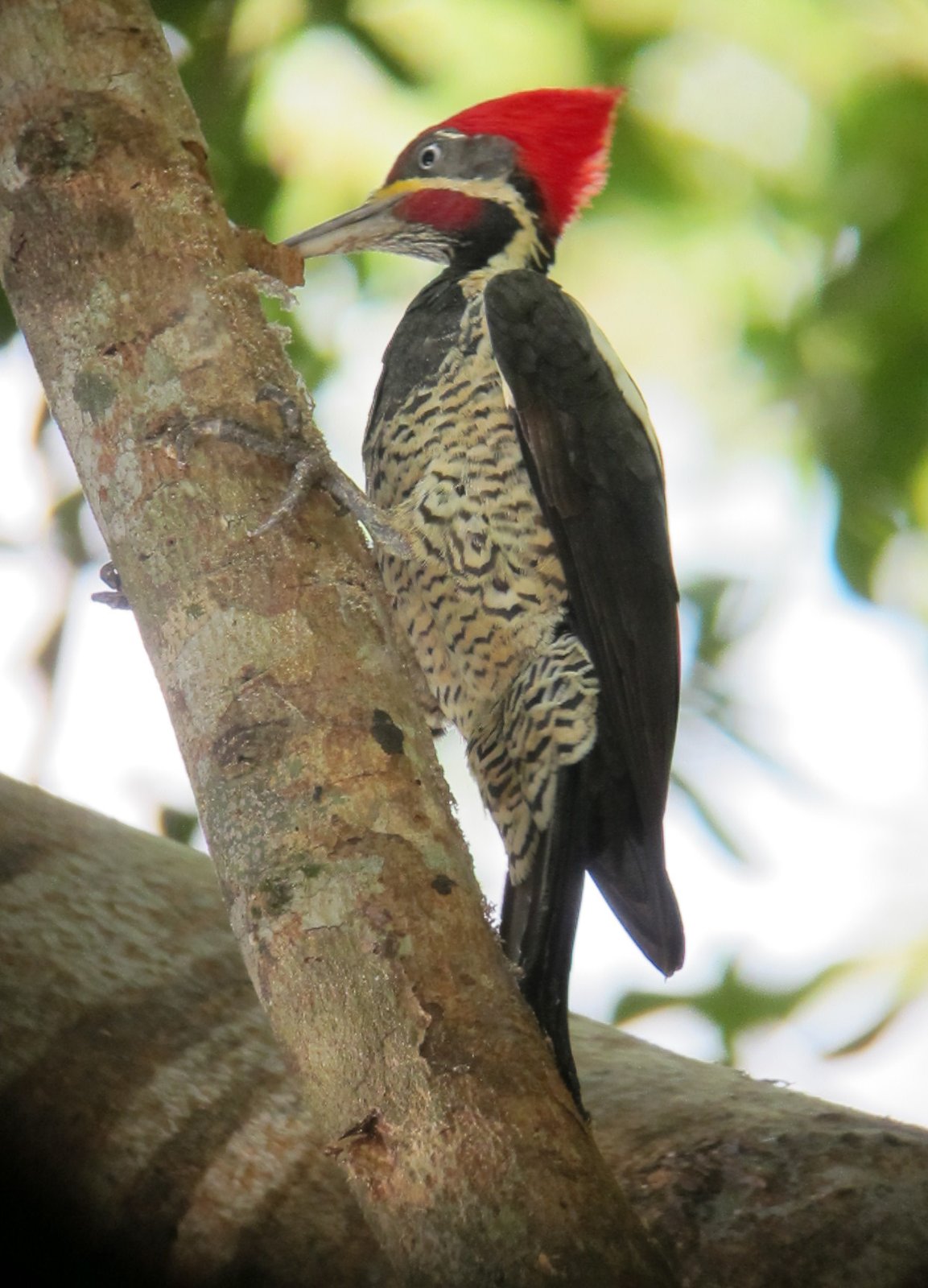
The Lineated Woodpecker is a large, black woodpecker with a red crest that in the region occurs only in Trinidad. It lives along forest edges and in semi-open country with scattered trees, and is therefore seen more often than many forest woodpeckers. Trinidad also has the Crimson-crested Woodpecker, which looks very similar.
Voice
A loud, ringing series wic-wic-wic-wic, carrying far, and a short, sharp pik or pik-krrr. Both sexes drum in a long, accelerating roll.
Recording: JAYRSON ARAUJO DE OLIVEIRA — CC BY-NC-SA 4.0 · converted to mono · xeno-canto
Identification
31–36 cm. The upperparts are black and the head carries a pointed red crest. A narrow white line runs from the bill base along the side of the neck to the shoulder; two white stripes on the scapulars run parallel and do not meet on the back. Throat streaked, underparts pale buff to white with dense black barring. The male has a red forehead and red moustache; in the female the forehead and moustache are black. The bill is pale horn. In flight the white underwings stand out.
Confusion species
Crimson-crested Woodpecker Campephilus melanoleucos is the same size and similarly patterned, but its white scapular stripes meet on the back in a V. The male has an almost entirely red head with a small white and black cheek spot; the female has a broad white stripe from the bill base across the cheek. Chestnut Woodpecker Celeus elegans is chestnut-brown.
Habitat
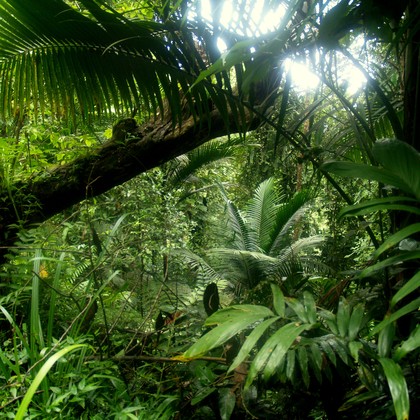
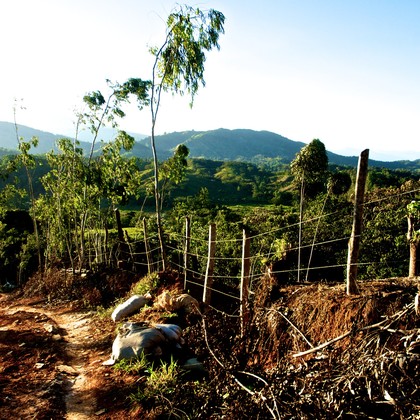
Forest edges, open woodland, secondary forest, plantations with shade trees, pastures and farmland with scattered large trees, and the edges of mangrove and swamp forest, mainly in the lowlands. It eats ants, beetle larvae and other insects dug from trunks and branches, as well as fruit and seeds. It excavates a nest hole in a dead tree; in Trinidad it breeds mainly from February to April.
Where the bird is most at home, classified by the vegetation types of the Caribbean.



Range and movements
In the region only in Trinidad, where it is a fairly common resident. Not in Tobago. Outside the region from Mexico through Central America to South America, as far as northern Argentina.
- Resident
- dark = core range, pale = thinly spread
How and when to look
In Trinidad in open wooded country and along forest edges, also in cocoa plantations and around villages with large trees. The ringing call and loud drumming give the bird away. With any large black woodpecker with a red head, checking the scapular stripes and face separates it from Crimson-crested Woodpecker.
Conservation status
Not threatened. The species has a large range and tolerates semi-open, man-modified landscapes with large trees.
Scientific name
Dryocopus lineatus | (Linnaeus, 1766)
Linnaeus described the species in 1766 as Picus lineatus; because it was later moved to another genus, the author and year stand in brackets. The genus Dryocopus was introduced in 1826 by Boie. Dryocopus goes back to Greek druokopos 'woodpecker', from druos 'tree' and kopos 'beating'. lineatus is Latin for 'lined', after the white stripe along the neck and back. The specimen the first description was based on came from Cayenne, French Guiana.