All species › Woodpeckers and allies › Woodpeckers › Chestnut Woodpecker
Chestnut Woodpecker | Celeus elegans
Vaalkuifspecht | Carpintero castaño
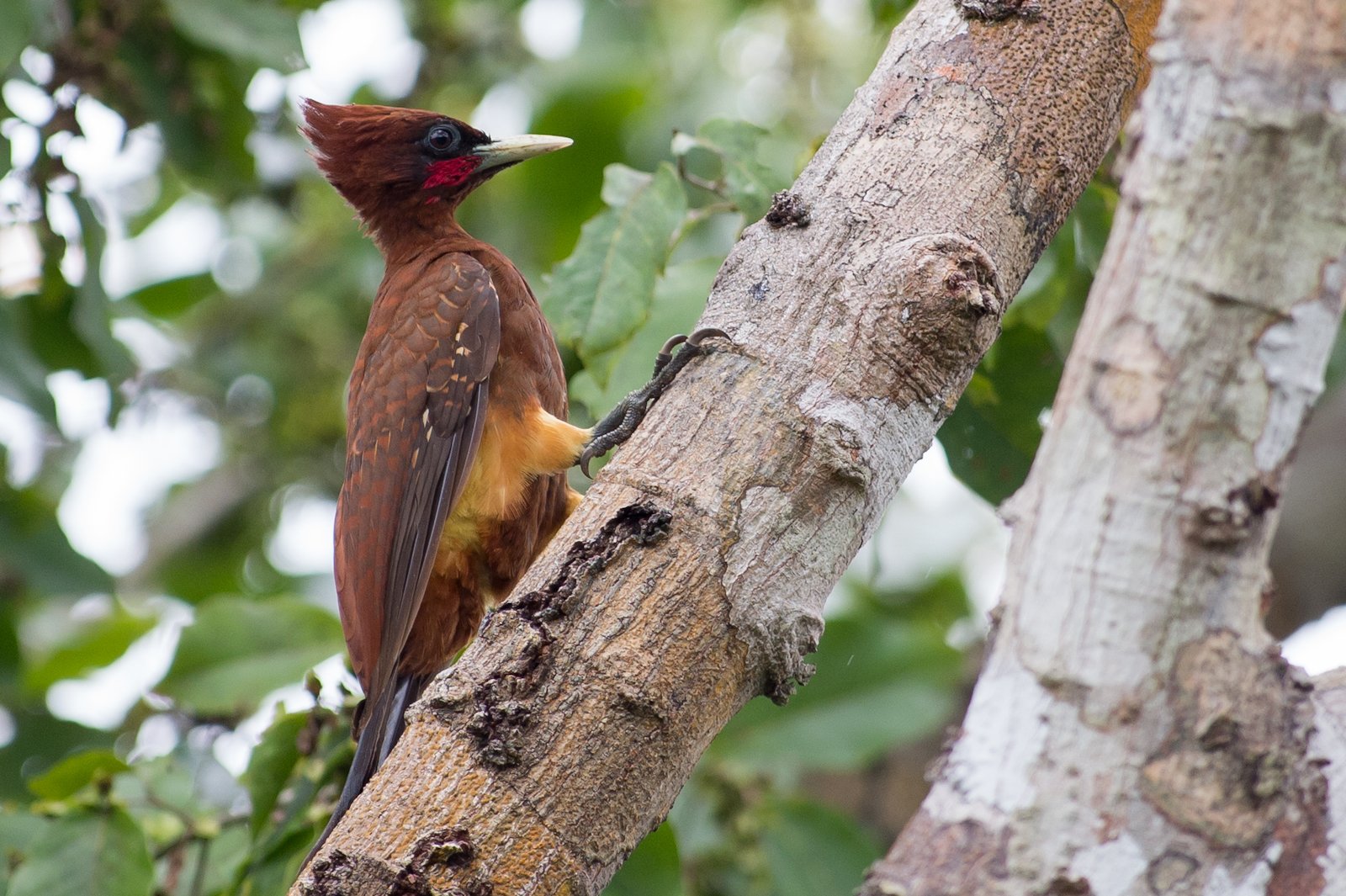
The Chestnut Woodpecker is a medium-sized, chestnut-brown woodpecker with a pale crest that in the region lives only in Trinidad. Trinidad birds belong to the subspecies Celeus elegans leotaudi, which is paler and brighter than the nominate. It lives in forest and is heard more often than seen.
Voice
A descending, laughing series wewa ew-ew-ew-ew-ew and a sarcastic-sounding har-hahaha, as well as various shorter calls. The drum is a short double rap.
Recording: Mauricio Cuellar Ramirez (@Birding.travel) — CC BY-NC-SA 4.0 · converted to mono · xeno-canto
Identification
26–32 cm. Body and wings are deep chestnut; head and pointed crest are paler, tawny to cream in Trinidad birds. The rump and flanks are pale yellow, the tail dark. The bill is pale, yellowish. The male has a broad red moustache and cheek; the female lacks red. In flight the pale rump stands out against the dark back and tail.
Confusion species
No other brown woodpecker with a pale crest occurs in Trinidad. Lineated Woodpecker Dryocopus lineatus and Crimson-crested Woodpecker Campephilus melanoleucos are black with white and red. Golden-olive Woodpecker Colaptes rubiginosus is smaller and olive-green, with barred underparts.
Habitat
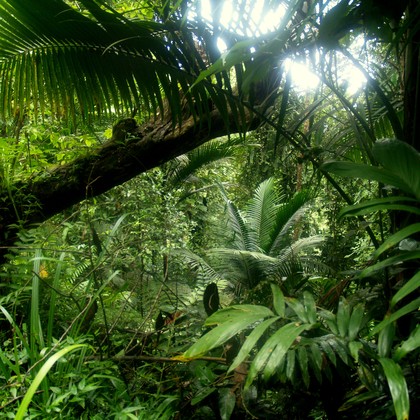
The interior and edges of moist and semi-evergreen forest in the lowlands and hills, also tall secondary forest. It eats mainly ants and termites, taken from nests in trees, as well as larvae and fruit. It excavates a nest hole in a dead tree.
Where the bird is most at home, classified by the vegetation types of the Caribbean.


Range and movements
In the region only in Trinidad, as a fairly scarce resident of forested areas. Not in Tobago. Outside the region in northern and central South America, from Colombia, Venezuela and the Guianas through Amazonia to Bolivia.
- Resident
- dark = core range, pale = thinly spread
How and when to look
In the forests of Trinidad's Northern Range and in larger forest tracts elsewhere on the island. The laughing call is the best lead; the bird often sits in the middle storey of the forest on a trunk or thick branch.
Conservation status
Not threatened. The species has a large range in South America; in Trinidad it depends on forest.
Scientific name
Celeus elegans | (Müller, 1776)
Müller described the species in 1776 as Picus elegans; because it was later moved to another genus, the author and year stand in brackets. The genus Celeus was introduced in 1831 by Boie. Celeus comes from Greek keleos, a name for a green woodpecker. elegans is Latin for 'elegant'. The specimen the first description was based on came from Cayenne, French Guiana.