All species › Woodpeckers and allies › Woodpeckers › Jamaican Woodpecker
Jamaican Woodpecker | Melanerpes radiolatus
Jamaicaanse specht | Carpintero jamaicano
The Jamaican Woodpecker is the only resident woodpecker in Jamaica and occurs nowhere else. It belongs to the genus Melanerpes, which has its own species in Cuba, Jamaica, Hispaniola, Puerto Rico and Guadeloupe. It is common across the island, from the coast to the mountain tops, including gardens and plantations.
Voice
The usual call is a loud kaaa, often repeated two or three times; also rolling and chattering calls between birds. Both sexes drum loudly on dead wood and tap more softly near the nest.
Recording: Bobby Wilcox — CC BY-NC-SA 4.0 · converted to mono · xeno-canto
Identification
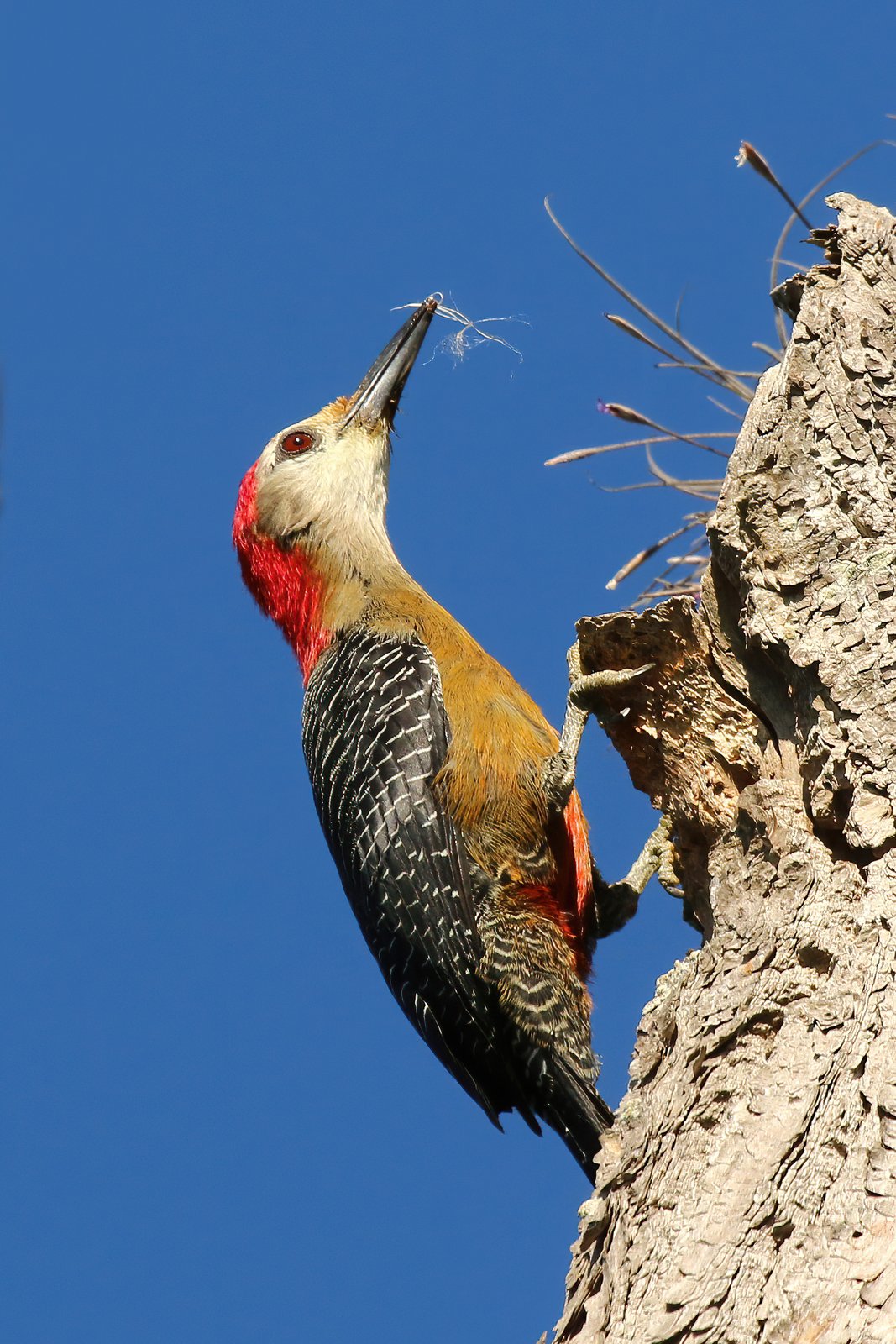
24–26 cm, a sturdy woodpecker with a long black bill and a red eye. Forehead and face are whitish to pale buff. In the male the crown is red from front to hindneck; in the female the crown is grey and only the hindcrown and nape are red. Back and wings are black with narrow white bars, the tail black with white markings. The underparts are olive-grey to olive-buff, with a reddish patch in the centre of the belly; the rear flanks and undertail coverts are barred black and white.
Confusion species
No other woodpecker is resident in Jamaica. Yellow-bellied Sapsucker Sphyrapicus varius, a winter visitor from North America, is smaller, with a black-and-white striped head, a white wing stripe and a yellowish belly. West Indian Woodpecker Melanerpes superciliaris and Hispaniolan Woodpecker Melanerpes striatus share a similar pattern but do not occur in Jamaica.
Habitat
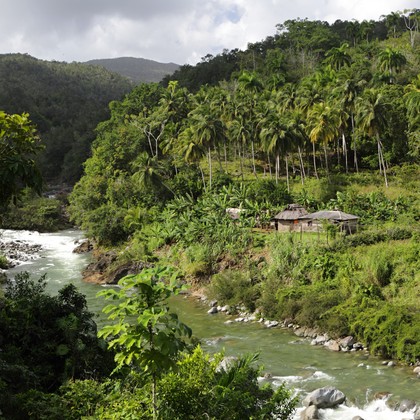
Almost any wooded landscape in Jamaica: moist forest and lower montane rainforest, secondary forest, mangroves, wooded pastures, citrus and coconut plantations and gardens, from sea level to the mountain tops. Densities are highest in secondary forest. The diet is roughly half insects, with the occasional snail or lizard, and half fruit, especially of Cecropia and figs; it often forages high in the canopy. The male excavates the nest hole in a dead branch, trunk or utility pole, 5–15 m up. Two or three broods are raised per year, with three to five eggs per clutch.
Where the bird is most at home, classified by the vegetation types of the Caribbean.





Range and movements
Endemic to Jamaica, across the whole island. The species does not occur outside Jamaica.
- Resident
- dark = core range, pale = thinly spread
How and when to look
Anywhere in Jamaica with trees, including town parks and hotel grounds. The loud call is usually noticed first. In fruiting trees the difference in crown pattern between male and female can be seen.
Conservation status
Not threatened. The species is common throughout Jamaica and well adapted to man-made landscapes, although BirdLife lists the population as decreasing.
Scientific name
Melanerpes radiolatus | (Wagler, 1827)
Wagler described the species in 1827 as Picus radiolatus; because it was later moved to another genus, the author and year stand in brackets. The genus Melanerpes was introduced in 1832 by Swainson. Melanerpes is Greek, from melas 'black' and herpēs 'creeper': 'black creeper'. radiolatus is Latin for 'rayed', from radiolus 'small ray', after the finely barred back. The specimen the first description was based on came from Jamaica.