All species › Woodpeckers and allies › Woodpeckers › Red-crowned Woodpecker
Red-crowned Woodpecker | Melanerpes rubricapillus
Roodkruinspecht | Carpintero coronirrojo
The Red-crowned Woodpecker is a small Melanerpes woodpecker of Costa Rica, Panama and northern South America. In the Caribbean it occurs only on Tobago, where it is common at forest edges and in plantations and gardens; it is absent from Trinidad.
Voice
A rolling, often wavering series such as churr, churr, krr-r-r-r with an abrupt final note; in display a repeated wicka, wicka, and chattering calls.
Recording: Francisco contreras — CC BY-NC-SA 4.0 · converted to mono · xeno-canto
Identification
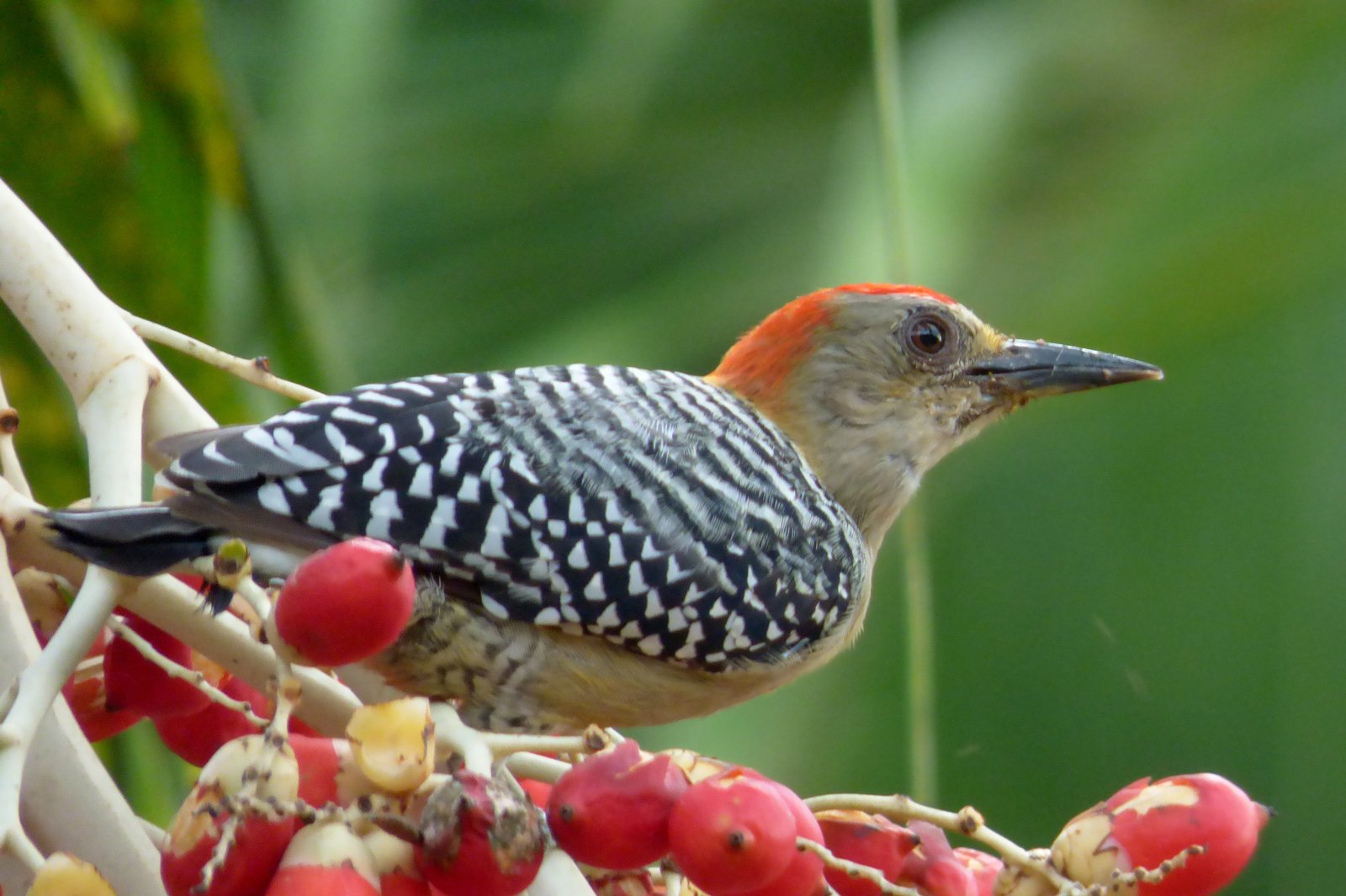
16–18 cm. Forehead yellowish white. The male has a bright red crown and orange-red nape; in the female the crown is pale grey to off-white and only the nape is reddish. Cheeks, throat and underparts are greyish buff, with a reddish to orange-red patch in the centre of the belly. Mantle and back are barred black and white, the rump is white and the flight feathers are black with white bars.
Confusion species
On Tobago the only woodpecker with a black-and-white barred back. Red-rumped Woodpecker Veniliornis kirkii is smaller, olive-brown above, with a red rump and densely barred underparts. Golden-olive Woodpecker Colaptes rubiginosus is larger and olive-green above, with a pale cheek, a grey crown bordered red and yellow, barred underparts.
Habitat
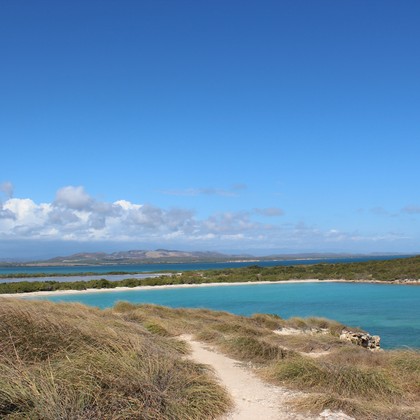
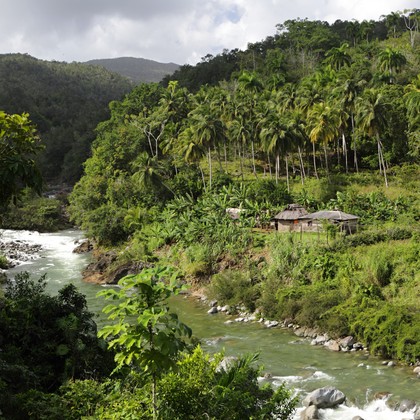
Dry deciduous forest, secondary forest, coastal scrub, mangroves, plantations and gardens. It eats insects and fruit. Both adults excavate the nest hole in a large trunk, a branch or a columnar cactus, 3–23 m up; the clutch is three or four eggs.
Where the bird is most at home, classified by the vegetation types of the Caribbean.




Range and movements
In the Caribbean only on Tobago (nominate Melanerpes rubricapillus rubricapillus), across the whole island. There is no population on Trinidad or the other islands. Outside the region from Costa Rica and Panama through northern Colombia and Venezuela to Guyana and Suriname, from sea level to about 1700 m.
- Resident
- dark = core range, pale = thinly spread
How and when to look
On Tobago almost anywhere with trees, including hotel grounds and roadsides. The rolling call is often the first sign. Male and female are told apart by the colour of the crown.
Conservation status
Not threatened. A common species that does well in secondary forest, plantations and gardens.
Scientific name
Melanerpes rubricapillus | (Cabanis, 1862)
Cabanis described the species in 1862 as Centurus rubricapillus; because it was later moved to another genus, the author and year stand in brackets. The genus Melanerpes was introduced in 1832 by Swainson. Melanerpes is Greek, from melas 'black' and herpēs 'creeper': 'black creeper'. rubricapillus is Latin, from ruber 'red' and capillus 'hair (of the head)', after the red crown. The specimen the first description was based on came from Barranquilla, Colombia.